Solution inventory planning
Dilution Yield Calculator
Estimate maximum recoverable final solution volume, full batches, and remainder from a finite stock inventory and declared usable-volume recovery.
CURRENT MODEL
Define the available stock, recovery, target, and batch size
Laboratory coordinators and production technicians planning how much target solution a finite, partially recoverable stock inventory can support.
Decision supportedDetermine the maximum prepared volume and batch count available without calling operational recovery a chemical reaction yield.
LIVE DECISION VIEW
Stock inventory transformed into recoverable final volume
Three vessels share one mL scale, separating nominal stock, usable stock after hold-up, and the maximum target solution supported by the recovered solute inventory.
| Quantity | Expression | Current value | Unit | Interpretation |
|---|
Subject illustration
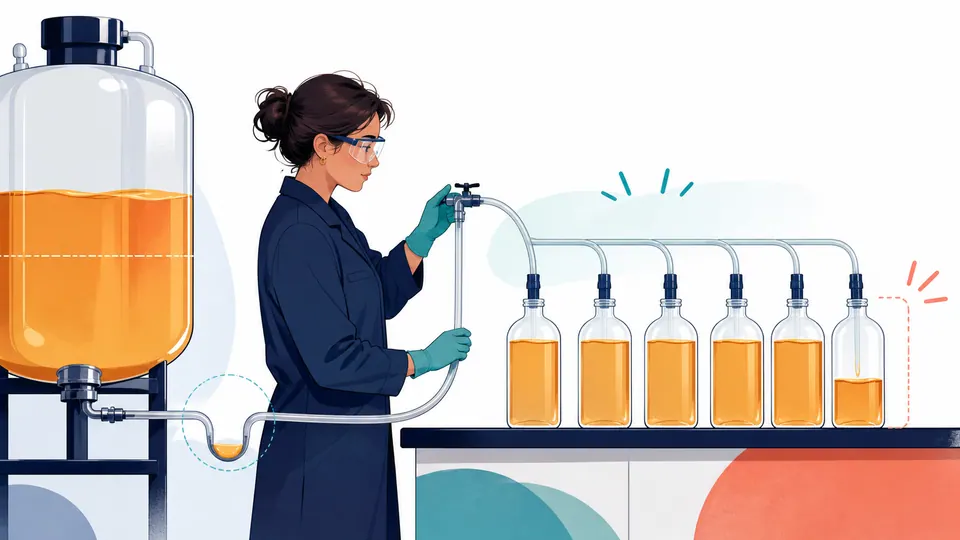
From recoverable stock to a finite batch plan
The editorial scene shows inventory and hold-up; the live vessel visual above carries the current volumes and batch count.
How to use
Convert stock inventory into a recoverable batch plan
- Confirm stock and target concentrations use the same chemical and concentration basis.
- Enter nominal stock volume before line hold-up, inaccessible residue, or handling loss.
- Enter a documented usable-volume recovery percentage rather than guessing a chemical yield.
- Set the target concentration and verify that it does not exceed the stock concentration.
- Enter the operational batch size, then read maximum final volume, full batches, and remainder together.
- Review the vessel view and solute-balance residual before committing inventory or packaging.
Yield fundamentals
Five layers in a recoverable dilution-volume estimate
- Nominal inventory
- The recorded stock volume before accounting for unavailable hold-up or handling loss.
- Usable-volume recovery
- The fraction of stock liquid actually available to transfer at unchanged concentration.
- Dilution factor
- The stock-to-target concentration ratio that expands usable stock into final solution volume.
- Full-batch count
- Only complete requested batches are counted; the unallocated remainder stays visible.
- Solute conservation
- Recovered stock moles must equal target concentration times maximum final volume.
Calculation method
Apply inventory recovery before concentration expansion
The model first removes inaccessible stock volume, then applies C1V1=C2V2 to the usable portion. Reversing that order can hide which loss is operational and which change is deliberate dilution.
The three-vessel visual keeps nominal stock, usable stock, and final target solution on one volume scale. The exact table separately records concentration, moles, and integer batch allocation.
Recovery is a measured process input
Line geometry, container heel, transfer method, and operator practice determine usable volume. A historical percentage should match the equipment and procedure being planned.
Exact batch boundaries
A volume ratio mathematically equal to an integer should not lose a batch because of binary floating-point representation. The count uses a tight equality tolerance before flooring.
Concentration integrity after recovery
The equation assumes the recovered stock has the entered concentration. Stratification, evaporation, adsorption, precipitation, or degradation can make recovered volume an inadequate proxy for recovered solute.
Detailed calculation process
Symbols, current substitution, intermediate quantities, and reconciliation
V_use=R V_stock; V_final,max=(C1/C2)V_useVolume recovery and dilution use unrounded decimals; full batches use a floating-point-safe integer boundary and the remainder reconciles to maximum final volume.
| Symbol | Meaning | Default | Unit |
|---|---|---|---|
| C1 | Stock concentration | 1.00 | mol/L |
| V_stock | Nominal stock inventory | 250 | mL |
| R | Usable-volume recovery fraction | 92%=0.92 | dimensionless |
| V_use | Usable stock volume | calculated | mL |
| C2 | Target concentration | 0.100 | mol/L |
| V_final,max | Maximum recoverable final volume | calculated | mL |
| V_batch | Requested complete batch volume | 500 | mL |
| N | Full batch count | calculated | count |
Waiting for valid inputs.
Result interpretation
Separate obtainable volume from packaging commitment
Maximum recoverable final volume assumes all usable stock is diluted to the target. Full batches are the integer packaging commitment; remainder is usable target solution that does not fill another declared batch. Zero recovery validly produces no output.
Evidence to retain
Document the inventory and recovery measurement
Keep stock lot, assay and concentration basis, nominal fill record, measured heel or line hold-up, transfer procedure, recovery study date and sample size, target specification, batch vessel capacity, packaging minimum, temperature, evaporation controls, and any rejected or quarantined volume.
Scope and limitations
Losses and process effects outside the volume model
- Selective solute loss or concentration change in recovered stock
- Chemical reaction, degradation, adsorption, precipitation, or contamination
- Density change, contraction, or exact solvent-addition volume
- Packaging line losses after the entered recovery point
- Assay uncertainty, specification guard bands, or release testing
- Scheduling, shelf life, labor, and vessel-cleaning capacity
Stock and target concentrations use the same basis; target does not exceed stock; usable-volume recovery describes stock volume available after hold-up; recovered stock concentration remains unchanged.
Key terminology
Inventory-dilution glossary
- Hold-up volume
- Liquid retained in equipment or containers and unavailable for the planned transfer.
- Usable recovery
- The operational fraction of nominal stock volume available at the modeled concentration.
- Dilution factor
- The ratio C1/C2 connecting usable stock volume to final volume.
- Recoverable final volume
- The target solution volume supported by the usable stock solute inventory.
- Batch allocation
- Partitioning final volume into complete requested units plus a remainder.
- Conservation residual
- The numerical difference between recovered-stock and final-solution solute amounts.
Practical cases
Two inventories with different operational decisions
Reservoir with known line hold-up
A 250 mL stock lot has 92% usable recovery and a tenfold dilution factor. The model supports 2.300 L, four 500 mL batches, and 300 mL remainder, so packaging can be planned without claiming reaction yield.
Zero-recovery quarantine
A damaged transfer set makes the current stock unavailable. Entering zero recovery preserves the nominal inventory record but correctly produces zero usable volume and zero batches until a new recovery basis is approved.
Important note
Volume recovery does not prove solute recovery
Verify concentration integrity and the actual transfer boundary before using this planning result for controlled production or release quantities.
Frequently asked questions
Is the recovery percentage a chemical yield?
No. It is the declared fraction of stock volume that remains usable after hold-up or handling. The calculator assumes that recovered stock keeps its entered concentration.
Why is a target above the stock concentration rejected?
Adding solvent cannot increase concentration. A higher target requires concentration, evaporation, additional solute, or a stronger stock.
What happens at zero recovery?
Zero recovery is a valid boundary: usable stock, maximum final volume, full batches, and remainder are all zero.
How are full batches counted near an exact boundary?
The unrounded volume ratio is compared with a tight numerical tolerance before taking the integer floor, preventing binary floating-point noise from losing an exact batch.
Does the nominal volume increase equal solvent to add?
Not necessarily. It is a planning difference. Accurate laboratory preparation transfers stock and dilutes to a calibrated final volume because component volumes may not add exactly.
What losses are not represented by usable-volume recovery?
Selective solute loss, degradation, adsorption, precipitation, evaporation, contamination, concentration drift, and density effects require separate evidence or a different process model.
Authority and follow-on work
Reliable sources and related calculators
- OpenStax Chemistry - Molarity and DilutionDerives C1V1=C2V2 from solute conservation during dilution.
- IUPAC Gold Book - Material RecoveryDefines recovery as a qualified recoverable fraction.
- IUPAC Gold Book - Chemical YieldClarifies why this operational volume result is not reaction yield.