Whole-byte reconciliation railLive expected, received, and tolerance boundaries
The exact table below is the accessible numeric equivalent of this visual.
Unit Converters
Normalize expected and received payload sizes to exact whole-byte counts, build an asymmetric tolerance interval from percentage or absolute allowances, identify missing or excess bytes, and keep the size decision separate from the reported cryptographic-hash result.
TRANSFER RECONCILIATION
Use this page when a manifest, backup job, object store, replication task, or delivery record provides an expected size and a separately observed received size. The calculator normalizes both quantities to whole bytes before applying the rule.
Decision boundary: percentage tolerances are calculated from the expected byte count; absolute tolerances use their own declared unit. Size status is inclusive at the effective whole-byte limits. A hash mismatch overrides size agreement, while an unchecked hash leaves content integrity unverified.
BYTE-COUNT TOLERANCE
The orange rail is the entered tolerance band after unit normalization and integer-boundary resolution. The expected and received markers remain separate so a near match cannot masquerade as an exact match.
The exact table below is the accessible numeric equivalent of this visual.
| Element | Exact bytes | Difference from expected | Decision role |
|---|
| Quantity | Entered value | Bytes per unit | Canonical bytes |
|---|
| Priority | Observed condition | Reported outcome |
|---|
HOW TO USE
TRANSFER FUNDAMENTALS
CALCULATION METHOD
DECIMAL AND BINARY UNITS
Decimal prefixes use powers of 1,000: 1 MB is 1,000,000 bytes and 1 GB is 1,000,000,000 bytes. Binary prefixes use powers of 1,024: 1 MiB is 1,048,576 bytes and 1 GiB is 1,073,741,824 bytes. The calculator converts each entered quantity through its selected factor before comparing them, so a label mismatch becomes visible rather than being absorbed into the tolerance.
WHOLE-BYTE DOMAIN
The canonical values must resolve to whole bytes and remain within JavaScript’s safe-integer range. Percentage tolerances may create fractional mathematical boundaries, but a received file cannot contain a fractional byte. The lower effective limit is therefore rounded upward and the upper effective limit downward before the inclusive comparison.
ASYMMETRIC TOLERANCE
A shortfall can indicate truncation, omitted records, failed blocks, or an incomplete restore. An excess can indicate appended metadata, padding, encapsulation, or a mismatched object. The calculator keeps the two allowances independent because a workflow may permit one condition while prohibiting the other. The entered tolerance is a project rule, not a universal networking standard.
INTEGRITY GATE
Two objects can have the same length while containing different bytes. NIST’s Secure Hash Standard defines message digests for detecting whether messages changed; this page records only the reported comparison state and does not compute a digest. A mismatch is an integrity failure. “Not checked” leaves integrity unresolved even when the byte count lies inside the selected interval.
DETAILED CALCULATION PROCESS
| Symbol | Meaning | Default | Canonical interpretation |
|---|---|---|---|
| E | Expected payload | 1024 MiB | 1,073,741,824 B |
| R | Received payload | 1023.5 MiB | 1,073,217,536 B |
| tl | Allowed shortfall | 0.1% | 1,073,741.824 B before integer-boundary resolution |
| tu | Allowed excess | 0.1% | 1,073,741.824 B before integer-boundary resolution |
| H | Hash evidence | Not checked | Integrity remains unverified |
RESULT INTERPRETATION
A negative variance means the received object is smaller; a positive variance means it is larger. Completeness is a quantity ratio, not a statement about semantic completeness. An exact count match is stronger size evidence than a tolerance match, but neither proves authenticity, ordering, parseability, or content identity. If the decision says “evidence conflict,” investigate the provenance of both the byte count and hash result instead of choosing whichever result is more convenient.
IAN / XIAOHEI EXPLAINER
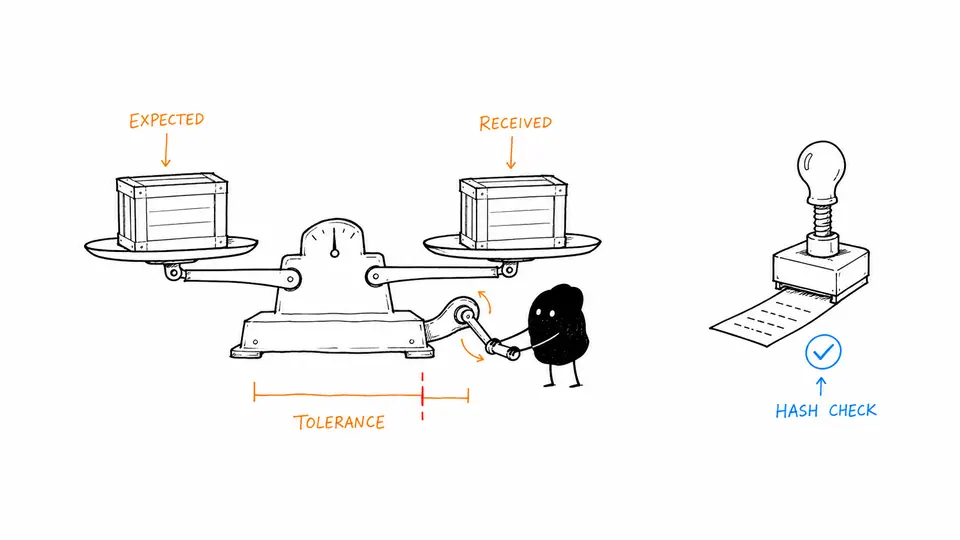
The balance scale represents quantitative reconciliation: how many bytes were expected and received, and whether the difference fits the declared interval. The separate stamp represents content-integrity evidence. Xiaohei can balance the crates and still cannot issue the stamp without a separate check.
EVIDENCE AND DATA LINEAGE
Keep the manifest or source-object identifier, expected-size acquisition method, received-size acquisition method, timestamp, host or storage service, transfer tool and version, protocol, retry count, packaging state, compression or encryption state, selected unit definitions, entered tolerance authority, hash algorithm, both reported digests, and operator or automated-job identity. Record whether the size refers to logical payload, stored object, archive, encrypted object, or transmitted wire quantity.
LIMITS AND EXCLUSIONS
WORKED DECISION CASES
A manifest expects 20 GiB and the restored object is 19.999 GiB. A 0.01% shortfall allowance may place the count inside the planning interval, but an unchecked hash leaves the restored content unverified. The correct outcome is provisional, not “backup accepted.”
A delivery record reports a matching digest while the observed byte count differs by one byte. The page reports conflicting evidence because identical full-file content and unequal length do not form a coherent record. Reacquire both values and confirm exactly which object was hashed.
TECHNICAL GLOSSARY
A payload size is a count of bytes. The selected value and unit must resolve to a whole count before the tolerance comparison can be audited.
No. 1 GB is 1,000,000,000 bytes, while 1 GiB is 1,073,741,824 bytes.
Yes. Zero shortfall and zero excess require an exact byte-count match, although content integrity still requires separate evidence.
Yes. The effective lower and upper whole-byte limits are inclusive.
Equal length does not guarantee equal content. A reported digest mismatch is direct evidence that the compared messages changed or that the evidence was collected incorrectly.
The two observations do not describe a coherent full-object comparison. Confirm the object boundaries, algorithm, digest source, and size acquisition method.
Only if both expected and received quantities use the same declared boundary. Do not compare logical payload bytes with wire bytes without a separate reconciliation.
Use the value approved by the governing transfer, storage, backup, delivery, or validation procedure. This calculator does not invent that policy.
AUTHORITATIVE BASIS