Stage-length risk
Growth, feeding transitions, daycare changes, and product fit can end the useful horizon before a theoretical payback.
Lifestyle planning
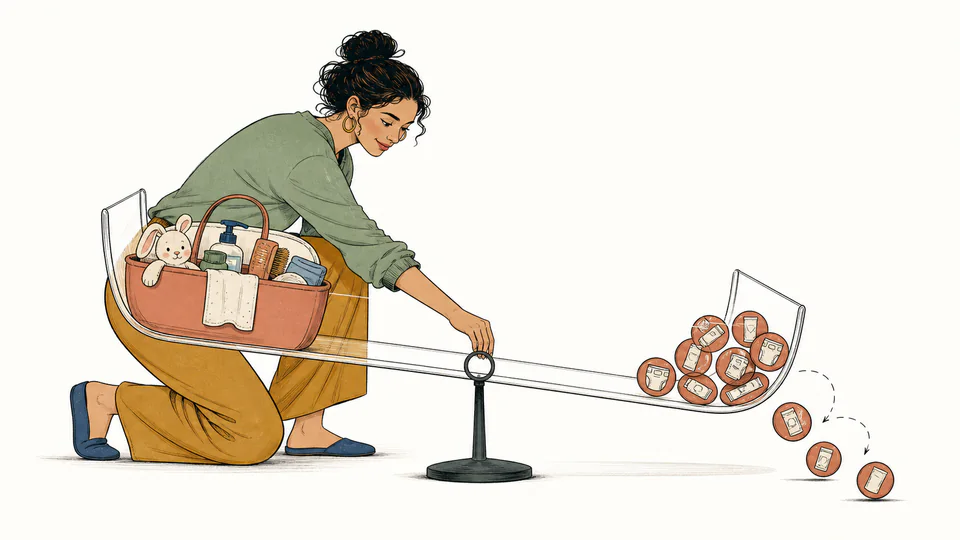
Compare a higher-setup baby-care option with a recurring-purchase path and find the exact cost crossover over a chosen horizon.
BABY-CARE COST CROSSOVER
For caregivers comparing two functionally and safely equivalent care choices. The model retains setup, transition, and monthly costs separately, then reports the exact crossover only when the reusable path truly has a lower monthly slope. It does not decide product safety, feeding, or medical suitability.
BABY-CARE COST CROSSOVER
A crossover supports cost timing only after both paths pass the same safety, care-quality, availability, fit, storage, and workload criteria. Ignore a crossover outside the child’s actual stage.
| Path or test | Entry cost | Monthly cost | Months | Horizon amount |
|---|
CURRENT CALCULATION PROCESS
TR=Ur+S+mrM; TD=Ud+mdM; M*=(Ur+S-Ud)/(md-mr)
Two straight cumulative-cost paths share one horizon. The crossover divides the extra net entry cost by positive monthly savings; totals, not the theoretical crossover, control the entered horizon decision.
HOW TO USE
SUBJECT FUNDAMENTALS
MODEL AND FORMULA
Two straight cumulative-cost paths share one horizon. The crossover divides the extra net entry cost by positive monthly savings; totals, not the theoretical crossover, control the entered horizon decision.
DEEPER DECISION ANALYSIS
Growth, feeding transitions, daycare changes, and product fit can end the useful horizon before a theoretical payback.
Cleaning, preparation, transport, and caregiver time should be priced only with a declared method or retained as a separate decision criterion.
Recall status, sanitation, sleep guidance, feeding instructions, and product condition can make the lower-cost path unusable.
WORKED DECISION CASES
A family compares equipment, laundering, utilities, and replacements with size-specific disposable purchases only for months when fit and care routine are stable.
Parents compare safe equipment ownership with a rental that includes maintenance, but stop the horizon at the expected return date rather than using an indefinite payback.
TECHNICAL LANGUAGE
EVIDENCE AND DATA LINEAGE
Save dated receipts or quotes, product model and condition, recall checks, care-stage start and end dates, cleaning and utility assumptions, package consumption, rental terms, transition tasks, and exclusions. Record whether costs include tax and delivery on the same basis.
LIMITS AND EXCLUSIONS
RELIABLE SOURCES
FREQUENTLY ASKED QUESTIONS
A larger entry cost cannot be recovered by a path that also adds cost faster each month. The page still reports horizon totals.
Include it only with a transparent rate and task estimate; otherwise keep workload as a separate non-price criterion.
Only when a conservative, documented resale assumption is decision-relevant. This model intentionally excludes uncertain resale.
End the horizon at the stage boundary and recalculate the next stage with new products and rates.
No. Safety, clinical guidance, sanitation, suitability, and recall status must be resolved before any cost comparison.
The exact value shows timing; actual decisions should use the first complete billing period after crossover and the horizon totals.
IMPORTANT NOTE
This is household planning arithmetic, not medical, feeding, product-safety, insurance, tax, legal, or financial advice. Follow qualified professional guidance and current manufacturer and government safety information.