Developmental transitions
Diaper size, feeding volume, feeding method, and care routines change over time. Long horizons should be split into documented stages.
Lifestyle planning
Estimate stage-specific diaper, wipe, and prepared-formula demand, convert demand into whole packs or cans, and calculate the purchase cost.
BABY CONSUMABLE USAGE
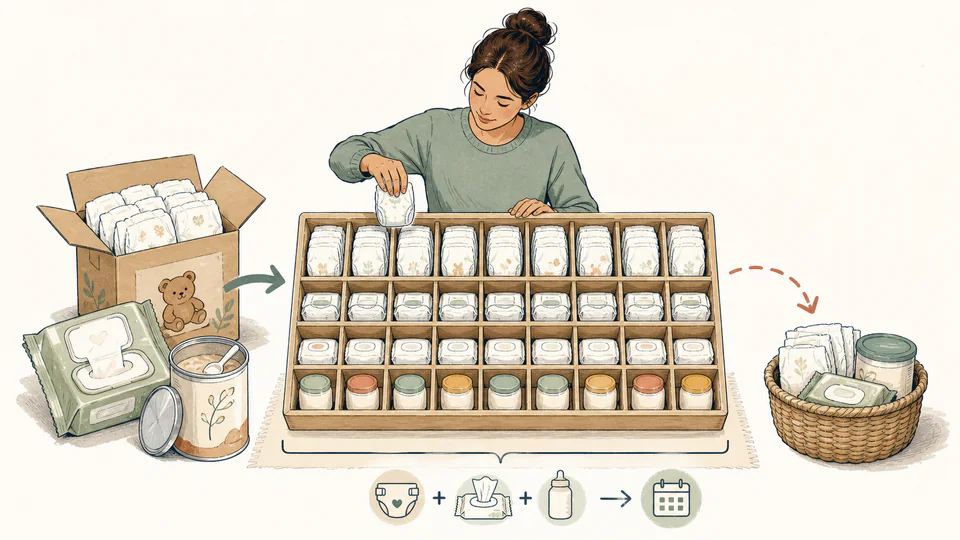
For caregivers building a short-horizon consumables plan from observed or professionally guided rates. The model calculates continuous demand first, rounds each purchasable pack upward, and keeps prepared formula volume separate from product-can yield.
BABY CONSUMABLE USAGE
The whole-package result is a purchasing baseline for the entered stage. Care, feeding, skin, growth, storage, expiry, recall, and product-suitability decisions must follow current professional and manufacturer guidance.
| Consumable | Stage basis | Usage rate | Continuous demand | Whole packages / cost |
|---|
CURRENT CALCULATION PROCESS
D=ceil(N cd); Pd=ceil(D/Yd); W=ceil(D cw); Pw=ceil(W/Yw); F=N cf; Pf=ceil(F/Yf); Cost=PdKd+PwKw+PfKf
Stage days multiply daily rates. Diaper count drives wipe demand. Formula is entered as prepared ounces and divided by a prepared-yield value. Each pack count is rounded up once; cost uses purchased packages, so leftover capacity remains visible rather than disappearing.
HOW TO USE
SUBJECT FUNDAMENTALS
MODEL AND FORMULA
Stage days multiply daily rates. Diaper count drives wipe demand. Formula is entered as prepared ounces and divided by a prepared-yield value. Each pack count is rounded up once; cost uses purchased packages, so leftover capacity remains visible rather than disappearing.
DEEPER DECISION ANALYSIS
Diaper size, feeding volume, feeding method, and care routines change over time. Long horizons should be split into documented stages.
Formula labels differ in scoop, water, powder, and displacement conventions. Use manufacturer preparation directions and never infer prepared ounces from net weight alone.
Ceiling creates leftover capacity, but opening, expiration, contamination, recall, size changes, and intolerance can prevent later use. Extra stock is not automatically efficient.
WORKED DECISION CASES
A caregiver uses recent daily observations for diapers and wipes and clinician-guided feeding information, then buys whole packages without assuming the rates remain constant for six months.
Formula ounces are entered only for the formula portion of a mixed feeding plan. The calculation does not infer nutrition needs or replace feeding guidance.
TECHNICAL LANGUAGE
EVIDENCE AND DATA LINEAGE
Keep stage dates, observed counts or guidance source, diaper size, wipe practice, feeding plan, exact product names, package counts, formula preparation label, prepared yield derivation, prices and dates, storage and expiry constraints, recall checks, and unrounded demand. Update rather than carrying an obsolete rate into a new stage.
LIMITS AND EXCLUSIONS
RELIABLE SOURCES
FREQUENTLY ASKED QUESTIONS
No. It multiplies an entered prepared-volume assumption. Feeding amount and method require guidance from qualified clinicians and the exact product instructions.
Feeding plans are often expressed as prepared volume, while containers list net weight. The relationship depends on product-specific preparation directions.
A fraction of a pack cannot be purchased to satisfy demand. Demand remains unrounded until the final package conversion.
Only for a documented operational reason and with storage, expiry, recall, size-change, and cash constraints considered. Do not hide an arbitrary reserve in the daily rate.
Only when rates, sizes, feeding method, and product yield are stable. Otherwise calculate separate stages and reconcile carryover stock.
Subtract usable, unexpired, suitable on-hand units in a separate inventory adjustment. This page intentionally reports gross stage demand and purchased packages from zero stock.
IMPORTANT NOTE
This page estimates purchases from user-entered rates; it is not medical, nutritional, feeding, skin-care, or product-safety advice. Follow qualified clinical guidance, manufacturer preparation and storage directions, current recalls, and safe-care practices.