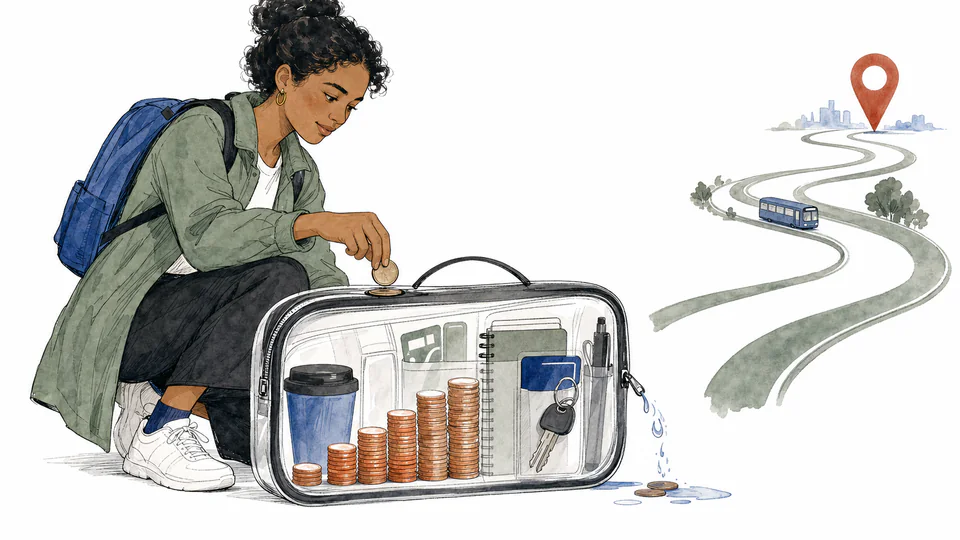
The target can move faster than the account
Vehicle parts, transit products, relocation costs, insurance deductibles, and currency may change. Refresh the quoted target rather than assuming yield alone protects purchasing power.
Lifestyle planning
Project a dedicated commute reserve using starting cash, monthly deposits after fees, a declared yield, and a fixed deadline.
TRANSPORTATION RESERVE PLAN
For households preparing a cash reserve for a transit pass, bicycle equipment, vehicle repair deductible, relocation transition, or another defined commuting need. The plan compounds existing savings monthly, deposits a fixed net amount at each month end, solves the gross deposit required for the deadline, and keeps account fees visible.
TRANSPORTATION RESERVE PLAN
A mathematically funded reserve is not automatically affordable. Confirm the target, due date, account access, deposit insurance where relevant, household emergency needs, and a zero-yield stress case before changing automatic transfers.
| Reserve layer | Amount or rate | Months | Deadline contribution |
|---|
DETAILED CALCULATION PROCESS
r=y/1200; c=C-f; FV=S(1+r)^M+c((1+r)^M-1)/r
Convert the annual percentage yield to a monthly decimal, subtract the monthly fee from the gross transfer, grow the opening balance, and add each net deposit at month end. The required-deposit result inverts the identical ordinary-annuity equation, with a direct division branch when yield is zero.
| Symbol | Meaning | Unit |
|---|---|---|
| y | Entered annual yield | percent/year |
| r | Monthly yield | decimal/month |
| C | Gross monthly deposit | USD/month |
| f | Monthly account fee | USD/month |
| c | Net deposit after fee | USD/month |
| S | Starting dedicated reserve | USD |
| M | Deadline length | months |
| FV | Projected deadline reserve | USD |
| T | Dated reserve target | USD |
| G | Target funding gap, max(0,T-FV) | USD |
HOW TO USE
SUBJECT FUNDAMENTALS
MODEL AND FORMULA
Convert the annual percentage yield to a monthly decimal, subtract the monthly fee from the gross transfer, grow the opening balance, and add each net deposit at month end. The required-deposit result inverts the identical ordinary-annuity equation, with a direct division branch when yield is zero.
DEEPER DECISION ANALYSIS
Vehicle parts, transit products, relocation costs, insurance deductibles, and currency may change. Refresh the quoted target rather than assuming yield alone protects purchasing power.
Yield does not show deposit insurance, withdrawal limits, settlement delays, minimum balances, taxes, or market loss. Choose the account based on horizon and availability, not only the displayed rate.
Transportation may be essential, but a narrow goal can still weaken rent, food, utilities, health care, or emergency capacity. Review the deposit inside the household cash-flow calendar.
WORKED DECISION CASES
A commuter combines a dated pass price, station bicycle lock, rain gear, and a modest replacement allowance. The deadline is the pass renewal month, and the account remains cash-accessible.
A household uses the policy deductible, towing allowance, and several days of alternate transport to define the target. Because timing is uncertain, liquidity matters more than chasing a volatile return.
TECHNICAL LANGUAGE
EVIDENCE AND DATA LINEAGE
Keep the target bill of materials, vendor or agency quotes with dates, included taxes and delivery, policy deductible or pass terms, target date, starting-account statement, annual yield and compounding convention, insurance status where applicable, monthly fees, deposit dates, missed transfers, and any amount already committed. Reprice the goal after route, job, vehicle, or household circumstances change.
LIMITS AND EXCLUSIONS
RELIABLE SOURCES
FREQUENTLY ASKED QUESTIONS
Otherwise the plan contributes no positive principal and could misleadingly rely entirely on the starting balance and yield. The calculator rejects that configuration.
The model adds equal net deposits without dividing by a rate. This is also a useful stress case for a short deadline.
Only after eligibility, amount, timing, and continued employment are documented. Keep uncertain reimbursement as a separate scenario.
Only after independently evaluating possible loss, liquidity, fees, taxes, and horizon. This calculator does not determine investment suitability.
Starting savings and modeled interest may already put the goal on schedule. Confirm the target is complete before reducing a transfer.
No. It forecasts a cash balance under fixed assumptions; price, inventory, service, route, and personal circumstances remain outside the model.
IMPORTANT NOTE
This deterministic projection is not financial, investment, banking, tax, insurance, employment, or transportation advice. Verify account terms, current target prices, liquidity needs, and essential household obligations.