L

Lifestyle planning

Commute Usage Calculator

Extend a driving commute across a selected horizon to estimate round trips, miles, fuel, fuel cost, and maintenance-interval crossings.

DRIVING COMMUTE USAGE

Translate a recurring route into fuel demand and odometer pressure

For drivers preparing a mileage, fuel, and service workload rather than a full ownership-cost forecast. The model extends one-way distance across round trips and commute days, converts distance through entered fuel economy, prices the resulting fuel, and counts complete service-interval crossings from the current post-service odometer position.

Round trips in horizon-
Commute miles-
Fuel demand-
Modeled fuel cost-
Complete service crossings-
Miles into next interval-

DRIVING COMMUTE USAGE

Commute mileage and consumption ledger

Use the result to plan fuel and check service timing, not to claim actual fuel economy or prescribe maintenance. Confirm the vehicle manual, operating conditions, odometer history, fuel grade, and noncommute mileage before scheduling work.

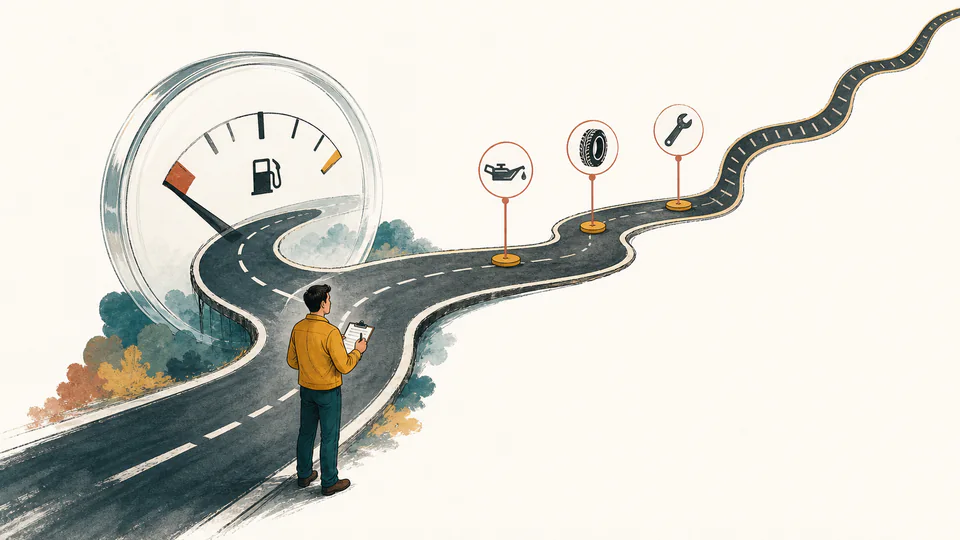
Editorial illustration of a car route winding through a transparent fuel gauge and then across maintenance tick marks
The route becomes odometer distance first, fuel second, and service crossings only after the existing interval is added.
Commute mileage and consumption ledgerExact current inputs and named intermediate quantities
Live detail from the current planning case
Usage layerFrequency or distanceHorizon or efficiencyCalculated quantity

DETAILED CALCULATION PROCESS

Formula, symbols, defaults, conversions, live substitution, and reconciliation

1. General symbolic formula

N=dm; M=2sN; F=M/e; C=Fq; E=floor((o+M)/I)

2. Calculation logic

Multiply monthly driving days by months for round trips, double one-way distance for each trip, divide total miles by observed miles per gallon, and multiply gallons by fuel price. Service events count how many complete intervals the current plus commute mileage crosses.

3–4. Symbol names, meanings, and units

SymbolMeaningUnit
dDriving commute daysdays/month
mUsage horizonmonths
NRound tripstrips
sOne-way route distancemiles/trip leg
MTotal commute distancemiles
eObserved fuel economymiles/gallon
FFuel demandgallons
qFuel priceUSD/gallon
CModeled fuel costUSD
oMiles already in service intervalmiles
ISelected service intervalmiles
EComplete interval crossingsevents

5. Default inputs

  • One-way commute miles: 17.5
  • Commute days per month: 18
  • Usage horizon (months): 12
  • Observed fuel economy (mpg): 31
  • Fuel price per gallon: 3.65
  • Selected service interval miles: 5000
  • Miles since last service: 1800

6. Percentage and unit conversions

  • A round trip contains exactly two entered one-way route distances.
  • Miles divided by miles per gallon yields gallons; gallons multiplied by dollars per gallon yields dollars.
  • Service crossings use floor because a partial interval does not become a completed event.

7–9. Live substitution, intermediate results, and final result

    10. Reverse or reasonableness check

    HOW TO USE

    Build usage from route records rather than a generic average

    1. Measure the route actually driven, including the usual access road and parking path, and freeze the endpoints.
    2. Count only days the vehicle makes this commute; separate remote days, carpool passenger days, transit, and leave.
    3. Estimate fuel economy from repeated fill-ups or a trip computer under comparable traffic, weather, load, and seasonal conditions.
    4. Use a current price for the vehicle’s required fuel and retain its date and station location.
    5. Choose one service item and its documented interval, then add all noncommute mileage before acting on the crossing count.

    SUBJECT FUNDAMENTALS

    Six quantities in a usage ledger

    Trip leg
    One direction between home and workplace.
    Round trip
    Outbound plus return movement for one commute day.
    Usage cadence
    Driving days per month extended across the horizon.
    Observed efficiency
    Distance per gallon under relevant operating conditions.
    Interval crossing
    Completion of a selected service-mile threshold.
    Residual interval mileage
    Distance accumulated after the most recent completed threshold.

    MODEL AND FORMULA

    Preserve distance before converting it to fuel and service events

    N=dm; M=2sN; F=M/e; C=Fq; E=floor((o+M)/I)

    Multiply monthly driving days by months for round trips, double one-way distance for each trip, divide total miles by observed miles per gallon, and multiply gallons by fuel price. Service events count how many complete intervals the current plus commute mileage crosses.

    DEEPER DECISION ANALYSIS

    Why actual consumption diverges from route arithmetic

    Fuel economy changes with conditions

    Temperature, speed, congestion, idling, grade, tire pressure, cargo, auxiliary loads, and driving behavior can move observed efficiency. Recalculate from current logs instead of treating a label value as a guarantee.

    Noncommute miles can dominate service timing

    Errands, weekend travel, rideshare use, and detours consume the same odometer interval. Add them in a complete vehicle ledger before booking maintenance.

    Service intervals are item-specific

    Oil, tires, filters, inspections, fluids, and manufacturer schedules do not share one universal mileage. The event count tracks only the interval entered and cannot prescribe work.

    WORKED DECISION CASES

    Two commute workloads

    Stable suburban drive

    A driver with twelve months of consistent office attendance uses a fill-up log and recent route distance to plan fuel cash and identify whether the commute alone crosses a selected oil-service interval.

    Seasonal stop-and-go route

    A city commuter runs a winter case with lower observed mpg and a summer case with different traffic. The two ledgers reveal fuel sensitivity while the service count remains an odometer planning aid.

    TECHNICAL LANGUAGE

    Vehicle-use glossary

    Observed mpg
    Distance-per-gallon estimate from relevant actual operation.
    Label fuel economy
    Standardized test information useful for comparison, not a guarantee of individual results.
    Service interval
    Manufacturer or qualified-service threshold for one maintenance item.
    Interval crossing
    A complete threshold passed by cumulative mileage.
    Residual mileage
    Distance into the next service interval after completed crossings.
    Horizon
    Number of months over which cadence is extended.
    Fuel demand
    Calculated gallons required at the entered efficiency.

    EVIDENCE AND DATA LINEAGE

    Keep a route, fill-up, and odometer chain

    Retain route-map mileage, commute calendar, beginning and ending odometer readings, gallons and price from fill-up receipts, fuel grade, trip-computer resets, traffic and seasonal notes, current miles since the tracked service, the vehicle-specific manual or maintenance schedule, and noncommute mileage. EPA fuel-economy information explains that actual results vary with conditions, so identify whether the efficiency is observed or label-based.

    LIMITS AND EXCLUSIONS

    What the usage model does not measure

    • Fuel economy is constant across the horizon and does not model idling, warm-up, weather, congestion, terrain, load, or degradation.
    • Fuel price is fixed; price changes, taxes embedded differently, and fuel-grade changes require new cases.
    • Service crossings do not diagnose condition, prescribe maintenance, or replace the vehicle manufacturer’s schedule.
    • Noncommute mileage, detours, alternate routes, carpool mileage sharing, electric charging, and hybrid energy splits are excluded.
    • Fuel cost is not complete vehicle cost; insurance, financing, depreciation, repairs, tires, registration, parking, and tolls remain outside.

    RELIABLE SOURCES

    Primary and authoritative planning references

    FREQUENTLY ASKED QUESTIONS

    Commute usage questions

    Can I use the window-sticker mpg?

    You can use it as a declared comparison input, but actual fuel economy varies. An observed log from the same route and season is usually more representative for budgeting.

    Why reject miles since service at or above the interval?

    The model needs a current position inside one interval. If a threshold is already passed, reconcile completed or overdue service before projecting future crossings.

    Does one crossing mean I should service the vehicle exactly then?

    No. It flags a mileage threshold under the entered schedule. Follow the applicable vehicle documentation and qualified advice.

    How should carpool days be counted?

    Include days your vehicle drives the route. Passenger days belong to a separate cash and attendance record.

    Can this calculate electric-vehicle energy?

    No. MPG and gallons are combustion-fuel quantities; use an electricity model with kWh per distance and charging losses.

    Why is fuel cost lower than my real commute cost?

    This page prices fuel only. Complete ownership and access costs require insurance, depreciation, repairs, parking, tolls, financing, and other relevant layers.

    IMPORTANT NOTE

    Usage arithmetic is not maintenance or safety advice

    This calculator does not diagnose a vehicle, prescribe service, guarantee fuel economy, or provide mechanical, environmental, tax, insurance, safety, or financial advice. Follow current vehicle documentation and qualified professional guidance.