H

Lifestyle planning

Hobby Usage Calculator

Convert a hobby project count into waste-adjusted material demand, whole purchase packs, leftover capacity, cost, and tool service crossings.

MATERIAL AND TOOL USAGE

Preserve continuous demand before rounding purchases to whole packs

For makers planning repeatable projects from measured material and tool use. Demand is calculated continuously, a declared waste allowance is applied once, whole packs are rounded upward at purchase, and completed tool-service intervals remain separate.

Whole packs to purchase-
Material purchase cost-
Waste-adjusted demand-
Leftover pack capacity-
Modeled tool hours-
Complete service crossings-

MATERIAL AND TOOL USAGE

Material and service usage ledger

Purchase count is a gross requirement from zero stock. Reconcile suitable on-hand inventory separately, and never extend a tool interval beyond manufacturer or competent technical guidance.
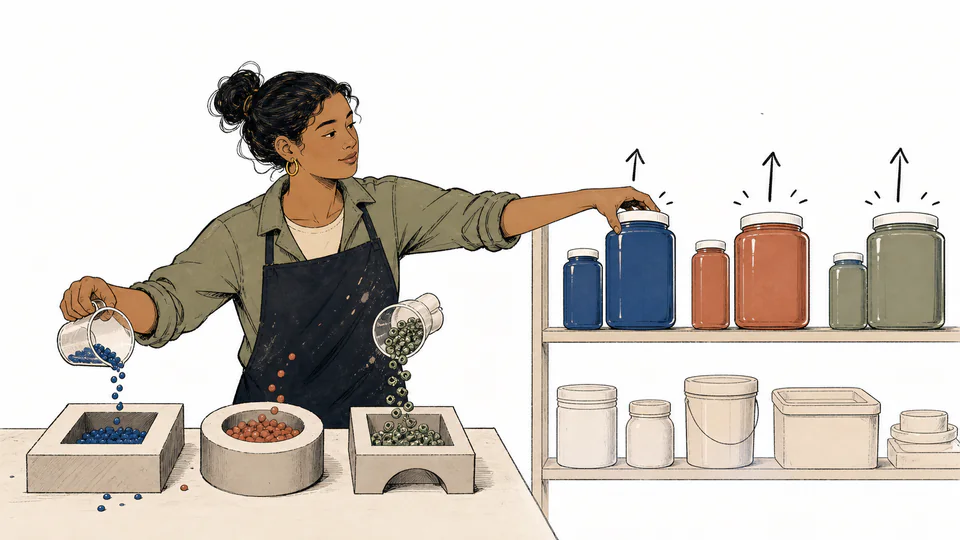
Editorial illustration of a maker pouring measured craft materials into project molds and rounding demand to whole containers
Demand remains continuous until the purchase boundary, where packs must become whole.
Material and service usage ledgerExact current inputs and intermediate quantities
Live detail from the current planning case
Usage layerProject / hours basisYield or intervalDemand or event count

CURRENT CALCULATION PROCESS

Formula, current substitution, intermediate steps, and reconciliation

Dn=Nq; Dg=Dn(1+w); P=ceil(Dg/Y); L=PY-Dg; H=Nh; E=floor(H/I)

Project count multiplies net material and tool hours. Waste increases material once, pack count uses a ceiling, leftover preserves the rounding consequence, and service events count complete interval crossings.

    HOW TO USE

    Estimate material purchases from observed project use

    1. Freeze one project definition and avoid mixing different sizes or material specifications.
    2. Measure net usable material on several completed projects before selecting a per-project basis.
    3. Separate normal cut or test loss from avoidable defects and apply one documented waste allowance.
    4. Copy usable pack yield and price from the exact product, then reconcile on-hand inventory outside the gross result.
    5. Use manufacturer or qualified technical maintenance intervals and inspect both hours and complete crossings.

    SUBJECT FUNDAMENTALS

    Five quantities in a usage ledger

    Net project demand
    Usable material incorporated into one defined project.
    Waste allowance
    One percentage covering documented non-usable material.
    Gross demand
    Net demand after the waste factor.
    Pack ceiling
    Whole packages required to meet gross demand from zero stock.
    Service crossing
    Completed tool-hour interval that triggers documented maintenance.

    MODEL AND FORMULA

    Calculate use first, then round only what must be purchased whole

    Dn=Nq; Dg=Dn(1+w); P=ceil(Dg/Y); L=PY-Dg; H=Nh; E=floor(H/I)

    Project count multiplies net material and tool hours. Waste increases material once, pack count uses a ceiling, leftover preserves the rounding consequence, and service events count complete interval crossings.

    DEEPER DECISION ANALYSIS

    Where usage estimates commonly drift

    Skill changes waste

    Learning, setup quality, nesting, test pieces, and defect rates can improve or worsen across a project series.

    Pack yield may not equal label weight

    Usable yield can be reduced by moisture, kerf, color matching, shelf life, defects, or required remnants.

    Hours do not replace condition checks

    Calendar time, dust, load, temperature, lubrication, blade condition, and inspection can require service before a nominal hour interval.

    WORKED DECISION CASES

    Two materially different usage plans

    Ceramic glaze series

    A potter measures usable glaze per batch, includes test tiles and transfer loss, rounds to whole containers, and tracks kiln or mixer maintenance separately.

    Small furniture run

    A woodworker uses board-foot demand, cut-plan waste, whole bundles, machine hours, and manufacturer service intervals without treating leftover offcuts as guaranteed stock.

    TECHNICAL LANGUAGE

    Hobby usage terms

    Net demand
    Material that becomes part of the finished project.
    Gross demand
    Net demand plus declared waste.
    Usable yield
    Quantity from a pack that matches the model unit and specification.
    Purchase ceiling
    Rounding up because partial packs cannot be bought.
    Leftover capacity
    Purchased usable quantity beyond modeled gross demand.
    Service interval
    Documented operating amount between maintenance actions.

    EVIDENCE AND DATA LINEAGE

    Keep measurement logs, product labels, and tool records

    Retain project dimensions, sample count, net-use measurements, waste categories, pack label and lot, usable-yield conversion, prices and dates, on-hand stock condition, shelf life, tool-hour meter or session log, maintenance manual, service history, and unit definitions.

    LIMITS AND EXCLUSIONS

    Boundaries of the usage model

    • All projects share one material and tool-hour basis.
    • Gross demand starts from zero usable stock and does not subtract leftovers from previous work.
    • Waste is constant and applied once; defects or redesign outside the allowance are excluded.
    • Service crossings do not replace inspections, calendar maintenance, safety checks, or manufacturer instructions.

    RELIABLE SOURCES

    References for the method and planning boundaries

    FREQUENTLY ASKED QUESTIONS

    Hobby usage questions

    Why is pack count rounded up?

    The gross requirement must be met with whole purchasable packages; leftover capacity remains explicit.

    Can I subtract material already on hand?

    Yes in a separate inventory reconciliation after confirming specification, condition, shelf life, and usable quantity.

    Should rework be inside waste?

    Include typical measured rework once; unusual defects or redesign should be a separate scenario.

    Why floor service events?

    Only completed intervals are counted. A partially used interval still matters for the next service plan.

    Do tool hours prove safe condition?

    No. Inspection, load, environment, calendar time, and manufacturer guidance can require earlier maintenance.

    Can different project sizes be combined?

    Only after converting each to a common material basis; otherwise calculate separate groups.

    IMPORTANT NOTE

    Usage arithmetic does not replace safe operation or maintenance instructions

    Follow product labels, safety data, equipment manuals, qualified instruction, and local rules. This page is a planning aid, not engineering or safety advice.