Total route miles measure vehicle movement
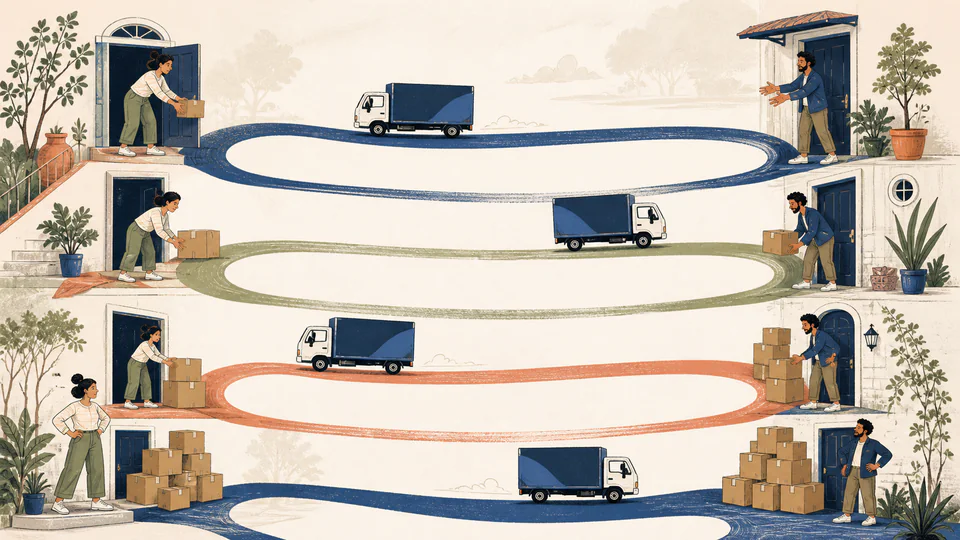
The mileage result includes the entered round-trip pattern for every required load. It is not the straight-line distance between the two homes.
Shared planning
Estimate a household move from route miles, fuel efficiency, tolls, rental, labor, packing materials, and budget.
PHYSICAL MOVE LOGISTICS
This route model converts one-way distance into complete vehicle miles, then adds fuel, tolls, rental, hired labor, and boxes. It uses only prices you enter.
PHYSICAL MOVE LOGISTICS
Confirm truck mileage limits, load capacity, insurance, access, parking, stairs, minimum labor hours, and toll classifications before booking.
| Layer | Quantity | Efficiency/unit | Rate | Cost |
|---|
DETAILED CALCULATION PROCESS
m=2dt; fuel=(m/e)p; total=fuel+tolls×t+truck+hr+bc
Double one-way distance for each round trip, divide miles by loaded efficiency, price fuel, then add five distinct cost layers.
| Symbol | Meaning | Unit |
|---|---|---|
| d | One-way distance | miles |
| t | Round trips | trips |
| e | Efficiency | miles/gallon |
| p | Fuel price | USD/gallon |
| h,r | Labor hours and rate | hours, USD/hour |
| b,c | Boxes and unit cost | units, USD/unit |
HOW TO USE
SUBJECT FOUNDATIONS
MODEL AND FORMULA
Double one-way distance for each round trip, divide miles by loaded efficiency, price fuel, then add five distinct cost layers.
RESULT INTERPRETATION
The mileage result includes the entered round-trip pattern for every required load. It is not the straight-line distance between the two homes.
An additional trip changes fuel, mileage exposure, labor time, and schedule risk together. Check vehicle payload and usable volume before accepting the calculated count.
A positive variance is the remaining allowance; a negative variance is an entered-plan overrun. Neither value includes omitted access or contract charges.
DECISION BOUNDARY
Confirm truck mileage limits, load capacity, insurance, access, parking, stairs, minimum labor hours, and toll classifications before booking.
A small increase in belongings can force a whole extra trip when the current load is near capacity, producing a discontinuous cost increase.
SENSITIVITY AND STRESS TESTING
Every additional route mile is multiplied by the modeled trip pattern, so an inaccurate address-to-address estimate compounds across the move.
Lower MPG or a higher fuel price raises the variable travel component. Rental, packing, and access charges remain unchanged by those fuel inputs.
DEEPER DECISION ANALYSIS
One underestimated load adds two route legs.
Mileage caps and late returns are not linear.
Stairs and long carries can extend quoted hours.
WORKED CASES
Reduce trips only if capacity evidence supports it.
Increase hired hours and revise trip count independently.
GLOSSARY
EVIDENCE
Keep maps, odometer estimates, truck capacity, rental terms, fuel quote date, toll schedule, labor minimums, access notes, and material receipts.
LIMITS
RELIABLE SOURCES
FAQ
Each modeled trip includes travel to the destination and the required return leg. Change the trip definition if the vehicle does not return.
Not with the displayed MPG and per-gallon model. Convert every distance, economy, and fuel-price input to one compatible system before calculating.
Include mileage fees, base rental, insurance, and applicable taxes in the truck-rental input or maintain a separate quoted-cost reconciliation.
The modeled move exceeds the entered budget by the absolute value shown. Identify the responsible line rather than treating the variance as optional.
Enter their expected net cost after planned reuse or resale only when that recovery is credible; otherwise use the full purchase or rental cost.
No. It excludes contract-specific minimums, stairs, elevators, parking, waiting, toll classes, damage protection, and late-return terms unless entered elsewhere.
Trip count is discrete. Crossing the vehicle-capacity boundary adds an entire route cycle rather than a small proportional amount of fuel and time.
Include it when the quoted labor clock runs during travel. If labor and vehicle charges use different rules, reconcile them as separate cost layers.
Calculate a measured best estimate and a conservative one-extra-trip case. The difference is more informative than hiding uncertainty inside a vague contingency.
No. Payload, axle limits, tie-downs, visibility, driver licensing, and insurance require vehicle-specific checks beyond the route-and-cost calculation.
IMPORTANT NOTE
Use current written quotes and safe handling plans. This arithmetic does not certify a mover, vehicle, insurance policy, or route.