Physics and mechanics
Ideal Gas Equilibrium Calculator
Find the final pressure, temperature, gas amount, and internal-energy redistribution after two ideal-gas chambers reach equilibrium inside one isolated rigid vessel.
CURRENT MODEL
Describe both gas inventories before the partition opens
Thermodynamics students, laboratory engineers, and process designers checking a two-compartment mixing thought experiment before using a real-gas or transient model.
Decision supportedDetermine the uniform final state produced when a partition is removed, and test whether the assumed rigid, adiabatic ideal-gas boundary is suitable for the intended comparison.
LIVE EQUILIBRIUM BALANCE
Initial chambers and final uniform state
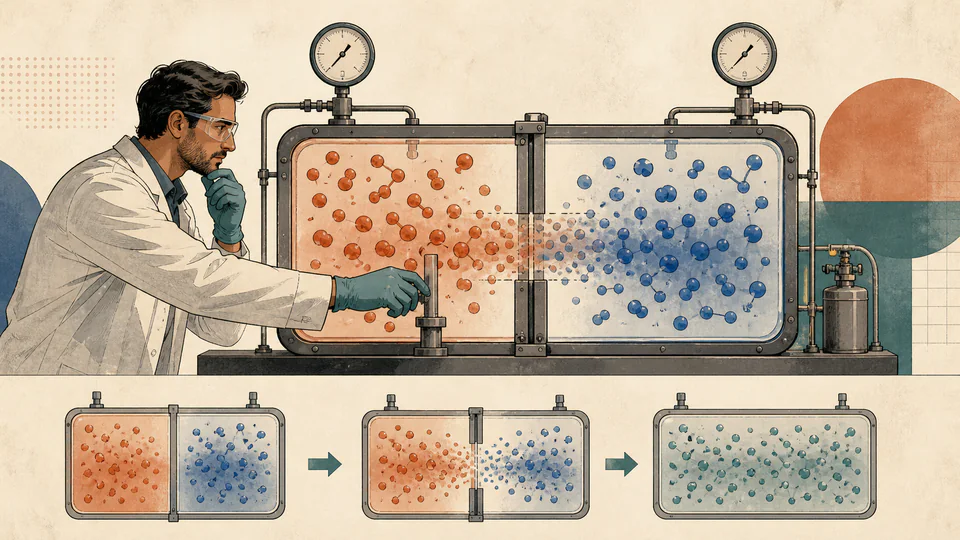
The live diagram compares both starting pressures and temperatures with the calculated final state, mole split, and internal-energy transfer.
| Quantity | Equation | Current value | Unit |
|---|
How to use
Define a closed equilibrium problem before opening the partition
- Enter absolute pressure for each chamber; convert gauge readings by adding the local atmospheric pressure first.
- Enter each fixed chamber volume and initial temperature, keeping Celsius above absolute zero.
- Choose a constant molar Cv for each inventory over the modeled temperature interval.
- Confirm that the combined vessel is closed, rigid, and sufficiently insulated for an adiabatic final-state estimate.
- Compare the calculated final temperature with both initial temperatures; it should lie between them for positive heat capacities.
- Use the energy residual and final-state pressure residual as reconciliation checks before exporting the case.
Equilibrium fundamentals
Six facts that determine this final state
- Absolute state variables
- The ideal-gas law requires pressure referenced to vacuum and temperature referenced to absolute zero.
- Mole inventory
- Each side contributes n = PV/(RT), so equal volumes do not imply equal gas amounts.
- Rigid outer boundary
- The combined volume does not change and no external boundary work is modeled.
- Adiabatic outer boundary
- Total gas internal energy is conserved even though energy moves between inventories.
- Heat-capacity weighting
- The final temperature weights each initial kelvin temperature by nCv, not by volume alone.
- Mechanical equilibrium
- After transients decay, one pressure occupies the combined volume.
Calculation method
Inventory first, energy balance second, state equation last
The model converts kPa to Pa, litres to cubic metres, and Celsius to kelvin. It calculates each mole inventory independently, multiplies by that side's molar Cv to form a heat-capacity weight, and solves the isolated-vessel internal-energy balance for one final temperature.
Only after energy has been reconciled does it apply pV = nRT to the combined moles and volume. This ordering prevents a pressure average from being mistaken for the final thermodynamic state.
Unequal gases
Different constant Cv values change the energy weighting. Chemical reaction, dissociation, condensation, and composition-dependent real-gas behavior remain outside the model.
Wall thermal storage
A massive partition or vessel wall can absorb energy while temperatures equalize. Add its heat capacity to the numerator and denominator when wall storage is material.
Pressure is not averaged
The final pressure follows the final temperature, total moles, and total volume. A simple arithmetic pressure average is generally wrong when volumes or temperatures differ.
Transient loads
The final equilibrium does not predict jet velocity, mixing time, pressure-wave peaks, valve loads, or relief demand immediately after the partition opens.
Detailed calculation process
Symbols, current substitution, intermediate quantities, and reconciliation
n_i = P_i V_i/(R T_i); T_f = sum(n_i Cv_i T_i)/sum(n_i Cv_i); P_f = n_total R T_f/V_totalCalculations retain full SI precision. Pressure and Celsius temperature display to 0.01, mole inventories to 0.0001, and energy residuals to sufficient precision to expose conservation error.
| Symbol | Meaning | Default A / B | Unit |
|---|---|---|---|
| P_A, P_B | Initial absolute pressures | 200 / 100 | kPa |
| V_A, V_B | Initial rigid volumes | 20 / 30 | L |
| T_A, T_B | Initial temperatures | 80 / 20 | deg C |
| Cv_A, Cv_B | Molar constant-volume heat capacity | 20.8 / 20.8 | J/(mol K) |
| R | Universal molar gas constant | 8.314462618 | J/(mol K) |
| n_i | Initial mole inventory | calculated | mol |
| T_f, P_f | Uniform final temperature and pressure | calculated | K, kPa |
Waiting for valid inputs.
Interpretation
Read conservation before using the final numbers
A final temperature outside the two initial temperatures signals invalid inputs or a missing energy term under positive Cv assumptions. Equal and opposite inventory energy changes show redistribution inside the rigid vessel; their sum should be numerically near zero.
Evidence and measurement
Preserve the basis of every state variable
Record whether pressures are absolute, the atmospheric correction applied to gauge sensors, calibrated chamber volumes, sensor locations and stabilization times, gas identity and purity, and the source and temperature range for each Cv. Preserve vessel heat-leak and wall-capacity evidence if the adiabatic assumption is consequential.
Scope and limitations
What this equilibrium model does not certify
- Real-gas compressibility at high pressure or near saturation
- Chemical reaction, phase change, leakage, or mass added after opening
- Heat transfer to walls or surroundings during equilibration
- Transient pressure waves, throttling losses, mixing time, or local hot spots
- Vessel stress, valve sizing, relief protection, and hazardous-material compatibility
- Regulatory compliance or safe operating procedure
Two closed ideal-gas inventories occupy fixed volumes, the combined vessel is rigid and adiabatic, molar Cv is constant for each inventory, no gas reacts or condenses, and the final state is uniform.
Key terminology
Two-chamber thermodynamics glossary
- Absolute pressure
- Pressure measured from a perfect vacuum rather than from atmosphere.
- Ideal gas
- A model whose state obeys pV = nRT with negligible molecular volume and interaction energy.
- Molar heat capacity
- Energy required per mole per kelvin for a specified constraint.
- Internal energy
- Microscopic stored energy represented here by nCvT up to a reference.
- Adiabatic
- A boundary across which no heat is transferred during the modeled process.
- Rigid vessel
- A container whose external volume and boundary work remain fixed.
- Thermal equilibrium
- A state with one uniform temperature and no net internal heat transfer.
- Mechanical equilibrium
- A state with one uniform pressure after motion and pressure waves decay.
Practical cases
Two equilibrium questions with different evidence needs
Calibration manifold equalization
A metrology lab connects a warm pressurized reference volume to a cooler evacuated manifold. The model estimates the stabilized pressure only after including both mole inventories and temperature weighting; the lab still waits for measured thermal stability.
Gas-transfer teaching vessel
An instructor uses equal Cv values but unequal volumes and pressures to demonstrate why neither pressure nor Celsius temperature may be averaged. The residuals provide a direct classroom conservation check.
Important note
Equilibrium is not a vessel-safety calculation
The final state is a screening result under declared idealized boundaries. It does not bound transient overpressure or certify hardware. Retain the unrounded case and obtain qualified pressure-system review before operating equipment.
Frequently asked questions
Why must the pressures be absolute rather than gauge values?
The ideal-gas equation uses absolute pressure. A gauge value omits atmospheric pressure and therefore understates each mole inventory and changes both the heat-capacity weighting and final pressure.
Why is the final temperature not the simple average of the two Celsius temperatures?
The equilibrium temperature is weighted by each side's mole inventory and molar constant-volume heat capacity in kelvin. Equal arithmetic weighting is valid only when the two heat-capacity inventories are equal.
Can chamber A and B contain different ideal gases?
The energy balance permits different constant molar Cv values if the gases do not react or condense. The calculator does not predict composition-dependent real-gas interactions or chemical equilibrium.
Does opening the partition perform boundary work?
Not on the external surroundings when the combined vessel is rigid. Internal redistribution occurs, but the model treats total combined volume and total internal energy as fixed.
What if the vessel loses heat while equilibrium is forming?
Then the adiabatic energy balance is invalid. Include measured heat transfer and wall thermal storage in a transient control-volume model instead of interpreting this final state as physical.
Is the result safe for high-pressure gas design?
No. Ideal-gas behavior, constant heat capacity, vessel ratings, mixing time, relief loads, and material compatibility require separate verification by qualified engineers.
Authority and follow-on work
Reliable sources and related calculators
- NASA Glenn — Equation of StateDefines pV = nRT and the absolute-temperature requirement.
- NASA Glenn — Ideal Gas ProcessesProvides constant-volume internal-energy and molar Cv relations.
- NASA Glenn — Specific Heats Cp and CvExplains constant-volume heat capacity and the first-law basis.
Related calculators
Continue with a distinct physics question without silently changing the model boundary.