Three-fragment breakup
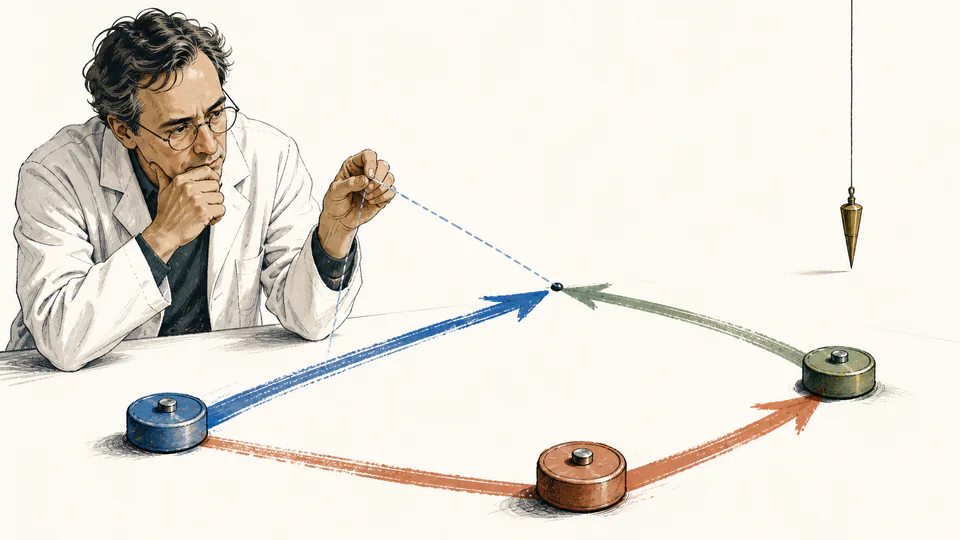
A laboratory records three fragments after a release and checks whether their momentum polygon closes within measurement tolerance.
Physics and mechanics
Sum three objects’ two-dimensional momentum vectors, compare the resultant with an explicit tolerance, and calculate the exact closing momentum vector.
MULTI-OBJECT MOMENTUM BALANCE
This calculator supports classroom vector checks, fragmentation bookkeeping, and test-data reconciliation at a declared instant. It calculates each object’s px and py, sums components, tests the resultant magnitude against an entered tolerance, and reports the closing vector. Momentum balance is not static equilibrium: moving bodies can have zero total momentum while forces remain nonzero.
MULTI-OBJECT MOMENTUM BALANCE
A resultant within tolerance is a momentum-balance finding for the entered objects and instant. It does not demonstrate zero net force, zero acceleration, structural equilibrium, or future conservation.
| Object | Mass (kg) | vx (m/s) | vy (m/s) | px | py | |p| |
|---|
DETAILED CALCULATION PROCESS
p_i = m_i (vxi, vyi); P = sum p_i = (sum px_i, sum py_i); R = |P|; p_close = -P
Calculate each body’s momentum components, add x and y totals independently, take the resultant magnitude, compare it with the entered absolute tolerance, and negate the total to obtain the exact closing vector.
| Symbol | Meaning | Unit | Default basis |
|---|---|---|---|
| mi | Mass of object i | kg | 2, 1.5, 1 |
| vxi, vyi | Signed velocity components | m/s | three entered vectors |
| pxi, pyi | Object momentum components | kg*m/s | mi vi |
| P | Total system momentum vector | kg*m/s | sum of components |
| R | Magnitude of total momentum | kg*m/s | sqrt(Px^2+Py^2) |
| tau | Entered resultant tolerance | kg*m/s | 0.1 |
| pclose | Vector needed to close the polygon | kg*m/s | -P |
HOW TO USE THIS CALCULATOR
MOMENTUM FOUNDATIONS
DEEP ANALYSIS 1
Equal and opposite object momenta cancel even when individual kinetic energies are large.
DEEP ANALYSIS 2
Static equilibrium requires zero net force and torque with no acceleration; this page evaluates only momentum vectors at one instant.
DEEP ANALYSIS 3
In an explosion or collision record, an untracked body or external impulse can produce a nonzero closing vector.
RESULT INTERPRETATION
Exact balance means both calculated components are numerically zero. Near balance means the resultant is nonzero but no larger than the entered tolerance; the tolerance must have an evidence basis.
Outside tolerance identifies an unresolved vector. The closing components show the momentum that a missing object, measurement correction, or external impulse would need to supply, but do not identify which explanation is true.
REAL USE CASES
A laboratory records three fragments after a release and checks whether their momentum polygon closes within measurement tolerance.
Students choose velocities in the centre-of-mass frame and verify that total momentum is zero despite all three bodies moving.
EVIDENCE AND DATA QUALITY
Retain object identities, masses, coordinate frame, sensor positions, synchronized timestamps, velocity-estimation method, uncertainty and covariance where available, excluded fragments, known external impulses, tolerance derivation, and the unrounded component ledger.
LIMITS AND EXCLUSIONS
TERMS USED HERE
RELIABLE SOURCES
FREQUENTLY ASKED QUESTIONS
No. Bodies may be moving with cancelling momenta, and net forces or torques may still be present.
Momentum is a vector. Opposing components cancel, while adding magnitudes would discard direction.
It is the exact vector needed to make the entered sum zero; it may suggest missing momentum but does not identify its physical source.
Yes for an exact mathematical exercise. Measurements usually require a tolerance derived from uncertainty rather than arbitrary rounding.
Total momentum can still be zero if their vectors cancel. Kinetic energy generally remains positive.
No. It checks one state. Conservation requires comparing synchronized before and after system totals and accounting for external impulse.
IMPORTANT BOUNDARY
This calculator is an educational vector-reconciliation tool. It does not certify structures, machinery, vehicles, explosions, forensic reconstructions, or safety-critical systems.