Partial shoes are not independent
If hands continue from the same shoe, remaining composition changes. Use sequential conditional probabilities or simulation rather than raising one miss probability to a power.
Probability
Calculate exact confidence of seeing at least one target card in one hand and across independently reshuffled hands.
CARD-DRAW CONFIDENCE
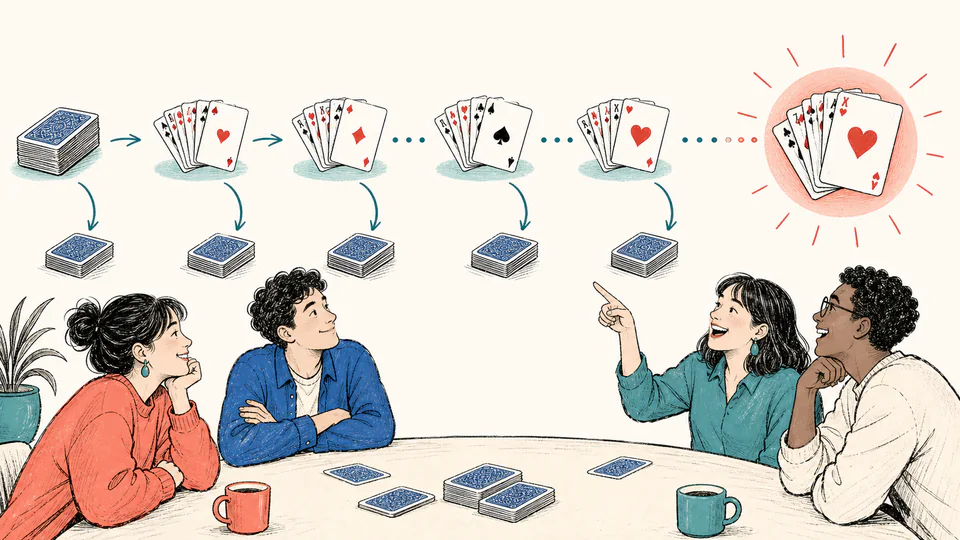
This calculator answers a specific without-replacement question: how likely is at least one target card in a hand, and how does that confidence accumulate across independently reshuffled hands? It uses exact combinations inside each hand and an independence model only between complete reshuffles.
CARD-DRAW CONFIDENCE
Use the result to plan repeated demonstrations, tests, or game observations under a declared shuffle protocol. Probability quantifies the model, not certainty, skill, fairness, or financial value.
| Calculation level | Hands or target | Combination basis | Independence condition | Miss probability (%) | Hit probability (%) |
|---|
CURRENT CALCULATION PROCESS
P(hit in one hand)=1−C(N−K,n)/C(N,n); P(hit by H hands)=1−[1−P(hit)]^H
The one-hand complement counts hands containing no target card. Complete deck restoration and reshuffling make the hand-level hit events independent; without that reset, the second formula is not valid.
Exact combination counts are retained before display rounding.
HOW TO USE THIS MODEL
CARD-DRAW CONFIDENCE FUNDAMENTALS
MODEL AND FORMULA
The one-hand complement counts hands containing no target card. Complete deck restoration and reshuffling make the hand-level hit events independent; without that reset, the second formula is not valid.
DEEPER PROBABILITY ANALYSIS
If hands continue from the same shoe, remaining composition changes. Use sequential conditional probabilities or simulation rather than raising one miss probability to a power.
Changing which ranks, suits, or special cards count after observing a hand invalidates the predeclared event probability.
A long miss streak can occur in a fair model. Testing shuffle fairness requires observed data, a null model, and a separate statistical procedure.
WORKED DECISION CASES
A trainer wants at least a 90% chance of showing an ace across repeated five-card demonstrations. The page returns exact one-hand probability and the minimum independently reshuffled hands.
A production deck contains six marked inspection cards among 80 cards. Repeated sample hands can be planned to make at least one inspection-card appearance likely under full reset.
TECHNICAL LANGUAGE
EVIDENCE AND DATA LINEAGE
Retain deck composition, target-card list, hand size, replacement and reshuffle protocol, number of hands, confidence threshold, treatment of jokers or removed cards, and the unrounded probabilities. If results are compared with observations, keep the full sequence rather than only hits.
LIMITS AND EXCLUSIONS
RELIABLE SOURCES
FREQUENTLY ASKED QUESTIONS
No. Here confidence means modeled probability of at least one hit. A statistical confidence interval estimates an unknown parameter from data and is a different concept.
The repeated-hand formula assumes each hand has the same hit probability and is independent. Continuing through one shoe changes the remaining composition.
No for an unordered hand and an at-least-one event. Combinations count which cards appear, not their draw order.
Not unless one hand is already certain to contain a target. For an event with nonzero miss probability, no finite number of independent hands gives exactly 100%.
Then missing every target is impossible, so one-hand hit probability is 100%.
No. Hit probability alone says nothing about payout, cost, strategy, dependence, house rules, or expected value.
IMPORTANT PROBABILITY NOTE
Use this page for transparent finite-population probability. Real games may use different decks, removals, drawing rules, shuffles, payouts, and legal conditions. Do not treat the result as a guarantee or a recommendation to wager.