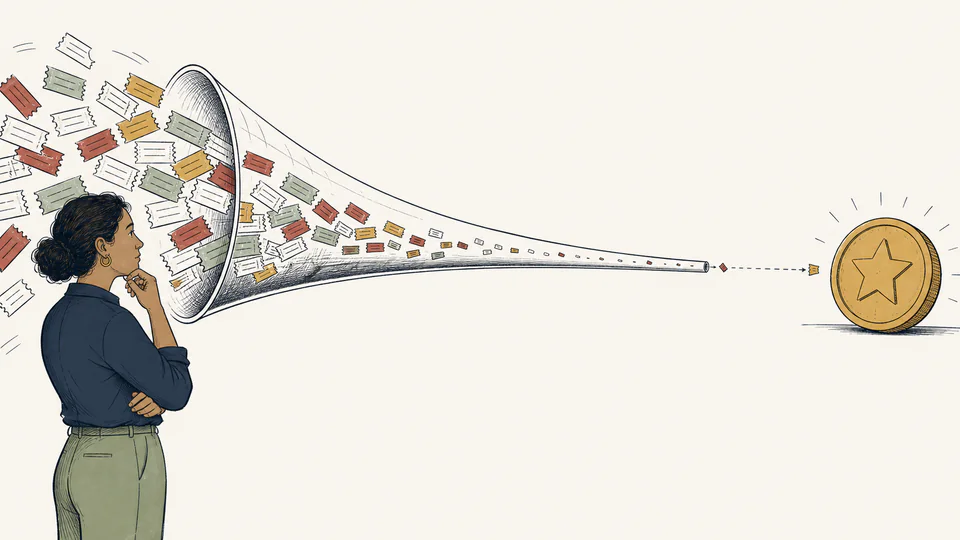
Why buying more barely moves jackpot risk
For very large D, the first tickets add approximately 1/D each. A larger n helps linearly at first but the absolute probability can remain tiny.
Probability
Calculate at-least-one lottery probabilities, expected jackpots, ticket spend, and budget headroom.
PROBABILITY AND BUDGET BOUNDARY
For players, pool organizers, and educators who need a transparent at-least-one probability plus an explicit entertainment-spend check.
CURRENT DECISION RECORD
Every row is regenerated from the active inputs and carried into Copy, TXT, and the page-specific PDF payload.
| Measure | Probability or input | Exposure | Current result |
|---|
CURRENT CALCULATION PROCESS
P(at least one) = 1 - (1 - 1/D)^n; spend = n x ticket cost
Waiting for valid inputs.
HOW TO USE
FOUNDATIONS
DEEP ANALYSIS
For very large D, the first tickets add approximately 1/D each. A larger n helps linearly at first but the absolute probability can remain tiny.
The any-prize event may include awards below ticket cost. This page intentionally reports event frequency, not payout value or return on spend.
The median-wait ticket count exposes scale. It is not a purchase recommendation and can imply an unaffordable outlay.
DECISION CASES
Ten $2 tickets against 1-in-292,201,338 jackpot odds produce a minuscule jackpot chance while using the full $20 budget. The useful decision is the explicit budget record, not an apparent percentage increase from one ticket.
A $0 budget with any positive ticket count is mathematically valid for risk but fails the spending boundary. The negative budget variance makes the conflict visible without suppressing the probability calculation.
TERMS
EVIDENCE RECORD
Retain the game name, draw date, rules edition, official jackpot and any-prize odds pages, ticket count, ticket price, entered budget, and the timestamp of the decision. This evidence distinguishes a reproducible probability record from a result copied after game rules or prices changed.
MODEL LIMITS
RELIABLE SOURCES
FAQ
Not when each valid selection has the same official chance. Different picks may affect prize sharing, but they do not change the draw probability modeled here.
At tiny probabilities they are close, but expected count can exceed one while probability is always capped at 100%. They are different measures.
Yes, if the ticket count represents independent future entries and the odds format stays unchanged. Record rule changes separately.
No. It includes all awards covered by the entered any-prize odds, including prizes worth less than total spend.
It gives a scale check using the same complement formula. It is intentionally separated from the budget recommendation.
No. It calculates probabilities from entered published odds; it cannot identify a winning combination or change a random draw.
IMPORTANT NOTE
Use the budget result as a hard boundary. If gambling is causing harm, stop and seek local support rather than trying to optimize ticket volume.