The most interesting calculator is not always the one with the most functions. Sometimes it is the object that understands one situation so well that its shape becomes part of the solution.
A cylindrical machine covered in sliders helped rally crews manage time and distance. A pair of rotating discs helped pilots reason about wind, speed, and fuel without electricity. Neither looks like the flat rectangle now associated with the word calculator. That is precisely why they are worth meeting.
The pepper-mill calculator
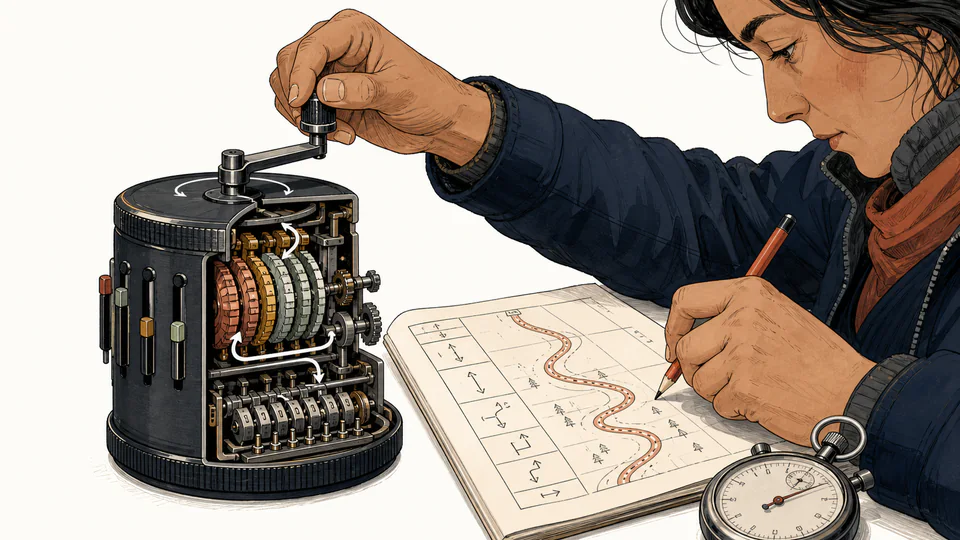
The Curta is small enough to hold in one hand and odd enough to invite the wrong comparison. It resembles a pepper mill, a compact camera lens, or a piece of precision laboratory equipment. Numbers are entered with sliders around its cylindrical body. A crank on top drives the mechanism. Windows reveal the result and revolution count.
Inside, arithmetic is physical. A modified stepped-drum mechanism translates slider positions into gear motion. Addition occurs through a crank rotation. Subtraction changes the operating mode. Multiplication repeats addition while place value is shifted; division reverses the logic through repeated subtraction. Carrying from one digit to the next is not an abstract rule in software—it is a coordinated mechanical event.
A design completed under brutal circumstances
The Curta’s history cannot be separated from its inventor, Austrian engineer Curt Herzstark. He had worked in his family’s calculating-machine business and developed ideas for a compact calculator before the Second World War. The Nazis arrested him in 1943, and he was imprisoned at Buchenwald concentration camp.
While imprisoned, Herzstark refined the design in his mind and on drawings. The Computer History Museum describes the mechanism as a modified version of Leibniz’s stepped drum. After the war, the calculator entered production in Liechtenstein. Its elegant engineering should not soften the brutality of the circumstances in which the design was completed; the human story is one of survival as much as invention.
The finished machine was a remarkable endpoint for mechanical calculation: four arithmetic operations in a compact, self-contained object that required no power source beyond the user’s hand.
Why rally crews liked it
Precision rallying is not simply about arriving first. In time-speed-distance events, crews try to maintain a prescribed average speed and reach checkpoints at the correct time. That produces a stream of calculations: distance covered, elapsed time, target time, and whether the vehicle is early or late.
The Computer History Museum notes that the hand-cranked Curta remained popular with sports-car rallyists even after electronic calculators became available. Its appeal makes practical sense. It was compact, rugged, independent of batteries, and operable in a moving car. A navigator could feel the machine’s state through sliders, carriage position, and crank rotations.
The Curta did not contain a “rally mode.” Its mechanical arithmetic happened to fit a demanding mobile workflow unusually well. That is an important form of specialization: not a dedicated formula, but a physical design suited to the environment.
The calculator that pilots still call a computer
The E-6B flight computer belongs to a different family. It is an analog calculating device made from rotating discs and, on many models, a sliding wind grid. One side behaves like a circular slide rule for relationships among speed, time, distance, fuel, and unit conversions. The wind side helps translate forecast wind into a heading correction and groundspeed estimate.
Naval Reserve pilot Philip Dalton developed the dead-reckoning computer in consultation with navigation instructor Philip Van Horn Weems. The Smithsonian’s National Museum of American History records a related patent from 1937 and notes that the device was widely used during the Second World War.
It solves a problem that is easy to state and surprisingly hard to feel. An aircraft points through moving air, while its actual path is measured over the ground. A crosswind pushes the aircraft sideways. To follow the desired ground track, the pilot must point somewhat into the wind. The E-6B turns that vector relationship into rotations, alignments, and distances on a grid.

Why not just use an app?
Electronic flight computers and navigation systems can calculate faster and integrate current data. The National Air and Space Museum notes that electronic devices have nearly replaced the old aluminum handheld variety. Yet the analog object remains a powerful teaching instrument because it exposes relationships that software can conceal.
Rotate one scale and speed, time, and distance move together. Plot wind and the difference between heading and track becomes visible. There is no menu hierarchy and no software update. The limitation is also the lesson: the device can only work with the information supplied, and the pilot must understand what each alignment means.
This does not make an analog computer automatically safer or superior. It makes its model inspectable.
Other machines shaped by a profession
Special-purpose calculation has produced a wonderful variety of objects:
- Slide rules printed for electrical engineers, photographers, surveyors, artillery crews, and concrete work.
- Nomograms that turn a multi-variable formula into the act of placing a straightedge across a printed chart.
- Financial calculators whose key layout embodies cash-flow timing rather than ordinary algebra.
- Mechanical planimeters that measure an irregular area by tracing its boundary.
- Watch calculators that value immediate access more than comfortable key size.
Each device embeds judgment. Its designer decides which variables deserve a scale, which steps can be combined, which errors are visible, and what the operator must already know.
A calculator can be an argument
General-purpose software suggests that every problem should enter through the same rectangle. Special-purpose calculators make the opposite argument: a tool can become clearer when its physical form resembles the structure of the problem.
The Curta turns place value and repeated operations into motion you can feel. The E-6B turns ratios and wind vectors into alignment you can see. Their strangeness is not decoration. It is evidence that a calculator can be designed around a human task rather than around a list of functions.