The most dangerous button on a scientific calculator may be the one you never press. It sits in a settings menu, quietly marked DEG, RAD, or sometimes GRA. The screen can look perfectly normal while that setting turns a familiar trigonometry answer into a very different number.
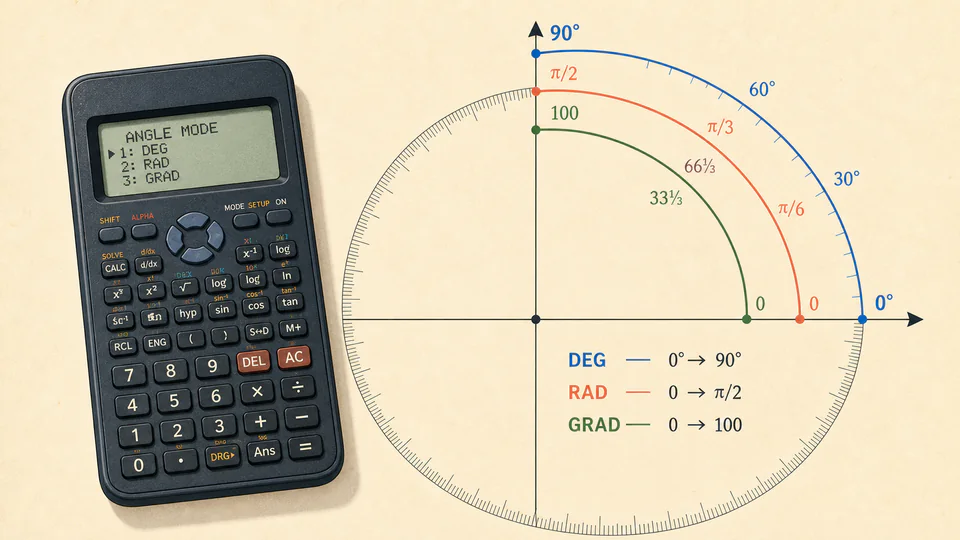
The reason is not that the calculator is being moody. An angle is not born with one universal numerical costume. A right angle can be written as 90 degrees, pi/2 radians, or 100 gradians. The geometry is the same; the number used to describe it changes.
An angle is a measurement, not a shape label
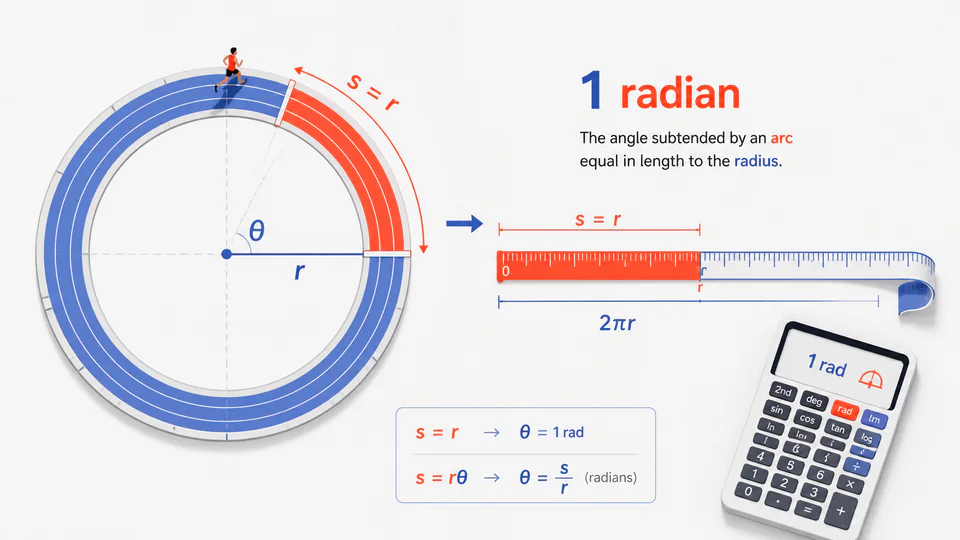
Imagine drawing a radius from the center of a circle and rotating it until it points straight up. Your eye sees one quarter of a turn. The calculator needs a number. Degrees divide a full turn into 360 equal parts. Gradians divide it into 400. Radians use the circle itself: one radian is the angle made when the length of the swept arc equals the radius.
That last definition feels less friendly at first, but it is remarkably useful. It ties the angle directly to lengths, which is why radians appear naturally in calculus, physics, signal work, and equations involving rates of change. The Bureau International des Poids et Mesures describes the radian through the ratio of arc length to radius and gives the conversion 360 deg = 2 pi rad.
The setting changes the input grammar
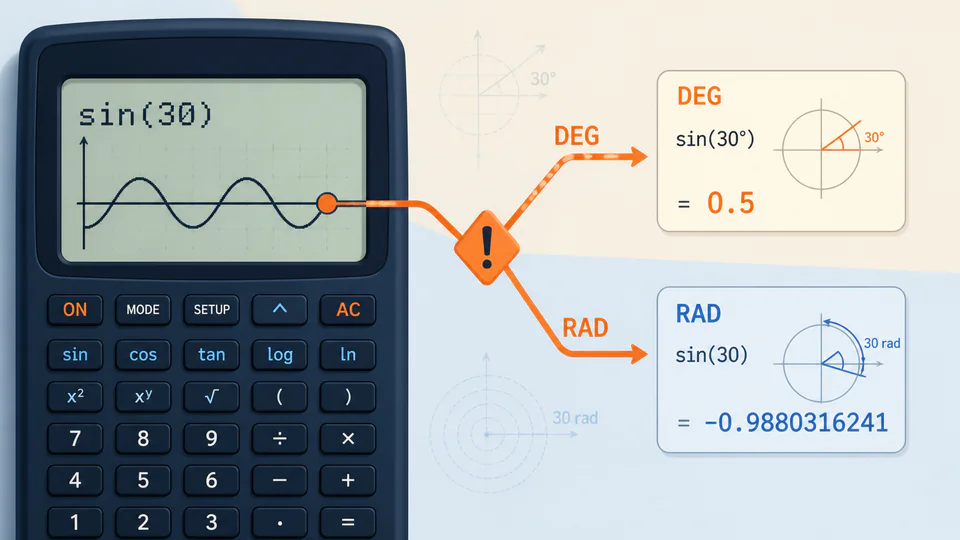
When you type sin(30), the digits alone are incomplete. They do not say whether 30 means 30 degrees, 30 radians, or 30 gradians. The angle mode supplies that missing piece of grammar.
In degree mode, sin(30) means sin(30 deg) and returns 0.5. In radian mode, the same keystrokes mean sin(30 rad), which is a different point on the sine wave. A calculator manual may show the mode indicator as D, R, or G; it is not decorative status text. It is part of the interpretation of every trigonometric input.
cos(-1)180 deginverse cosine in degree modecos(-1)pi radinverse cosine in radian modeThe answer changes because the output is also expressed in the selected angle unit.
This is why an answer can be numerically correct and still be wrong for the problem in front of you. A survey drawing, a classroom triangle, and a differential equation may all mention an angle while silently expecting different units.
The quiet trap in inverse trigonometry
Forward trigonometry starts with an angle and returns a ratio. Inverse trigonometry starts with a ratio and returns an angle, so the unit choice becomes visible in the answer.
For example, the inverse cosine of -1 is the straight-line angle at the far side of a circle. A degree-mode calculator reports 180. A radian-mode calculator reports pi. Neither screen is broken. Each is answering in the selected language.
- 01Find the indicatorDEG, RAD, or GRA should be visible somewhere.
- 02Match the sourceGeometry worksheets usually state degrees; calculus notation often assumes radians.
- 03Test a known point`sin(30 deg)` should be 0.5. If not, stop and change the mode.
Radians are not a more advanced version of degrees, and degrees are not a beginner-only version of radians. They are measurement systems suited to different jobs. The useful habit is not memorizing which one is superior. It is noticing that the calculator needs the unit before it can even interpret the number.
The calculator does not need to know what an angle feels like. It only needs the scale you meant.