On a basic calculator, 100 is just 100. On a financial calculator, 100 may be money today, money next year, a payment at the beginning of a month, or a future amount discounted back to now. The number is not enough. Its position in time is part of the input.
That is why financial calculators put variables such as N, I/Y, PV, PMT, and FV on the case. They are not a longer version of the same arithmetic keypad. They are a compact language for cash flows.
A payment is an event, not only an amount
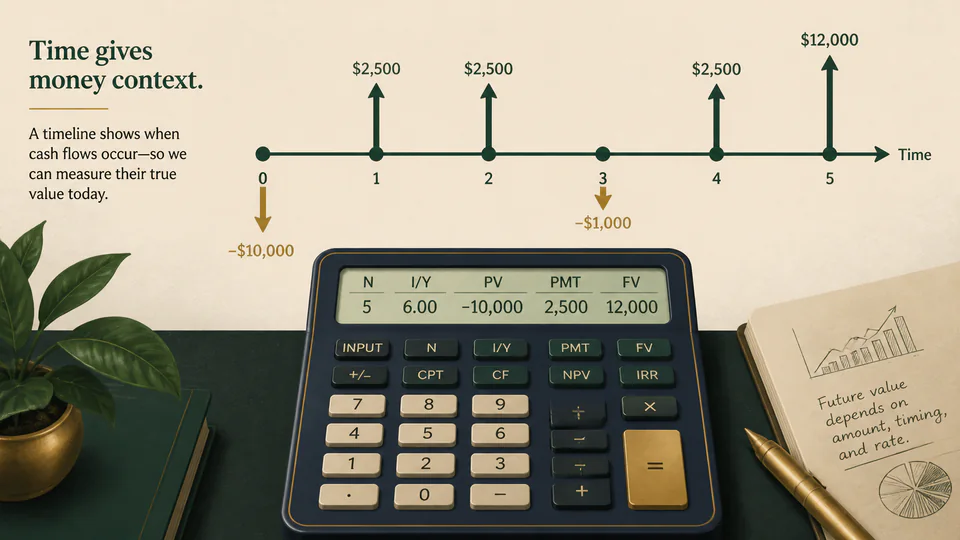
Imagine a horizontal line marked 0, 1, 2, 3. A payment at time 0 is not interchangeable with the same payment at time 3. The calculator needs to know the period count, the rate, and the direction of each cash flow.
TI describes the BA II Plus TVM keys as variables for number of periods, annual interest rate, present value, payment, and future value. This vocabulary is a deliberate design choice: it makes the timeline explicit enough for a loan, annuity, mortgage, or savings problem.
Present value is a trip backward
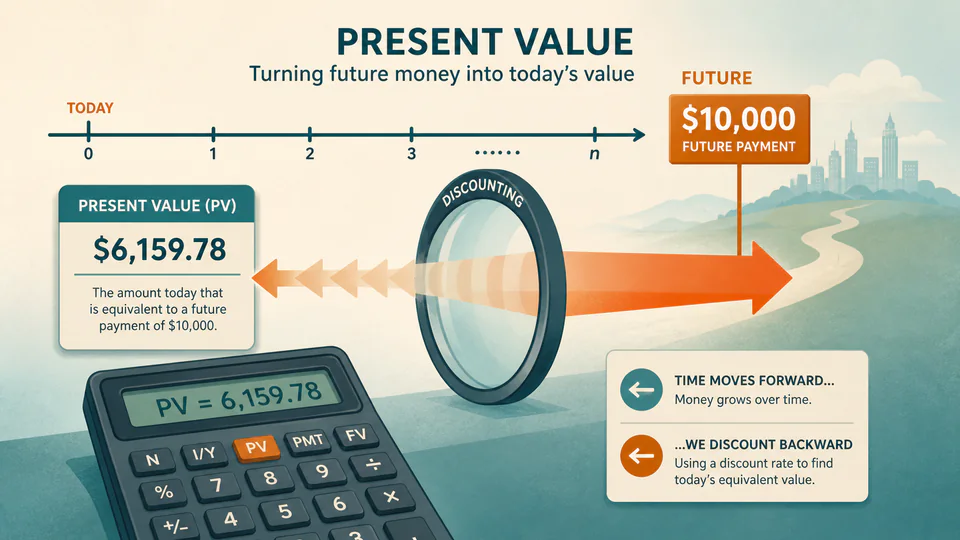
Interest grows a present amount forward. Present value reverses that trip: it asks what a future amount is worth at an earlier point when a rate is applied. The calculator is not judging the money. It is changing the time coordinate used to compare it.
The sign convention matters too. A loan can be entered as money received now and payments leaving later. A savings problem may reverse those directions. The calculator needs a consistent story about inflows and outflows before its answer has financial meaning.
Beginning and end are not the same setting
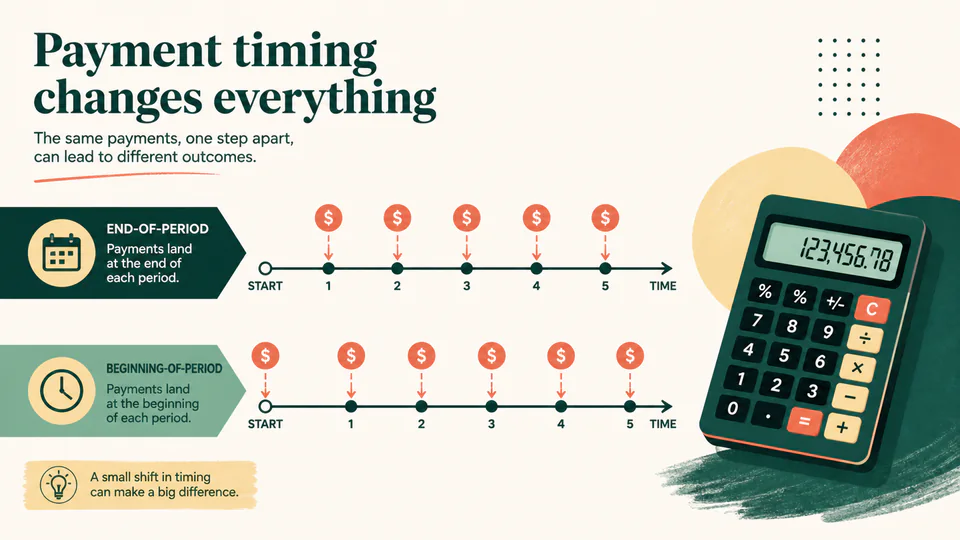
An annuity paid at the end of each period is shifted one step later than an annuity paid at the beginning. TI exposes this as an END or BGN setting because the payment timing changes the result without changing the payment amount.
A financial calculator is less a pocket calculator than a small clock for money.