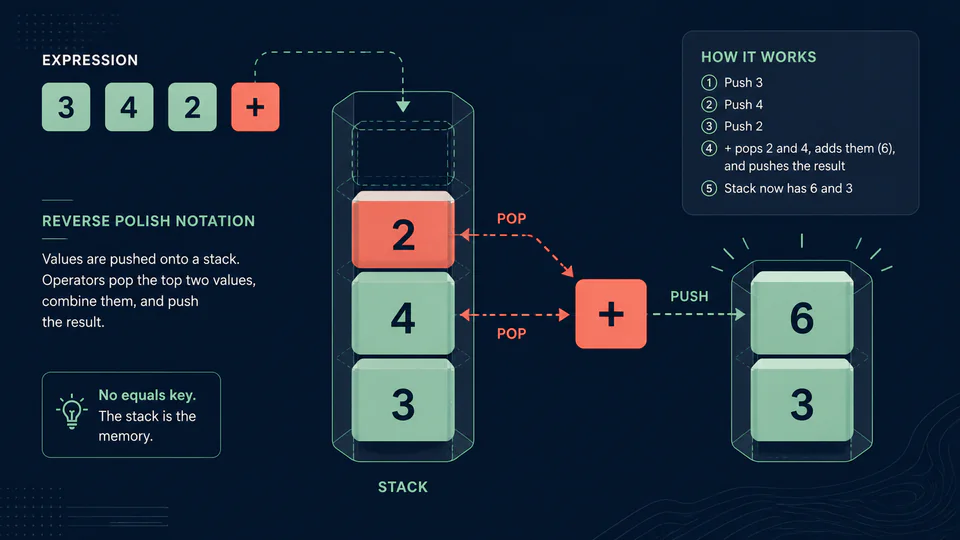
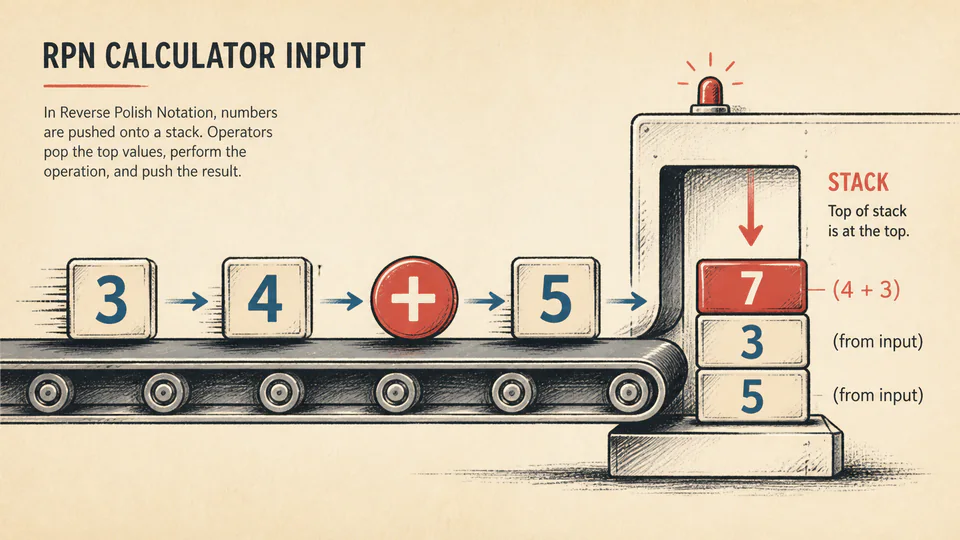
The expression (3 + 4) x 2 contains a small instruction to the calculator: finish the parentheses first. An RPN calculator records the same structure without drawing the parentheses. You enter 3 ENTER 4 + 2 x. The intermediate result, 7, sits on the stack until multiplication needs it.
RPN is not ordinary notation written backwards. It is a different way to store unfinished work. Algebraic notation keeps structure in symbols and precedence rules. RPN keeps structure in a last-in, first-out stack.
Follow the stack one key at a time
On a classic four-level HP-style stack, the display shows the X-register. Values waiting behind it occupy Y, Z, and T. ENTER separates consecutive numbers and lifts the earlier value into the stack.
For (3 + 4) x 2:
The stack is not a queue. A queue removes the oldest item first. RPN operators work from the most recently available operands at the top of the stack.
Parentheses become timing
Consider a less friendly expression:
(8 + 2) / (7 - 5)
An RPN sequence is:
The first + creates 10 and leaves it waiting. The - creates 2 above it. Division then consumes Y and X as Y / X, producing 10 / 2 = 5. The grouping is encoded by when each operator is pressed.
Operand order still matters
Addition hides many input mistakes because 3 + 4 equals 4 + 3. Subtraction and division expose them.
The operator is postfix, but the operands keep their mathematical order. For a two-number operation, the older value is usually in Y and the newer value is in X. If the result is the reciprocal of what you expected, inspect that order before blaming the arithmetic.
What RPN helps, and what it demands
RPN can make long chains economical when the user understands the stack. It can also be unforgiving when a value is entered in the wrong order or when the user cannot see deeper registers. The trade is not “expert notation versus beginner notation.” It is one representation of structure versus another.
HP’s HP 12C documentation describes X as the displayed register and explains how ENTER preserves a number in Y while lifting earlier stack contents. It also documents Last X and stack reordering operations, which make the stack a working memory rather than a decorative display.
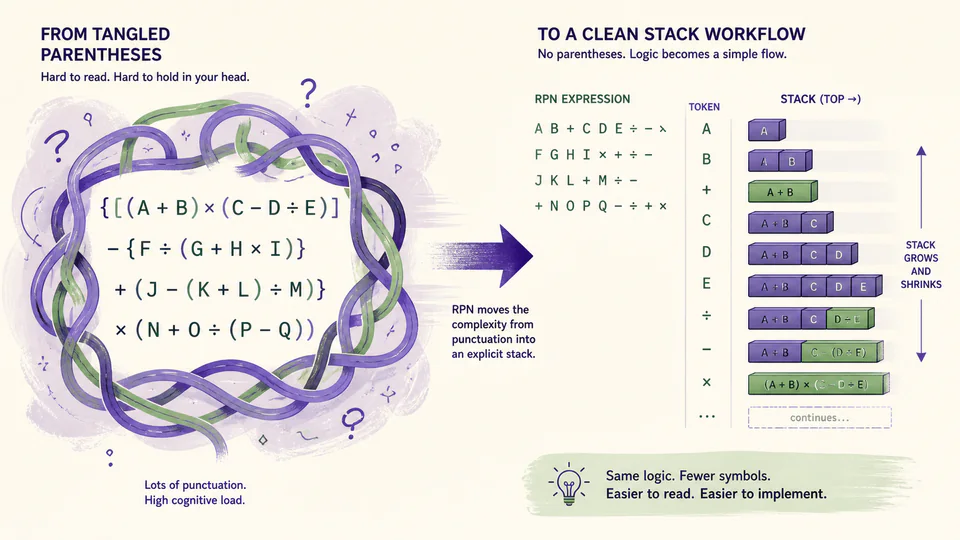
RPN becomes readable when you stop reading it as a sentence and start watching values enter, wait, and combine.