In 1971, buying a handheld calculator could feel less like picking up stationery and more like buying a serious appliance. Early models performed only four operations, cost hundreds of dollars, and advertised portability as a technological marvel. Less than a decade later, a basic calculator could cost about as much as lunch.
That collapse in size and price was not a single invention. It was a chain reaction involving integrated circuits, displays, batteries, manufacturing, and a fierce argument about what a calculator ought to be. The result did more than replace desk machines. It helped establish the expectation that useful computing should travel with its owner.
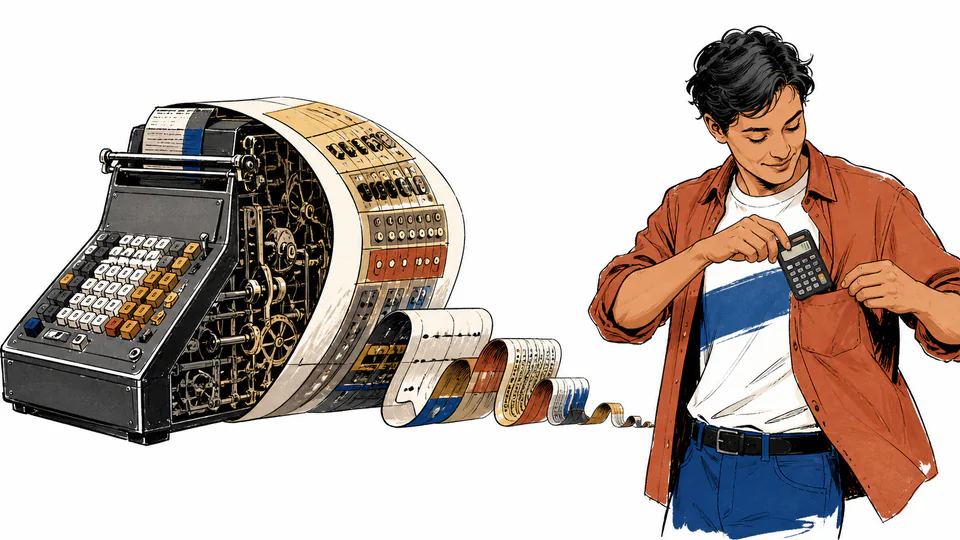
When calculation was furniture
Before handheld electronics, fast arithmetic usually belonged to a place: a bank counter, an engineering office, an accounting department, or a laboratory. Mechanical calculators could add columns and perform multiplication through repeated motion, but they were heavy assemblies of keys, gears, registers, and cranks. Electronic desktop calculators removed much of the mechanical labor in the 1960s, yet many were still substantial and expensive machines.
Portability already existed in other forms. A slide rule fit in a case. An abacus could be carried to a market. Paper tables put precomputed values in a book. But each tool asked the user to participate in the method. A four-function electronic calculator promised something different: enter numbers, press an operation, and receive digits immediately.
The obstacle was not the arithmetic. Engineers already knew how to build electronic adders. The obstacle was fitting logic, storage, keys, power, and a readable display into a package that could survive daily handling and sell in large numbers.
The prototype that proved a hand could hold it
At Texas Instruments, Jack Kilby and colleagues designed a handheld four-function prototype in 1967. It used a small paper-tape printer rather than the familiar glowing display. The object was not yet a mass-market pocket calculator, but it demonstrated the key proposition: integrated circuits could compress a consumer calculating machine into a palm-sized package.
By 1971, commercial handhelds were reaching buyers. The Computer History Museum identifies the Bowmar Brain as the first mass-market handheld and records its original price at $245. Busicom’s Handy LE-120A, introduced in the same era, brought together the processor, display, keys, battery, and memory that would also become the basic anatomy of later handheld computers.
Calling these machines “pocket” devices sometimes required an optimistic pocket. Their importance was not perfect smallness; it was the direction of travel. Every product generation made the old assumption—that serious calculation required a desk—look less secure.
| Year | Turning point | Why it mattered |
|---|---|---|
| 1967 | Texas Instruments demonstrates a handheld four-function prototype. | The room-sized idea becomes a physical engineering target. |
| 1971 | Mass-market handhelds reach buyers. | Electronic arithmetic starts moving out of offices and into pockets. |
| 1972 | The HP-35 carries scientific functions beyond the desk. | Logarithms and trigonometry become practical during field work. |
| 1973 | Low-power LCDs begin making everyday portability practical. | Longer battery life helps the calculator stay ready instead of staying precious. |
The scientific calculator changes the contest
Four-function arithmetic was only the beginning. In 1971, Hewlett-Packard co-founder Bill Hewlett challenged his engineers to place the capabilities of a desktop scientific calculator into his shirt pocket. The resulting HP-35 arrived in 1972. It had 35 keys, weighed about nine ounces, and sold for $395.
Its price made it a professional instrument, not an impulse purchase. Yet more than 100,000 units sold in the first year, according to the Computer History Museum. Scientists and engineers could evaluate logarithms and trigonometric functions without consulting printed tables or reading a slide-rule scale. The HP-35 did not merely make an existing calculator smaller; it changed which methods felt practical during real work.
Texas Instruments answered with machines such as the SR-50. Competition expanded functions while pressing prices downward. Programmability soon entered the pocket too: the HP-65 stored programs on magnetic cards, while later models offered removable modules and larger program memories.
Displays mattered as much as chips
Early light-emitting-diode displays were crisp and dramatic, but they consumed precious battery power. Liquid-crystal displays needed far less energy and could remain visible without producing their own light. The Sharp EL-805, introduced in 1973, is described by the Computer History Museum as the first pocket calculator with an easy-to-read LCD instead of red LEDs.
This sounds like a display footnote. In a handheld product, it was a lifestyle feature. Lower power meant longer battery life, thinner cases, and less anxiety about whether the machine would be ready when needed. Solar cells later pushed the same logic further: a calculator could be treated as a durable everyday object rather than a tiny appliance demanding frequent attention.
LED era
Bright, crisp, power-hungry
Glowing red digits made electronic calculation feel immediate, but battery life limited how casually the machine could travel.
LCD shift
Quiet display, longer life
Lower power consumption helped cases become thinner and turned the calculator into a tool that could simply stay ready.
From $245 to roughly $10
Integrated circuits improved, component counts fell, manufacturing volumes rose, and competition intensified. The Computer History Museum summarizes the speed of the change neatly: the first mass-market handheld cost $245 in 1971, while similar calculators sold for about $10 within a decade.
That price collapse changed the social identity of the calculator. It moved from executive desks and engineering cases into grocery shops, kitchens, classrooms, workshops, and promotional giveaways. Once arithmetic became cheap, instant, and portable, debates followed. Would students lose number sense? Would slide-rule skills vanish? Which examinations should permit calculators? Those questions were evidence of success: the machines had become ordinary enough to influence education and culture.

A small ancestor of every handheld computer
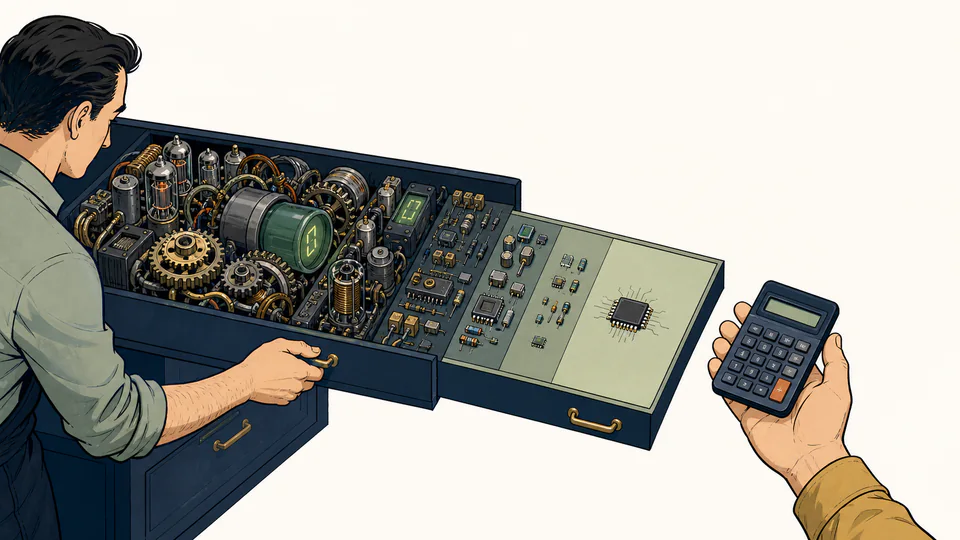
A pocket calculator is not a smartphone in disguise. Its interface is narrow, its memory is limited, and its purpose is explicit. But the calculator established a durable product grammar: processor, display, keyboard, battery, memory, and a case designed to live close to the body.
Later electronic organizers added clocks, alarms, schedules, and address books. Programmable calculators blurred into pocket computers. The most important inheritance may be psychological. After calculators, people increasingly expected computing to be immediate, personal, and available wherever a question occurred.
The room did not literally shrink into a hand. The infrastructure of the room—logic, display, power, manufacturing precision—was redesigned until the hand became the natural place to put it.