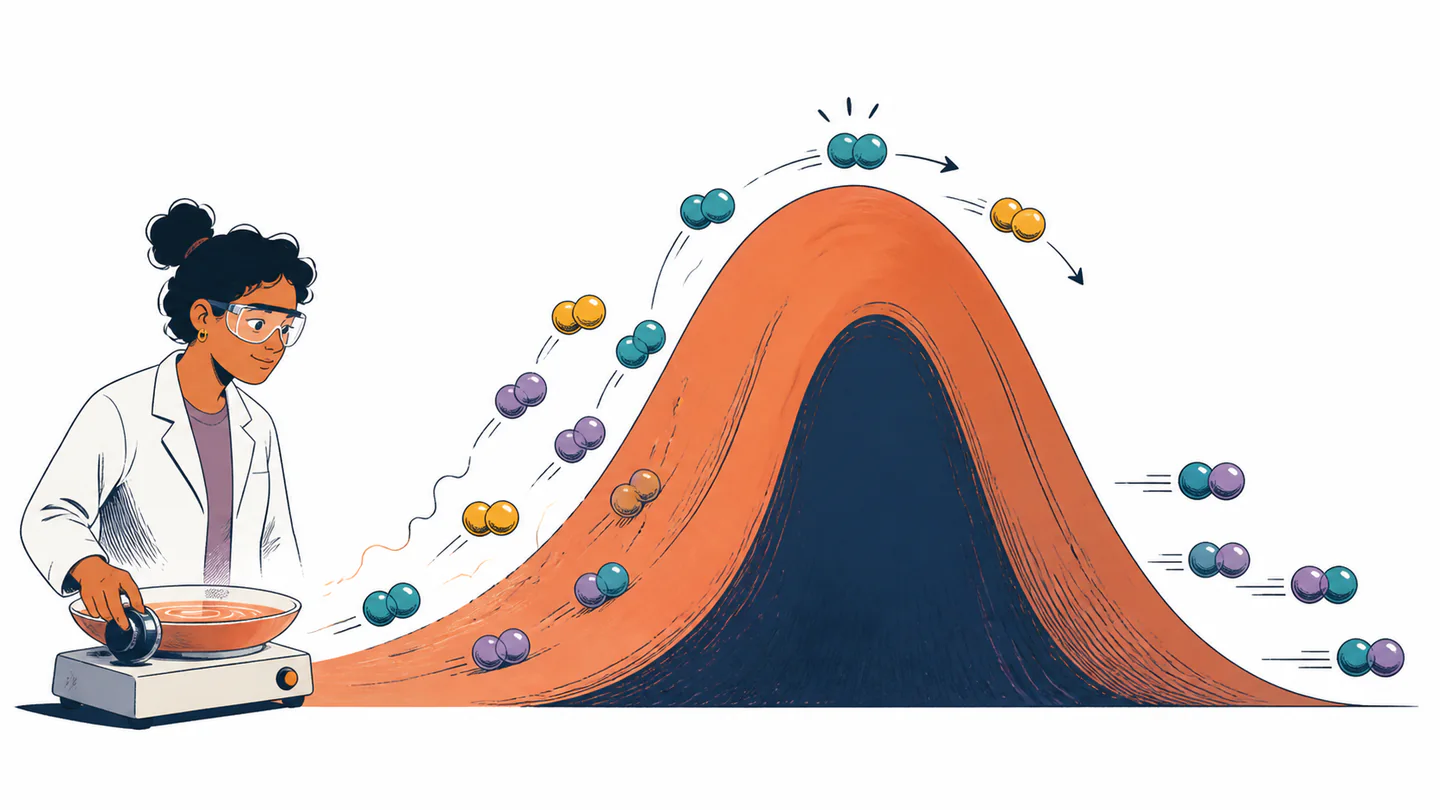
A reaction mixture can look unchanged while its microscopic traffic has transformed. Raise the temperature and molecules move through a wider range of energies; more encounters may reach configurations that can become products. The Arrhenius equation turns that temperature sensitivity into a compact exponential model.
Its compactness invites shortcuts. Temperature entered in degrees Celsius, activation energy left in kilojoules beside a joule-based gas constant, or a rate coefficient mistaken for the whole reaction rate can produce a plausible-looking but meaningless number. Arrhenius is most useful when its units, fitted range, and empirical status stay visible.
k = A exp(−Ea / RT)Temperature changes the exponential factor; the original simple form treats A and Ea as constant over the fitted range.
Every symbol carries a condition and a unit
The IUPAC Gold Book defines the Arrhenius equation as a relationship between a rate coefficient and thermodynamic temperature. It separately calls activation energy an empirical parameter. That wording matters: the equation summarizes how a measured k changes; it does not by itself identify a molecular mechanism.
The exponent must be dimensionless:
J mol−1(J mol−1 K−1)(K)dimensionlessUsing R = 8.31446261815324 J mol−1 K−1 from NIST’s 2022 CODATA adjustment means an activation energy reported in kilojoules per mole must first be multiplied by 1000. A temperature such as 25 °C must become 298.15 K. A 10 °C interval equals 10 K, but an absolute temperature of 10 °C is not 10 K; the BIPM SI Brochure distinguishes those two ideas.
A rate coefficient is not the complete reaction rate
For a concentration-based rate law such as rate = k[A]m[B]n, Arrhenius models k. Concentrations and reaction orders remain in the rate law. If the total order is m + n, the unit of k changes so the final rate retains concentration per time.
k, A: M s−1k, A: s−1k, A: M−1 s−1There is no universal unit for k or A. Pressure-based, surface, number-density, and other kinetic conventions use other units. IUPAC’s definition of reaction order and the OpenStax rate-law treatment supply the link between exponents and coefficient units.
Compare two temperatures without knowing A
For the same fitted model at two temperatures, divide one Arrhenius equation by the other. The pre-exponential factor cancels:
ln(k2/k1) = (Ea/R)(1/T1 − 1/T2)k2 = k1 exp[(Ea/R)(1/T1 − 1/T2)]Ea = R ln(k2/k1) / (1/T1 − 1/T2)The logarithm is legitimate because k2/k1 is dimensionless when the coefficients use the same unit. A useful sign check follows immediately: for positive Ea, if T2 > T1, then 1/T1 − 1/T2 is positive and k2/k1 should exceed one.

Worked example 1: predict k after a 10 K increase
Suppose a first-order reaction has Ea = 50.0 kJ mol−1 and k1 = 2.50 × 10⁻³ s−1 at T1 = 298.15 K. Predict the coefficient at T2 = 308.15 K.
50.0 kJ mol−1 = 50,000 J mol−1(50,000 / 8.314462618)(1/298.15 − 1/308.15) = 0.654543981k2/k1 = e0.654543981 = 1.924264816k2 = (2.50 × 10⁻³)(1.924264816) = 4.81066 × 10⁻³ s−1Substituting the unrounded k2 into the activation-energy rearrangement returns 50,000 J mol−1. The example also disproves a common shortcut: this particular 10 K increase multiplies k by about 1.92, not exactly two.
Worked example 2: infer Eₐ and A from two measurements
For an overall second-order reaction, suppose k1 = 0.150 M−1 s−1 at 300.0 K and k2 = 1.20 M−1 s−1 at 340.0 K. The ratio is 8.00.
Ea = 8.314462618 ln(8.00) / (1/300.0 − 1/340.0) = 44,088.1 J mol−1 = 44.09 kJ mol−1A = k1 exp(Ea/RT1) = 7.11797 × 10⁶ M−1 s−1k(320.0 K) = A exp[−Ea/(R·320.0)] = 0.45275 M−1 s−1Forward substitution at 300.0 K and 340.0 K recovers 0.150 and 1.20 M−1 s−1. The units of A match the second-order coefficient; reporting it in s−1 would silently change the rate law.
Why “10 °C doubles the rate” is not a law
OpenStax describes approximate doubling for many homogeneous reactions as a useful observation, not a universal identity. The multiplier also depends on activation energy and the starting temperature. From 25 °C to 35 °C:
| Ea | temperature interval | predicted k₂/k₁ |
|---|---|---|
| 40 kJ mol−1 | 298.15 → 308.15 K | 1.688 |
| 50 kJ mol−1 | 298.15 → 308.15 K | 1.924 |
| 80 kJ mol−1 | 298.15 → 308.15 K | 2.850 |
Exact doubling over that specific interval would require Ea ≈ 52.949 kJ mol−1. Change the starting temperature and the required value changes too. Moreover, Arrhenius predicts a change in k; the observed rate can also move because concentrations, phases, or other conditions changed.
The straight-line plot is a test, not a guarantee
Taking logarithms gives a linear form. Strictly, a logarithm needs a dimensionless argument, so choose a fixed reference coefficient k° with the same unit as k:
ln(k/k°) = −(Ea/R)(1/T) + ln(A/k°)Textbooks often write ln k as shorthand after fixing a unit. Changing from s−1 to min−1 multiplies every numerical coefficient by 60, shifting the intercept by ln 60; the slope and inferred Ea stay unchanged. If the horizontal axis uses 1000 K/T instead of 1/T, the slope also changes by a factor of 1000, so axis scaling must be stated.

Where the simple model stops earning trust
A fit belongs to the measured interval. NIST kinetics records publish expressions with explicit ranges rather than promising unlimited extrapolation.
The simple form assumes one A and one Ea. IUPAC also defines modified forms when temperature dependence needs more structure.
Phase, solvent, pressure regime, catalyst state, mixing, diffusion, and the rate-law definition must remain comparable.
Curvature proves that one constant slope is inadequate. It does not by itself prove which step, pathway, or transport process changed.
Narrow temperature ranges create a second problem: the small spread in 1/T makes the fitted slope sensitive to scatter, while A is extrapolated to the distant intercept at 1/T = 0. Fitted A and Ea can therefore be strongly correlated. Report the range and uncertainty when they are available, and do not treat a precise-looking intercept as independent molecular evidence.
The NIST Chemical Kinetics Database illustrates the right reporting habit: an Arrhenius expression appears with reaction order, units, and a fitted temperature interval. A usable calculation carries those conditions forward. It can interpolate compatible data, compare sensitivities, and expose a model’s assumptions. It cannot certify a mechanism, replace the rate law, or make an extrapolation safe merely because the exponential returns a number.