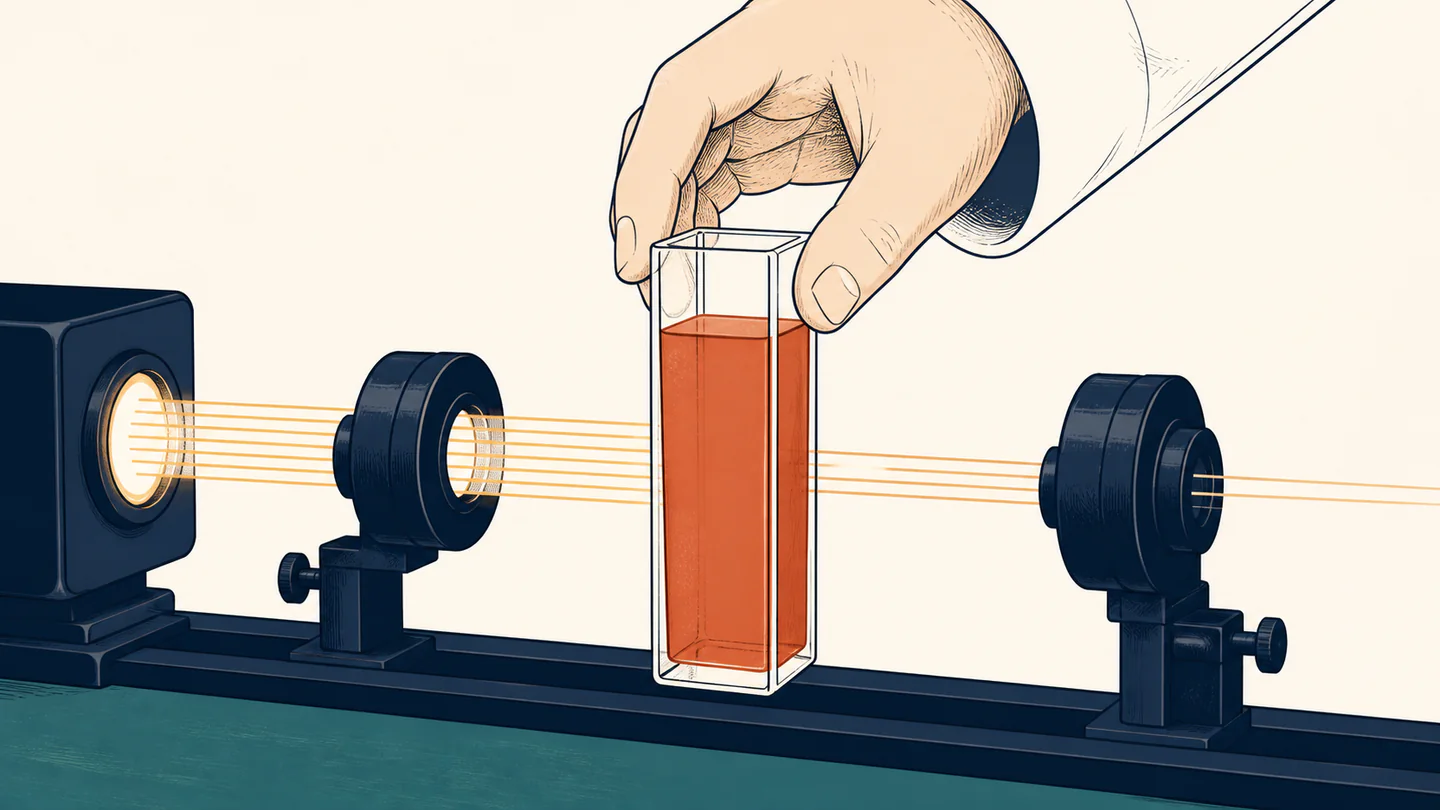
Light passing through a solution is not simply “weaker.” For a controlled optical measurement, the fraction that survives contains quantitative information about how much of a particular absorber sits in the light path. Beer–Lambert turns that attenuation into a concentration calculation—but only after wavelength, path length, blank, and sample behavior have been made explicit.
A = −log10T = log10(I0/I) = ελbcT = I/I0 = 10−A. Absorbance and transmittance are ratios, not units of light.
The terms must describe the same measurement
With these common solution units, everything cancels. A coherent SI version uses ε in m² mol⁻¹, b in m, and c in mol m⁻³. The logarithm only accepts the dimensionless ratio I/I₀.
Why the logarithm appears
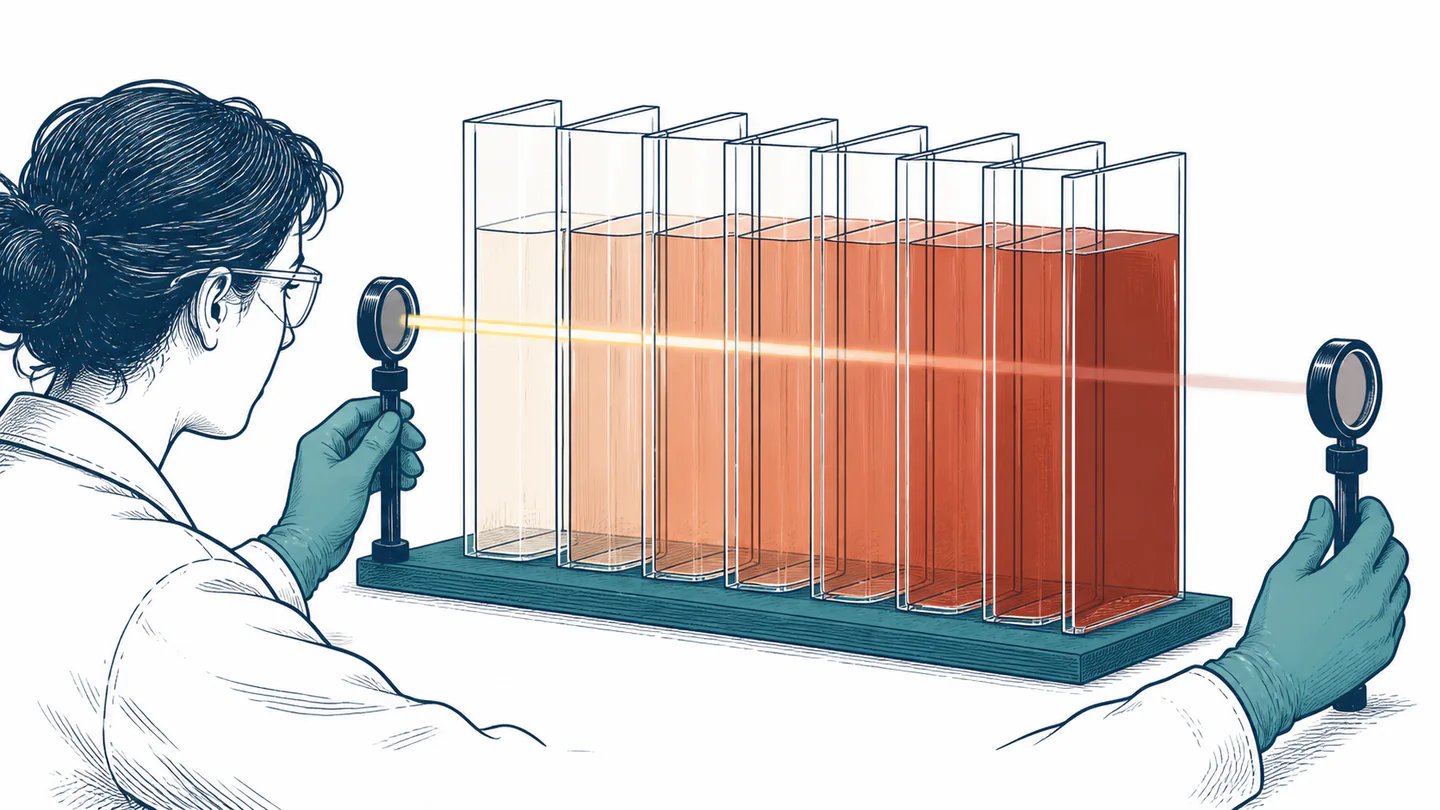
Imagine a beam crossing successive thin layers. Each layer removes a fixed fraction of the light that reaches it, so dI = −kcI dx. Integrating gives ln(I/I₀) = −kcb. Converting to base ten produces A = εbc, where ε = k/ln 10.
Match blank, cuvette, wavelength, and instrument state.
What fraction survives the optical path?
Multiplicative attenuation becomes additive absorbance.
For a valid absorbing system, concentration enters linearly.
Solve the form the instrument gives you
c = A/(εb)c = −log10T/(εb)ε = A/(bc)b = A/(εc)Do not substitute a natural log into a tabulated decadic ε. A Napierian attenuation coefficient belongs with T = e−κbc; it differs by a factor of ln 10.
Worked example 1: predict absorbance and transmission
At one chosen wavelength, take ε = 1.50 × 10⁴ L mol⁻¹ cm⁻¹, b = 1.00 cm, and c = 2.00 × 10⁻⁵ mol L⁻¹.
The reverse check is −log10(0.501187) = 0.300000. The coefficient here is illustrative; a real analysis needs a calibration or condition-matched reference.
Worked example 2: recover concentration from T
An instrument reports T = 0.250000 through a 0.500 cm cell. A matched calibration supplies ε = 2.00 × 10⁴ L mol⁻¹ cm⁻¹.
A = −log10(0.250000) = 0.602060c = 0.602060 / [(2.00 × 10⁴)(0.500)] = 6.02060 × 10⁻⁵ mol L⁻¹(2.00 × 10⁴)(0.500)(6.02060 × 10⁻⁵) = 0.602060The number is valid only while the calibration transfers to this sample matrix and range.
The boundary is part of the measurement
Collimated, narrow-band light; a homogeneous isotropic absorber; stable chemical form; matched blank; and a verified linear calibration range.
Particles, bubbles, emulsions, rough optics, and fluorescence can change detector signal without following molecular absorption.
Unabsorbed light reaching the detector commonly biases high-absorbance readings low; changing ε cannot repair the instrument effect.
A single reading constrains εbc. Overlapping absorbers, purity, chemical form, and mechanism need spectra, standards, or separation.
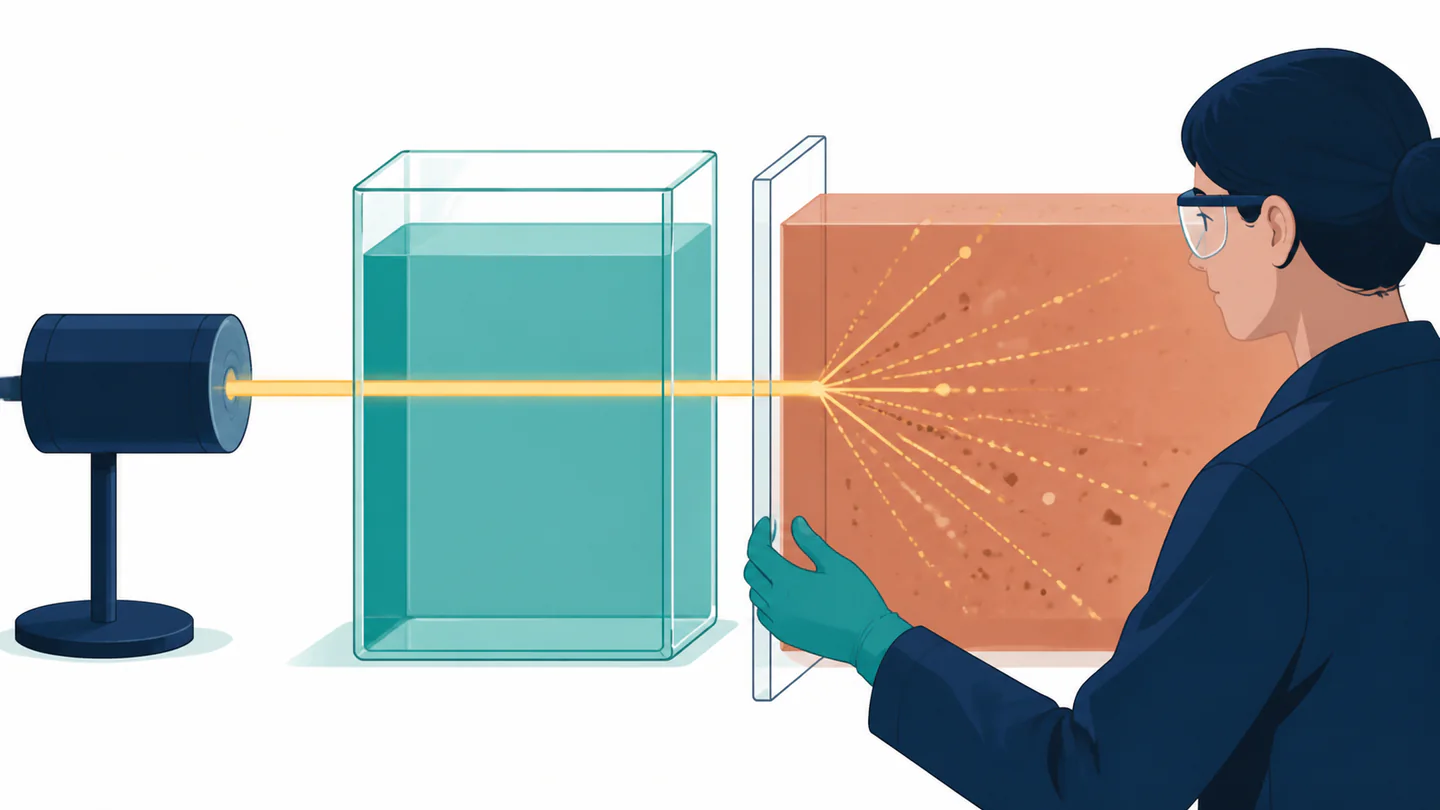
Beer–Lambert is powerful because it converts a carefully defined optical ratio into a linear concentration relation. It cannot certify that the light was monochromatic, the sample was homogeneous, the chemistry unchanged, or the detector free of stray light. Those checks turn a convenient formula into an analytical measurement.
Four checks before reporting a concentration
Match the blank. The reference must contain the solvent, cuvette, and matrix components that are not the analyte. A lamp reading from another time cannot correct solvent absorption, window contamination, or drift.
Choose the wavelength deliberately. Use a stated wavelength with useful response and controlled interferences. A broad band crossing a structured feature no longer has one stable coefficient.
Test the calibration range. Prepare standards that bracket the sample and inspect whether the measured relationship is linear. The range is an experimental property of the chemistry and instrument, not a default entitlement of the formula.
Keep signal credible. Near zero absorbance, a tiny difference between two large signals dominates uncertainty. At very high absorbance, little transmitted light remains and stray light becomes influential. Dilution or a shorter path can be more defensible than extrapolation.
For mixtures that genuinely obey independent absorption, absorbances can add: Atotal = bΣ εici. That does not identify several unknown compounds from one wavelength. Full spectra, multiple wavelengths, standards, or separation supply information that a single absorbance cannot.