A number can look impeccably precise and still be impossible. A report may claim an energy in kilograms, a speed in square metres per second, or a force produced by adding metres to seconds. The arithmetic can be flawless; the physical statement is not.
Dimensional analysis gives units an active role. Before accepting a formula or pressing calculate, translate each quantity into a small vocabulary of base dimensions—mass, length, time, electric current, temperature, amount of substance, and luminous intensity—and see whether the expression can possibly end with the kind of quantity being claimed. It is not a substitute for a model. It is the inexpensive inspection at the door.

The rule in its shortest useful form
Physical equations may equate, add, or subtract quantities only when their dimensions match. Multiplication and division create new dimensions by combining exponents.
[left-hand side] = [right-hand side]For an addition such as A + B, require [A] = [B]. For a product, multiply dimensions; for a quotient, divide them.
The square brackets mean dimension, not a numerical value. Write length as L, mass as M, and time as T. A speed is LT−1; acceleration is LT−2; force is MLT−2. The named SI units may change from centimetres to metres or hours to seconds, but the dimensional relation does not. The BIPM SI Brochure and NIST Special Publication 811 describe this coherent SI framework.
Unit anatomy: dimensions are not unit labels
vm/s = LT−1
am/s² = LT−2
FN = kg·m/s² = MLT−2
EJ = kg·m²/s² = ML²T−2
“Kilometres per hour” and “metres per second” are different units but the same dimension, so conversion is allowed. “Metres per second” and “metres per second squared” are different dimensions, so treating one as the other is a model error, not a conversion issue.
A formula check: gravity has to end in acceleration
For a small test mass near a spherical body, the Newtonian gravitational acceleration is g = GM / r². Here G is the gravitational constant, M the attracting mass, and r the centre-to-centre distance. In SI units, [G] = m³·kg−1·s−2.
[g] = (m³·kg−1·s−2)(kg) / m²= m³·s−2 / m²= m·s−2m/s² is acceleration, exactly as required.The check catches an accidental missing square on r: GM/r ends in m²/s², the dimensions of specific energy, not acceleration. It cannot prove the inverse-square law is the right model, but it can prove that the mistyped version cannot produce g.
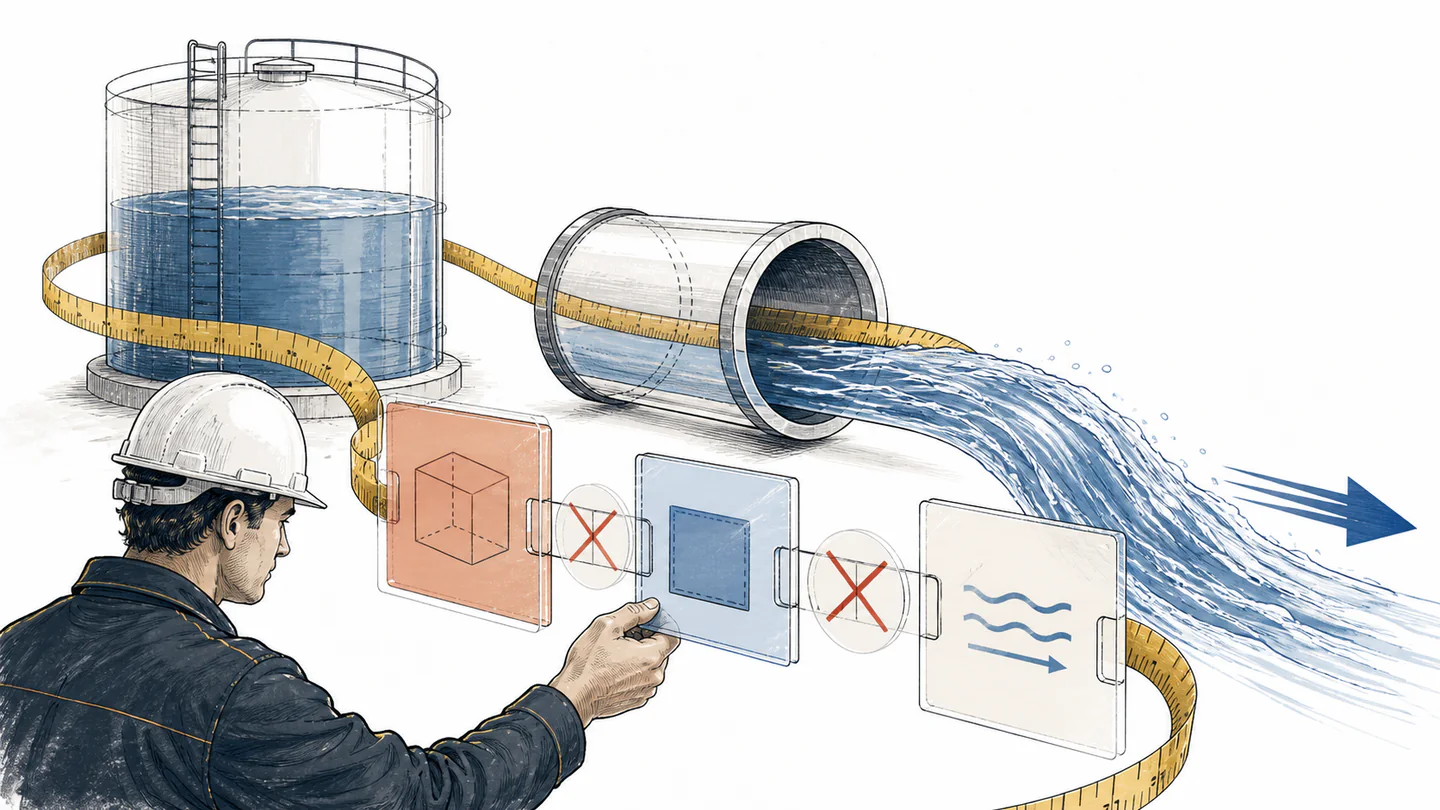
Worked example 1: turn a road speed into an energy check
A 1,500 kg car travels at 72 km/h. What kinetic energy should appear in SI units?
72 km/h × (1,000 m / 1 km) × (1 h / 3,600 s) = 20 m/sThe km and h cancel; speed is now in SI.
E = ½mv² = ½(1,500 kg)(20 m/s)²= 300,000 kg·m²/s²
E = 300,000 J = 300 kJA joule is kg·m²/s², so the result has energy dimensions.
If 72 is inserted without conversion, the arithmetic returns a number carrying kg·km²/h², not joules. It is an energy unit in principle, but not the SI quantity claimed by a display labelled J. Conversion factors are ratios equal to one, so they change representation without changing the physical speed.
Worked example 2: from pipe diameter to a flow rate
Water moves at an average speed of 2.00 m/s through a circular pipe of inside diameter 50.0 mm. Find the volume flow rate.
D = 50.0 mm × (1 m / 1,000 mm) = 0.0500 mA = πD²/4 = π(0.0500 m)²/4 = 0.0019635 m²Q = Av = (0.0019635 m²)(2.00 m/s)= 0.0039270 m³/sQ = 3.93 L/sBecause 1 m³ = 1,000 L. The dimensions m² × m/s become m³/s, volume per time.
The tempting mistake is to use 0.0500 as a radius, which makes the area—and therefore flow—four times too large. Dimensional analysis will not catch it: radius and diameter are both lengths. A unit check is a necessary filter, not a geometry tutor.
The conversion ledger: write every cancellation once
| Goal | Safe move | Quick audit |
|---|---|---|
| Convert 90 km/h to m/s | 90 × 1,000 m/1 km × 1 h/3,600 s | km and h cancel; result is 25 m/s. |
| Convert 2.5 L/min to m³/s | 2.5 × 10⁻³ m³/L × 1 min/60 s | L and min cancel; result is 4.17 × 10⁻⁵ m³/s. |
| Square a converted length | Convert first, then square the whole quantity. | (100 cm)² = (1 m)²; do not convert only one factor. |
| Add measurements | Convert to one unit before adding. | 2 m + 30 cm = 2.30 m, not 32 m. |
NIST’s Guide for the Use of the International System of Units emphasises coherent unit use and unambiguous symbols. Keep units in every intermediate line until they have genuinely cancelled. A bare number loses the evidence needed to debug it.
What this method catches—and what slips through
Adding incompatible quantities, missing or extra powers of time or length, inverted conversion factors, and a result reported in the wrong physical category.
Two dimensionally valid formulas can still make different physical claims. Unit compatibility is necessary, never proof of a mechanism.
A dimensionless coefficient may be 0.01, 1, or 2π. Unit checking cannot discover it, nor can it detect a wrong dimensionless multiplier.
Radians are dimensionless in SI, while degrees need explicit conversion. Temperature differences convert linearly; absolute temperatures cannot be treated like arbitrary offsets.
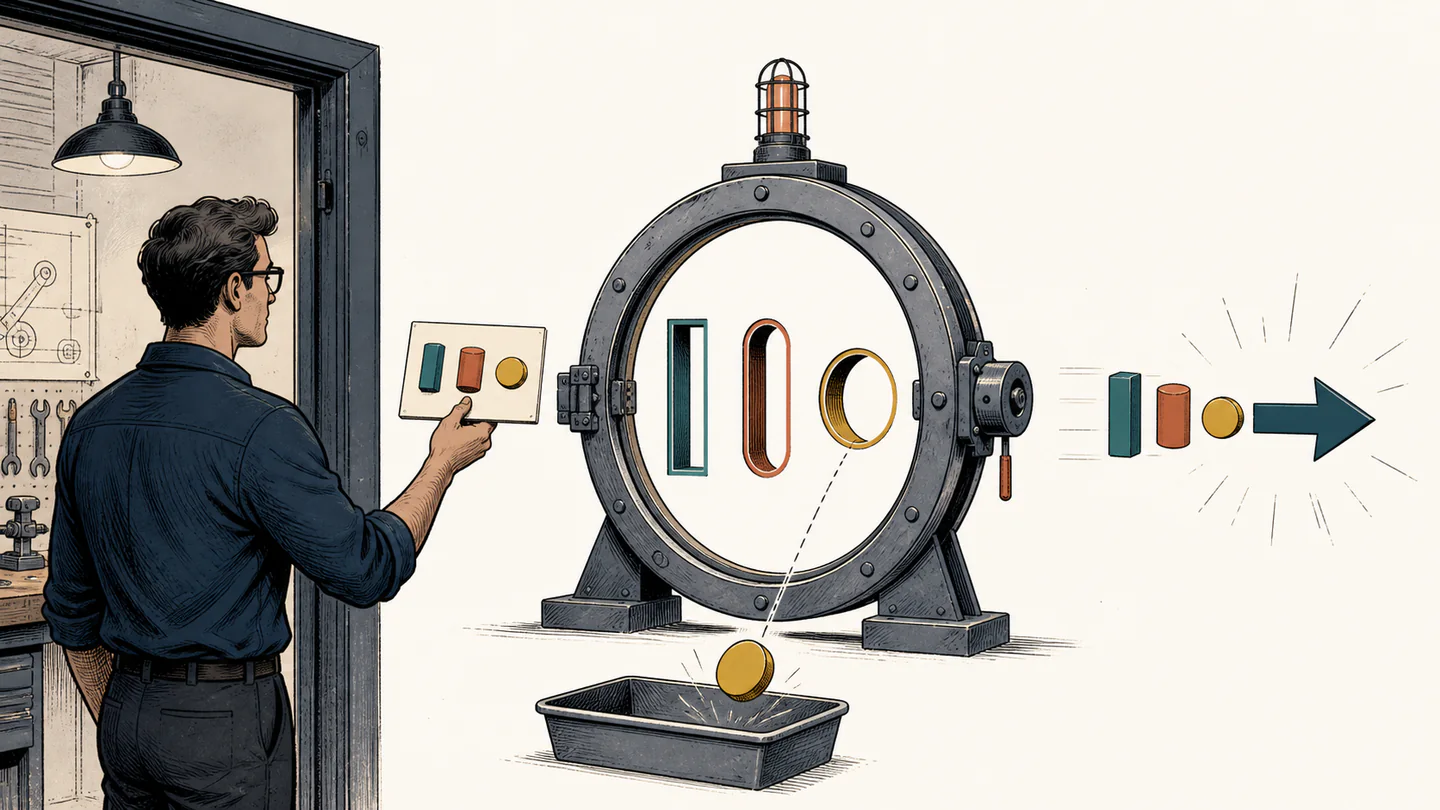
Use dimensional analysis early and often: before a derivation, beside a spreadsheet column, and while reading a result that seems suspiciously neat. It tells you whether a calculation is allowed to mean what it claims. It cannot tell you whether inputs were measured well, whether a turbulent flow may be treated as uniform, or whether the real system follows the chosen equation. Those are separate questions—and why a unit check should be a first gate, not the last word.