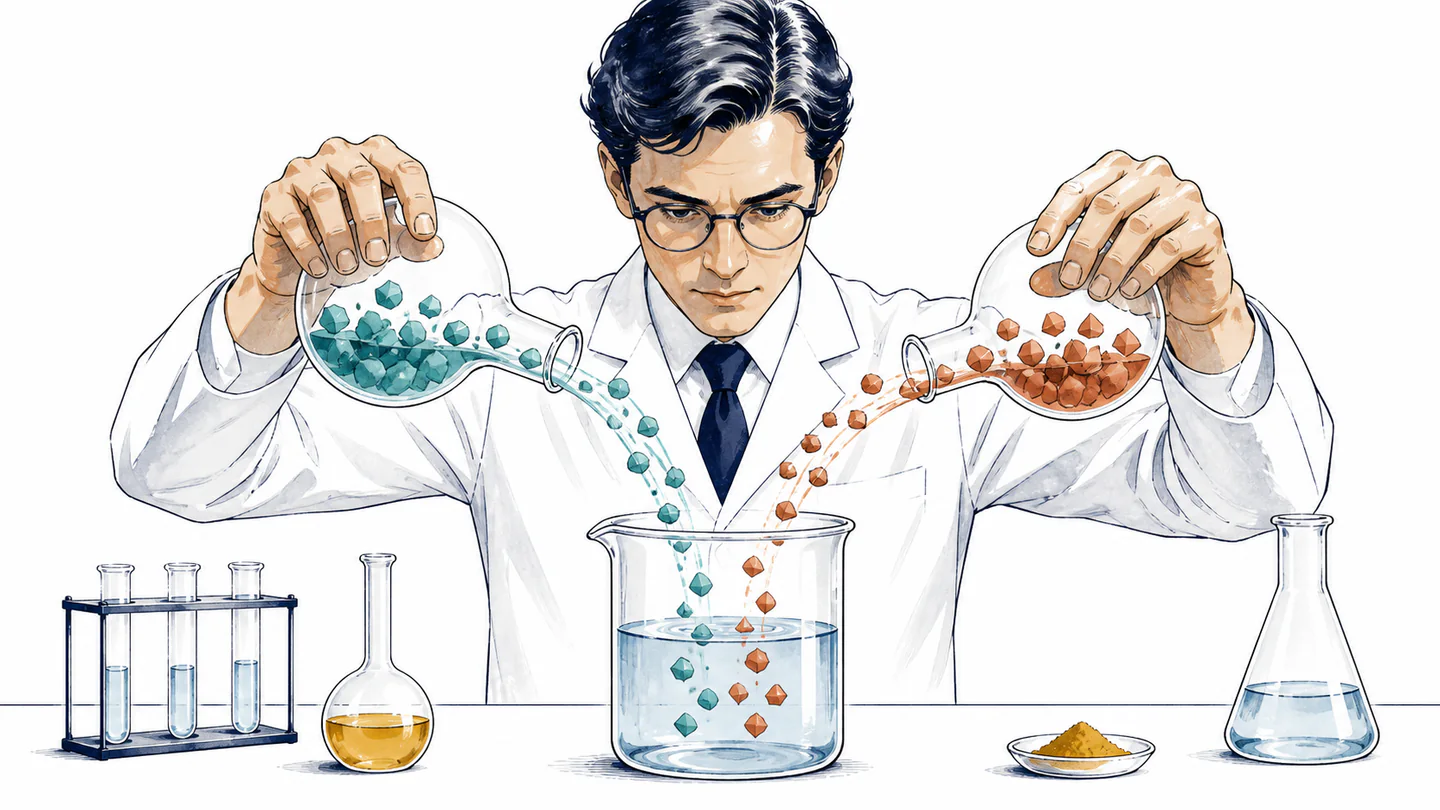
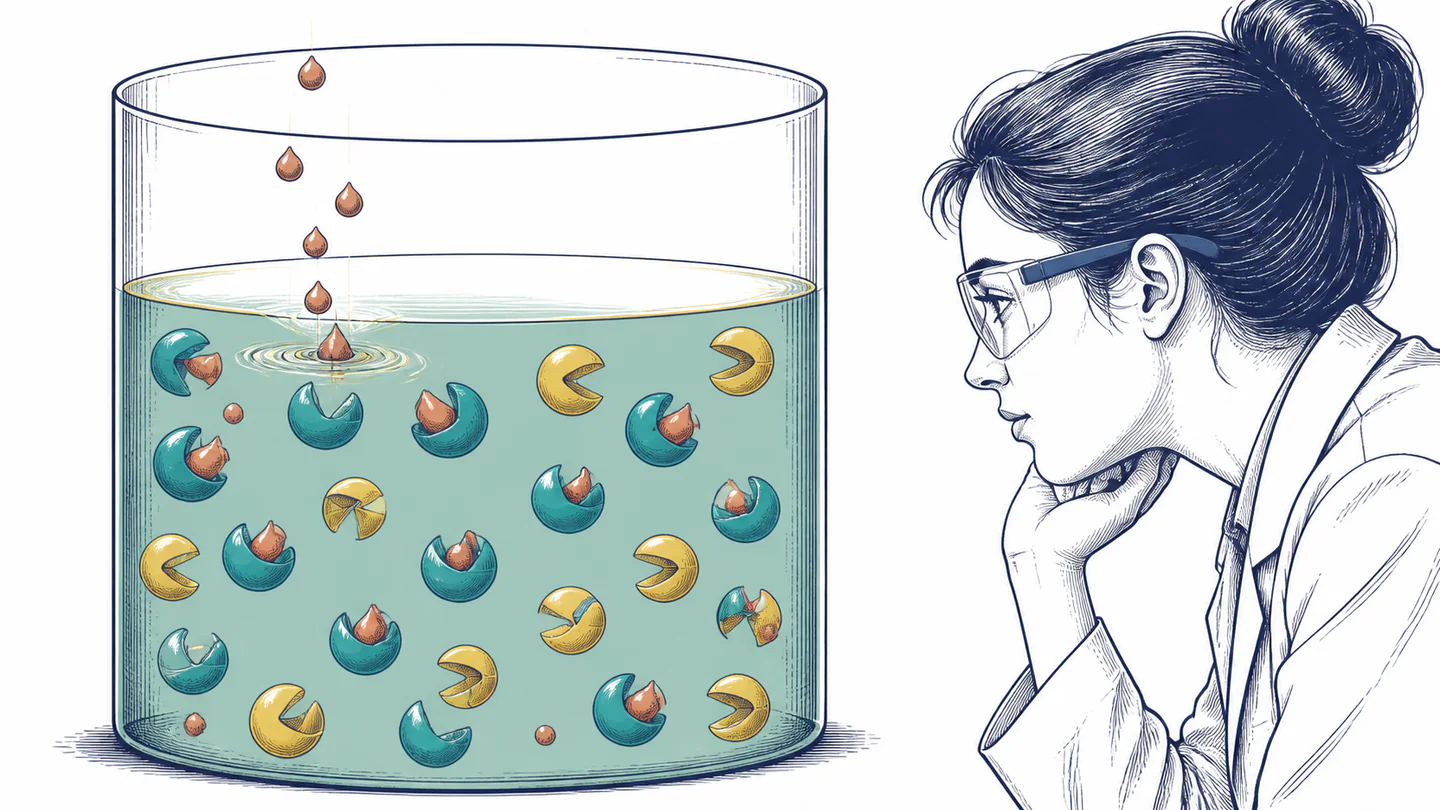
A buffer is not a liquid that refuses to change pH. It is a solution containing two chemical partners ready to trade a proton. The Henderson–Hasselbalch equation tells you where that balance places the pH—provided the acid, its conjugate base, temperature, and activity model are genuinely specified.
pH = pKa + log10(aA−/aHA)The familiar concentration form is an approximation: pH ≈ pKa + log10([A⁻]/[HA]).
What the equation means
The logarithm accepts a ratio of activities, not a dimensional concentration. In a dilute, condition-matched solution, normalized concentration ratios can be a useful proxy. At changing ionic strength, in saline matrices, or in mixed solvents, that shortcut can drift.
Derivation from acid dissociation
For HA ⇌ H⁺ + A⁻, Ka = aH+aA−/aHA. Isolate hydrogen-ion activity and take the negative base-10 logarithm:
aH+ = KaaHA/aA−−log aH+ = −log Ka − log(aHA/aA−)pH = pKa + log(aA−/aHA)The sign provides a fast check: more base than acid means a ratio above one, a positive logarithm, and pH above pKa. More acid reverses that result.
Inverse solves
aA−/aHA = 10pH−pKₐaA− = aHA10pH−pKₐaHA = aA−10pKₐ−pHpKₐ = pH − log(aA−/aHA)These are equilibrium-ratio calculations. They do not tell you how much strong acid or base was needed to make the mixture; that needs material balance, dilution, and additional equilibrium work.
Worked example 1: acetate buffer pH
Use the illustrative dilute-aqueous 25 °C value pKa = 4.76 for acetic acid. If [CH₃COO⁻] = 0.150 M and [CH₃COOH] = 0.0500 M, the approximate ratio is 3.00:
The stated-model answer is pH ≈ 5.24. It is above pKa, as the base-rich ratio requires.
Worked example 2: choose the ratio for a target pH
Target pH 4.46 for the same illustrative pair, with acid-side concentration 0.0800 M under the same dilute approximation:
104.46−4.76 = 10−0.300 = 0.501187[CH₃COO⁻] ≈ (0.0800)(0.501187) = 0.0400950 M4.76 + log₁₀(0.0400950/0.0800) = 4.460000Rounded appropriately, use 0.0401 M conjugate base. This says nothing about buffer capacity: a dilute and a concentrated buffer can share pH while resisting added acid very differently.
Where it stops being enough
pH and pKa are activity concepts. Concentration ratios can fail at substantial ionic strength or changing solvent composition.
Polyprotic acids, complexation, side reactions, and total analytical concentrations need a fuller speciation model.
A tabulated value belongs to a temperature, solvent, and ionic-strength convention; it is not portable without qualification.
The equation does not calculate buffer capacity, kinetics, dilution, or the junction and calibration behavior of a pH electrode.
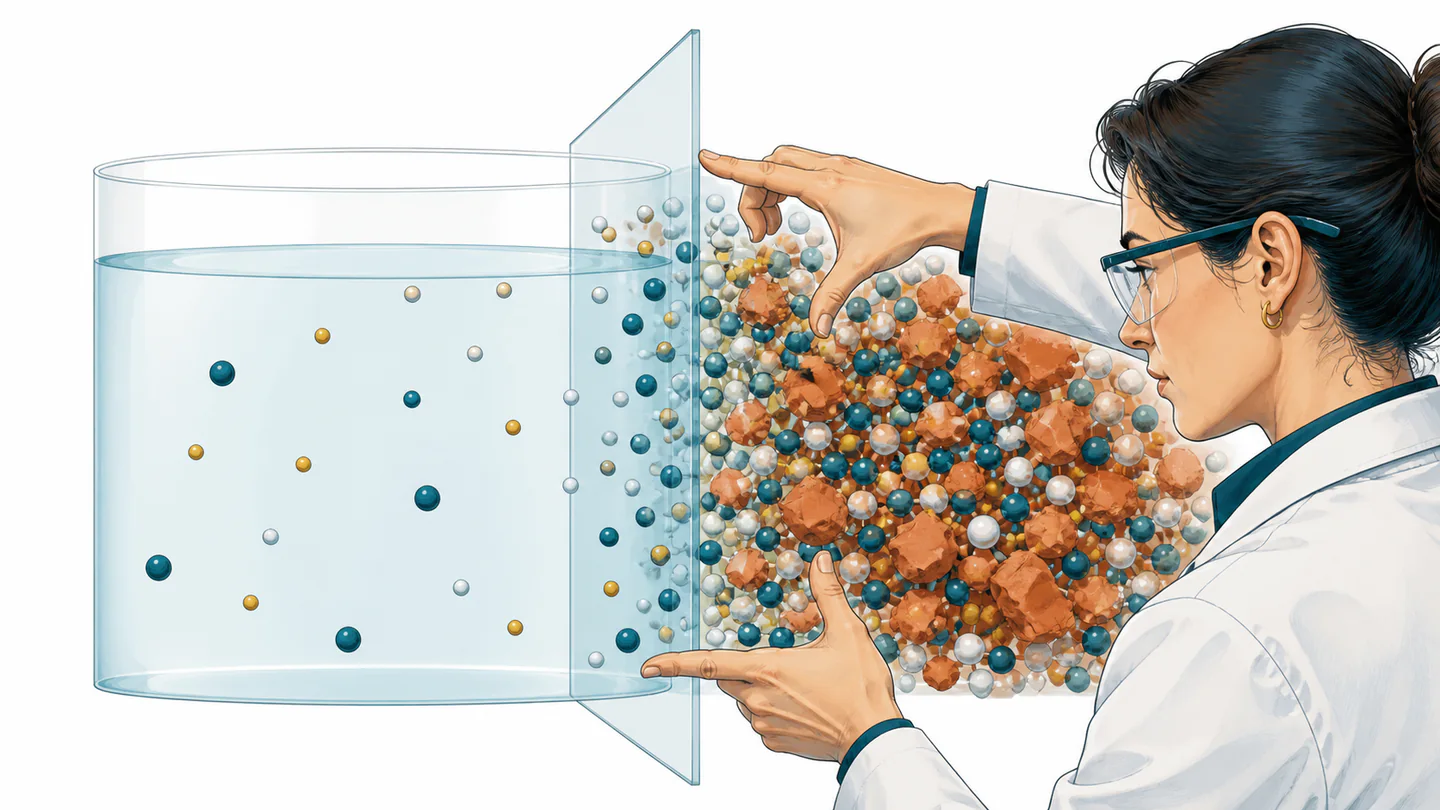
Henderson–Hasselbalch is a compact rearrangement of one acid equilibrium. It is exact in its activity form and often useful in a dilute concentration form. It is not a replacement for identifying the right conjugate pair, choosing condition-matched pKa data, or modeling how a real sample is prepared and measured.
A buffer calculation is not a preparation recipe
Before using the ratio form, first decide what is actually present after mixing. Adding strong acid converts some conjugate base into acid; adding strong base converts some acid into conjugate base. Those stoichiometric changes happen before the equilibrium ratio is evaluated. Mixing two stock solutions also changes their final concentrations through dilution. Treating the original bottle labels as the final buffer ratio is a quiet but common mistake.
The equation is most informative when both members of the pair are present in appreciable amounts and the chosen pH sits near the relevant pKa. If one member is nearly exhausted, the ratio becomes highly sensitive to small analytical errors. Water autoionization, a large added titrant, or a second acid-base equilibrium can then matter as much as the nominal buffer pair.
For a polyprotic system, write the particular adjacent equilibrium first. A calculation involving phosphate, carbonate, or an amino acid needs the acid and base species belonging to the same dissociation step, with that step’s pKa. Selecting an unlabeled “pKa” because it looks numerically close is not an approximation; it is a different chemical model.