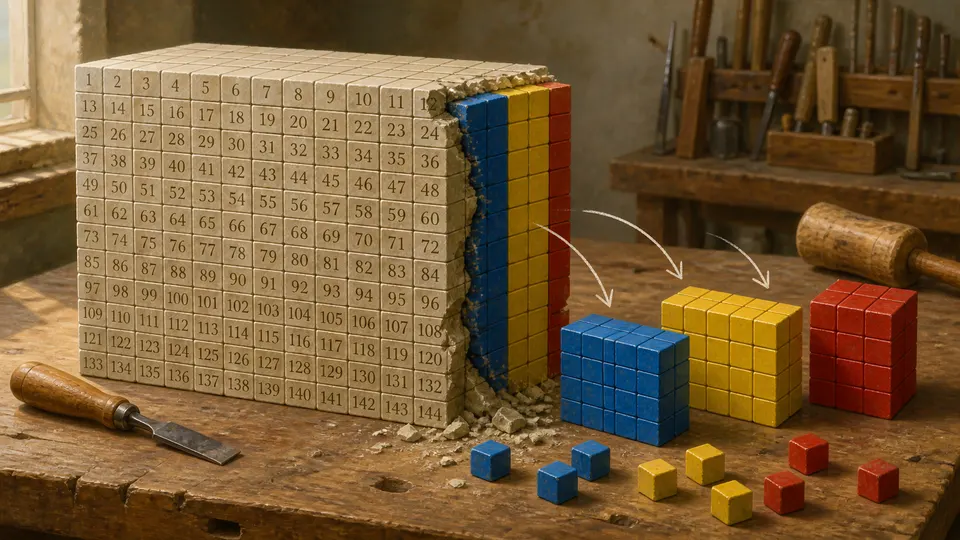
A number such as 61226001 looks like a wall. Prime factorization turns it into a small construction kit: factors that cannot be split into smaller whole-number factors.
The calculator is not guessing a pattern from the shape of the digits. It is testing divisibility, removing factors it finds, and continuing with the quotient until the remaining pieces are prime or outside the device’s supported range.
A factor is a building block, not just any divisor
Six divides 30, but six is not prime because it can still be split into 2 x 3. A prime factorization continues the process until every factor is prime. For 60, the result is 2 x 2 x 3 x 5.
Casio’s Calculate app supports prime factorization for positive integers within a documented digit range. That range is not a statement about the mathematics; it is a statement about what the calculator promises to complete and display.

The algorithm meets a practical stopping line
A calculator can factor small integers quickly, but trial division becomes expensive as candidates grow. Some models show an unfactored part in parentheses when a remaining factor exceeds their documented ability. That output is more honest than pretending the entire expression has been resolved.
Factorization is useful because structure survives the answer
Prime factors reveal divisibility, simplify fractions, expose repeated powers, and support number-theory exercises. The point is not merely to print a longer multiplication sentence. It is to replace an opaque integer with a structure that can be inspected.

Prime factorization is a calculator turning a number into parts you can reason about.