Ordinary sine takes an angle and returns a ratio. Inverse sine walks the other way: give it a ratio such as 0.5 and it returns an angle whose sine is 0.5. The calculator is not “undoing” every possible sine value. It is choosing a principal angle from a defined range.
That small word, inverse, hides a domain decision. Trigonometric functions repeat around a circle, so one ratio can belong to several angles. An inverse function needs a convention to return one answer.
The ratio comes from a geometric relationship
For a right triangle, sine is opposite divided by hypotenuse, cosine is adjacent divided by hypotenuse, and tangent is opposite divided by adjacent. If the sides are known and the angle is not, inverse trigonometry turns that ratio into an angle.
TI describes inverse trigonometric functions as angle finders and shows that the calculator’s angle mode controls whether the result is displayed in degrees or radians. A correct ratio with the wrong angle mode is still a wrong answer for the question being asked.

One ratio can describe more than one direction
On a circle, the same sine value appears in more than one quadrant. The inverse function returns a principal value, not every geometric possibility. If a problem asks for an angle in a particular quadrant, the calculator result is a starting point that must be interpreted with the diagram.
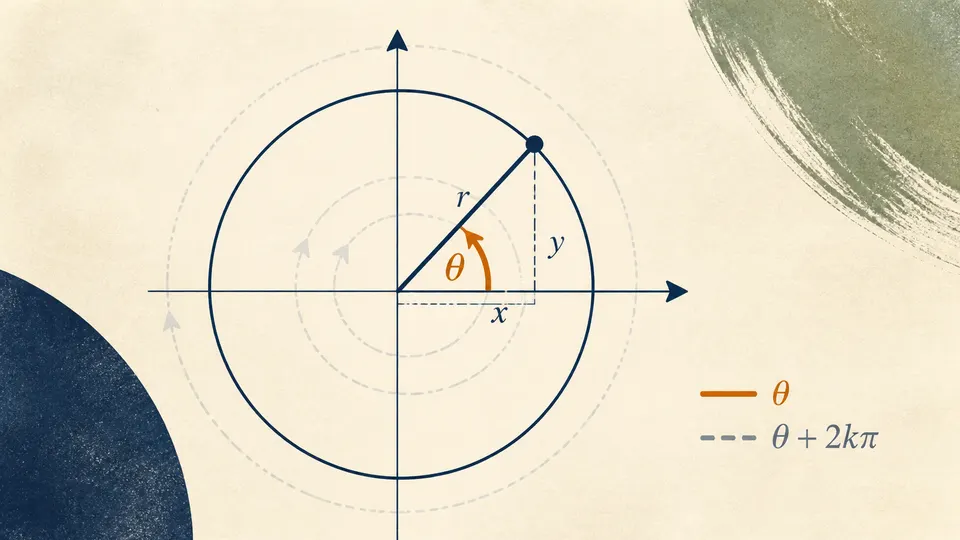
The calculator’s “answer” is a convention plus arithmetic
Inverse trig functions are implemented with numerical algorithms and a specified output branch. They are not a mechanical reversal of a key press. Understanding the branch is what keeps a triangle problem from turning into a confident but incomplete single number.
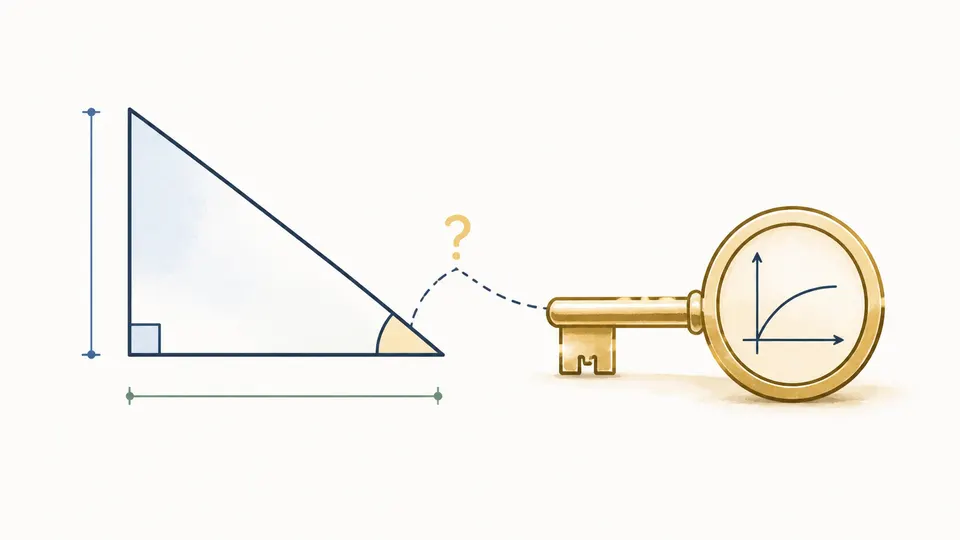
Inverse trigonometry finds a legal angle. The diagram decides whether it is the angle you need.