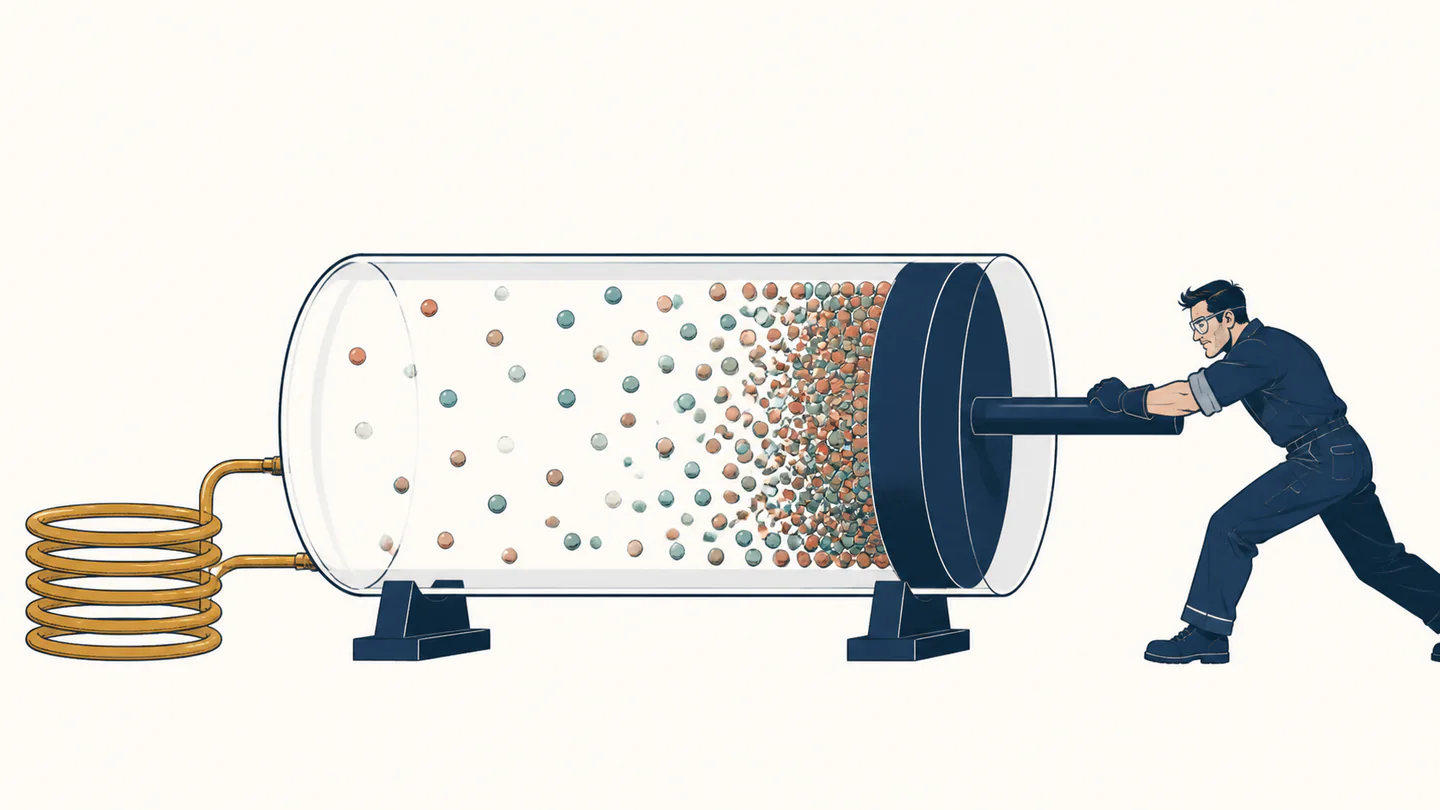
Put gas in a cylinder, move the piston, add heat, or add more molecules, and something else must respond. Pressure, volume, temperature, and amount are not four independent knobs. For an ideal gas at equilibrium, the ideal gas law records their balance:
PV = nRTThe equation describes a state. It does not say how quickly the state changes, whether heat has flowed, or whether the gas is close enough to ideal for the answer to be reliable.
The formula is so familiar that it can look harmless. It is not. Using a gauge pressure where absolute pressure is needed, or Celsius where kelvin belongs, can create a neat but physically impossible result. And at high density, low temperature, or near condensation, an actual gas stops behaving like the imagined one behind the equation.
The five quantities in one line
Force per unit area. This must be measured from vacuum, not from local atmosphere.
The gas volume, not the container’s nominal capacity if a piston or liquid occupies part of it.
For an ideal mixture, use total moles with total pressure.
8.314 462 618 153 24…; exact in the current SI.
Absolute temperature; convert Celsius before calculating.
IUPAC defines an ideal gas through this equation of state. It is a model of a gas whose molecules are sufficiently separated that their own size and mutual attraction or repulsion do not alter the pressure–volume relation. “Ideal” does not mean exceptionally good gas. It means a deliberately simplified physical model.
Why molecules lead to PV = nRT
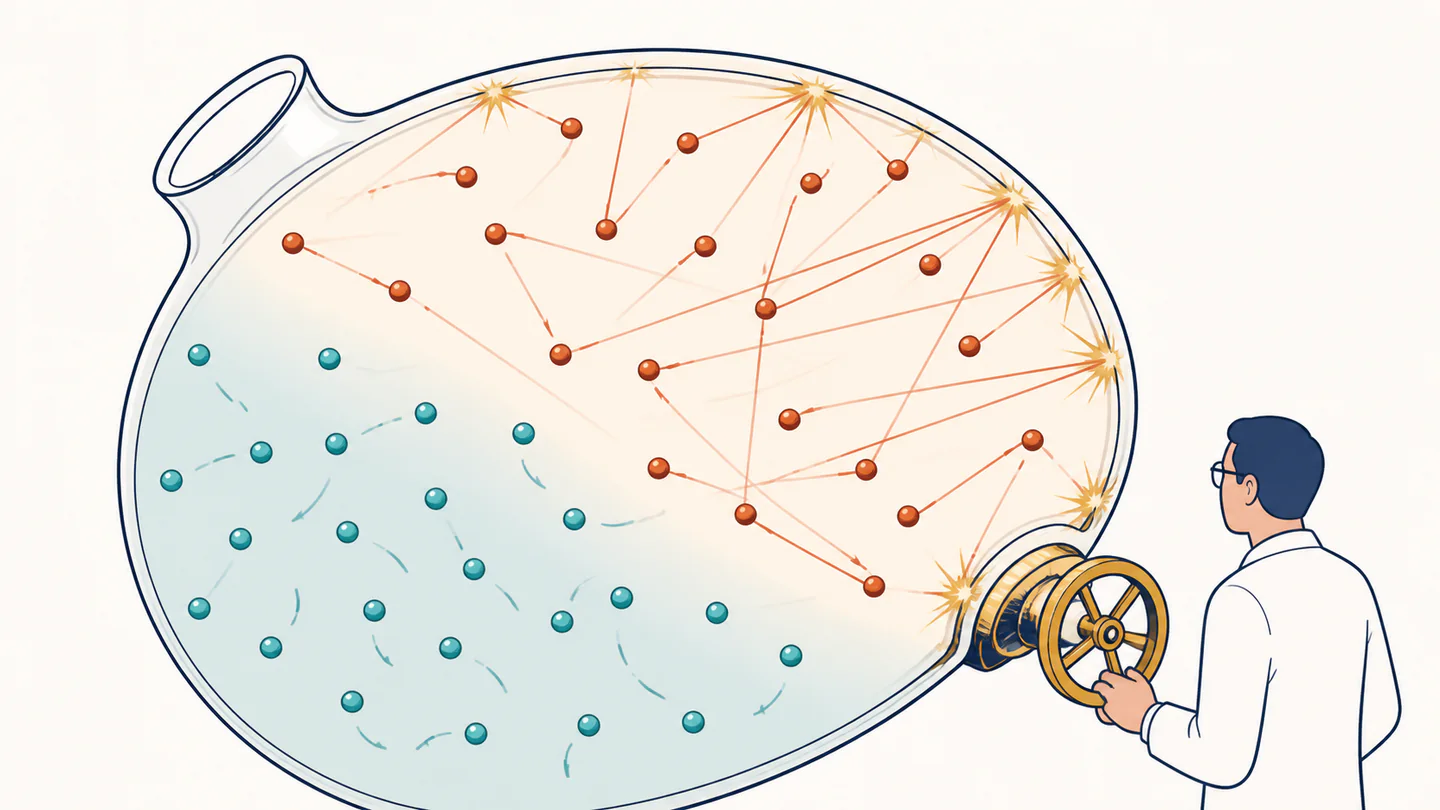
Kinetic theory supplies a useful chain of reasoning. Molecules in a container collide with the walls. Each collision transfers momentum; the combined rate of those transfers is pressure. For N identical particles,
PV = ⅓Nm c̄²Pressure comes from molecular momentum transfer to the container wall.
½m c̄² = 3/2 kBTFor a classical monatomic ideal gas, mean translational kinetic energy follows absolute temperature.
N = nNAOne mole contains the Avogadro number of specified entities.
R = NAkBSubstitution turns the particle expression into PV = nRT.
This is reasoning, not permission to apply the final line everywhere. The model assumes a well-defined equilibrium temperature, elastic wall collisions, and a low-enough density that intermolecular forces do not dominate the pressure. Real gases can be close to that limit; they are never made of points with no mutual interaction.
Dimensional consistency: both sides are energy
The equation is often taught as a proportion, but its units say something more revealing:
[PV] = Pa·m³ = (N m⁻²)(m³) = N·m = J[nRT] = mol · (J mol⁻¹ K⁻¹) · K = JPressure multiplied by volume has an energy dimension. If a calculation mixes litres, bars, and an SI value of R without conversion, it is no longer checking equal physical quantities.
Work in SI when possible: Pa, m³, mol, K, and R = 8.314462618… J mol⁻¹ K⁻¹. Two conversions routinely matter: 1 L = 10⁻³ m³ and 1 bar = 10⁵ Pa. Other unit systems can be valid, but only when R has been converted consistently.
Absolute pressure and kelvin are non-negotiable
Pabs = Pgauge + PatmA gauge reads relative to local atmospheric pressure. Zero gauge does not mean zero pressure in the equation.
T(K) = t(°C) + 273.15A Celsius increment and a kelvin increment have equal size, but a Celsius reading is not an absolute temperature.
n = mass / molar massDo not confuse moles with grams. The molar mass has to match the gas composition.
V = gas space onlyA liquid level, a moving piston, or plumbing dead volume can change the relevant volume.
The most costly ambiguity is pressure reference. Suppose a vessel is at 0 kPa gauge in ordinary air. Its absolute pressure is roughly 101 kPa, not zero. Substituting zero into PV=nRT would force either zero moles, zero temperature, or a broken model.
Solve for the quantity you actually need
P = nRT/VUseful when amount, temperature, and free volume are known.
V = nRT/PUse absolute pressure and remember that the result is gas volume.
n = PV/RTTurns a measured state into moles only if the ideal model is adequate.
T = PV/nRReturns kelvin, not Celsius.
P₁V₁/T₁ = P₂V₂/T₂Allowed only when the amount and composition have not changed.
The last form is useful for a sealed sample that is compressed or heated. It is not a shortcut for a leaky tank, a reaction vessel, a condensing gas, or a flow process where moles cross the boundary.
Worked example 1: pressure of a known gas sample
A 10.0 L vessel holds n = 2.00 mol of gas at T = 300.0 K. Convert volume first: 10.0 L = 0.0100 m³. Then:
The back-check returns the starting energy dimension: PV = (498,867.757)(0.0100) = 4,988.6776 J, matching nRT. The answer is absolute pressure. If a pressure gauge outside the vessel is referenced to a 101 kPa atmosphere, its reading would be about 398 kPa gauge—not 499 kPa gauge.
Worked example 2: amount in a room-temperature sample
Now reverse the problem. A sample occupies V = 24.0 L = 0.0240 m³ at P = 101,325 Pa absolute and T = 298.15 K. Find its amount:
PV = (101,325)(0.0240) = 2,431.8 JRT = (8.314462618)(298.15) = 2,478.948… J mol⁻¹n = 2,431.8 / 2,478.948… = 0.980977 molRounded to three significant figures, the sample contains 0.981 mol. Substitute the result back: nRT/P = 0.0240000 m³, which recovers the stated 24.0 L. Calling 101,325 Pa a gauge pressure instead would describe a completely different state.
Where the equation stops being the right answer
Low-density gases at sufficiently high temperature, far from condensation, when the required accuracy tolerates the approximation.
Higher pressures, lower temperatures, dense gases, critical-region states, and conditions near liquefaction make molecular volume and attraction important.
PV = ZnRT uses the compressibility factor Z. An ideal gas has Z = 1; a real value must match composition, pressure, and temperature.
Flow rate, heating time, diffusion, chemical reaction, phase change, and pressure drop require additional conservation laws and property data.
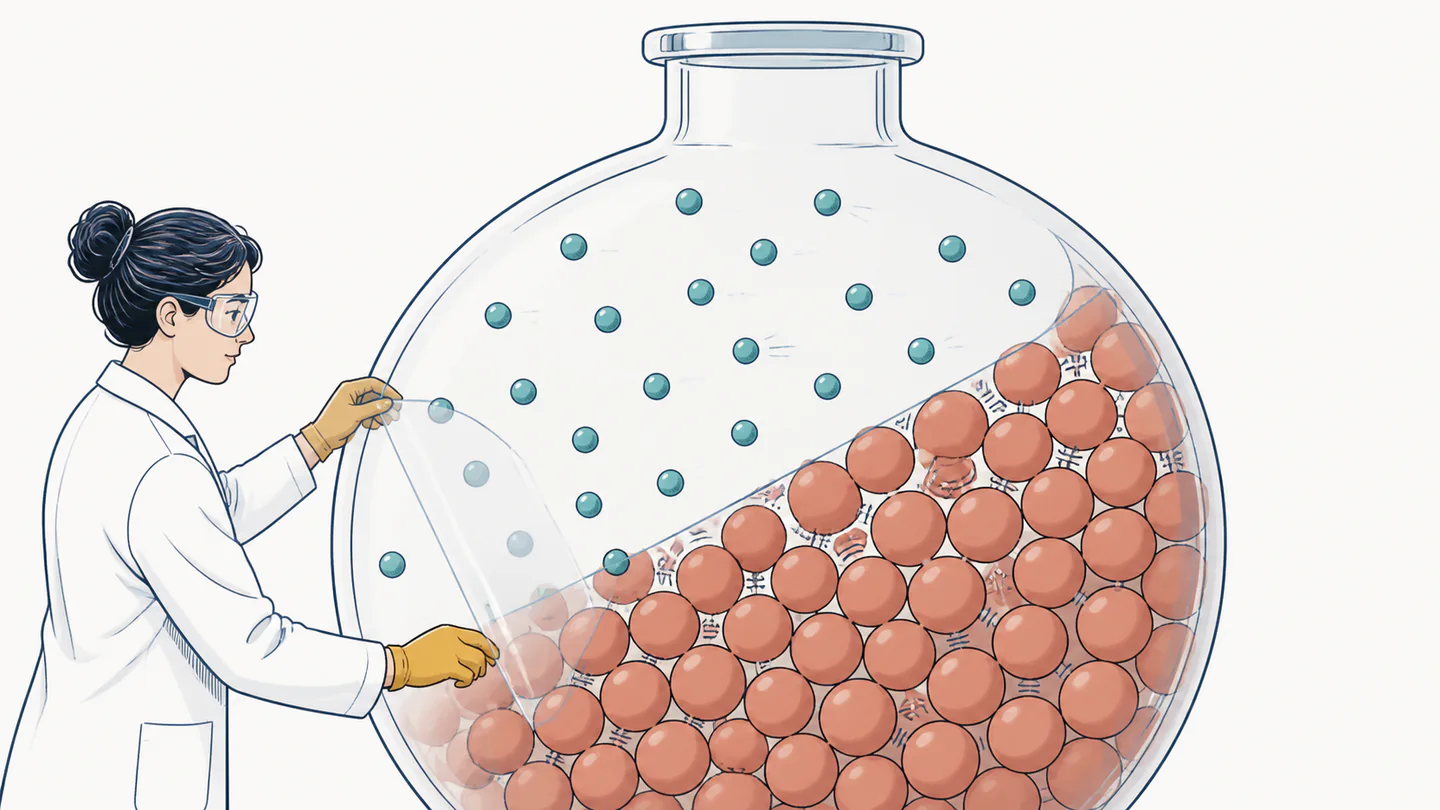
The ideal gas law can turn a well-defined equilibrium state into a missing pressure, volume, temperature, or amount. It cannot decide whether a pressure is gauge or absolute, estimate a real-gas departure without data, or calculate a process rate. Those are not footnotes to the equation. They are the conditions that tell you whether its elegant one-line answer belongs to the physical situation at all.