An orbit does not carry a label saying how far it is from its primary or how heavy that primary is. What it does carry is timing. Watch a body complete the same path again and again, measure the size of the relative orbit, and Newtonian gravity ties the two observations together.
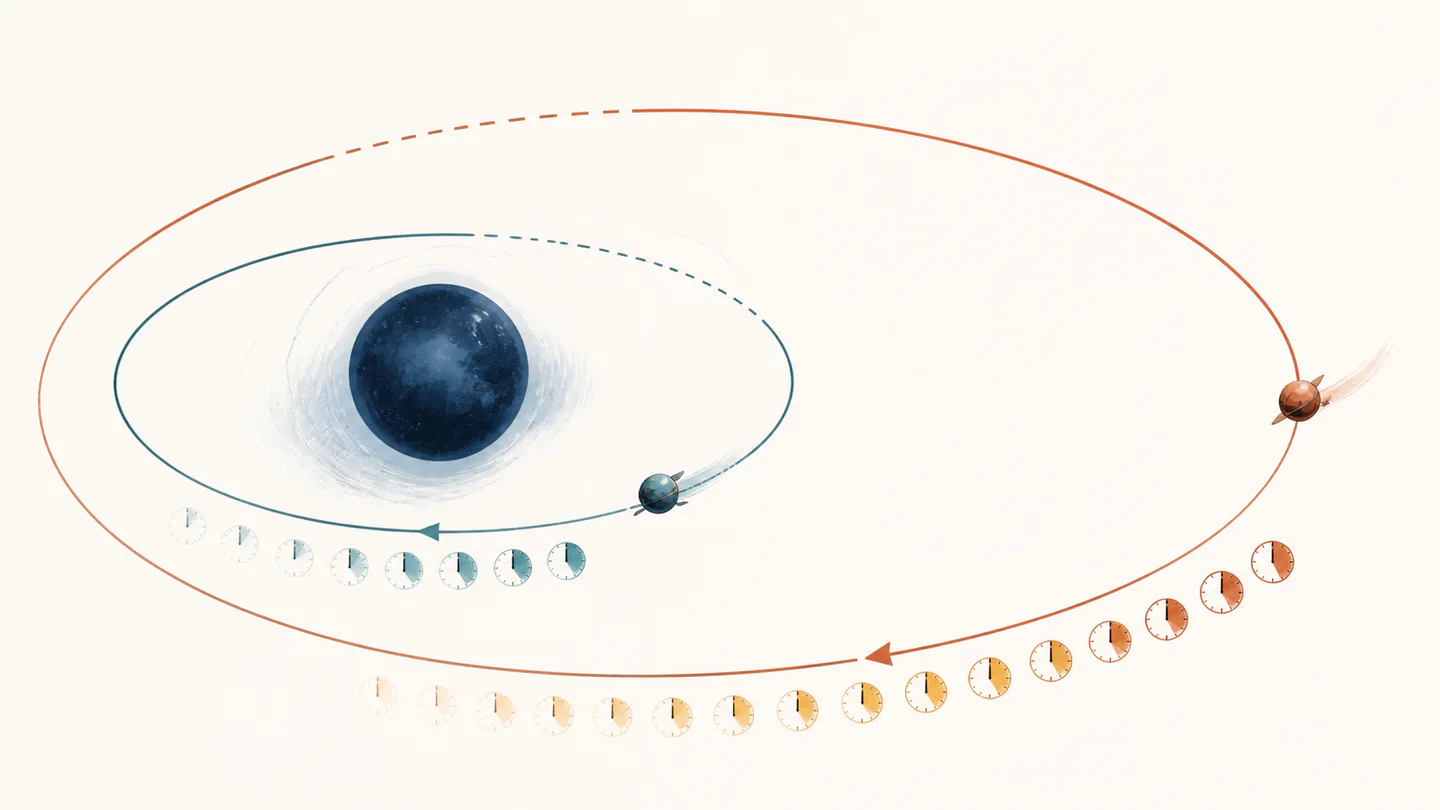
Kepler’s third law is often compressed to “farther planets take longer.” That is true but incomplete. The useful version is a three-way relationship: a wider orbit takes longer, a more massive pair moves through a given orbit faster, and the orbit size in the equation is the semi-major axis—not whichever separation happens to be visible in a photograph.
T² = 4π²a³ / G(M + m)Equivalently, T² = 4π²a³ / (μM + μm), where μ = GM. The second form is often the one precision orbit work actually measures.
Read the variables before using the formula
Time for one full cycle of the relative orbit.
Half the major axis of the pair’s relative ellipse.
Central body and companion; the exact law uses their sum.
CODATA 2022: 6.674 30(15) × 10⁻¹¹.
The adjective relative matters. In a binary, both objects orbit their shared barycentre. The a in the complete equation is the semi-major axis of their separation orbit, not just the primary’s small wobble or the companion’s barycentric ellipse by itself. When m ≪ M—a spacecraft around Earth, or Earth around the Sun—the shortcut M + m ≈ M is excellent. In a stellar binary or a double-planet system, it may not be.
The short circular derivation—and the extra step an ellipse needs
For a circular orbit of radius r, gravity supplies the inward force required for circular motion. Set the two expressions equal:
F = GMm / r²F = mv² / rv = 2πr / TT² = 4π²r³ / GMThat last line is the circular, small-companion version. Here the radius is constant, so r = a. It correctly exposes the scaling: double the orbit size and the period becomes 23/2 ≈ 2.83 times longer.
An ellipse needs one carefully stated upgrade. Newton’s exact two-body reduction says that the relative separation moves under −G(M + m)/r. A bound solution is an ellipse, and its mean motion obeys n²a³ = G(M + m), with n = 2π/T. That gives the full law at the top of the page. The circular derivation shows why the relationship has its shape; it is not permission to replace an elliptical orbit with a fixed radius.
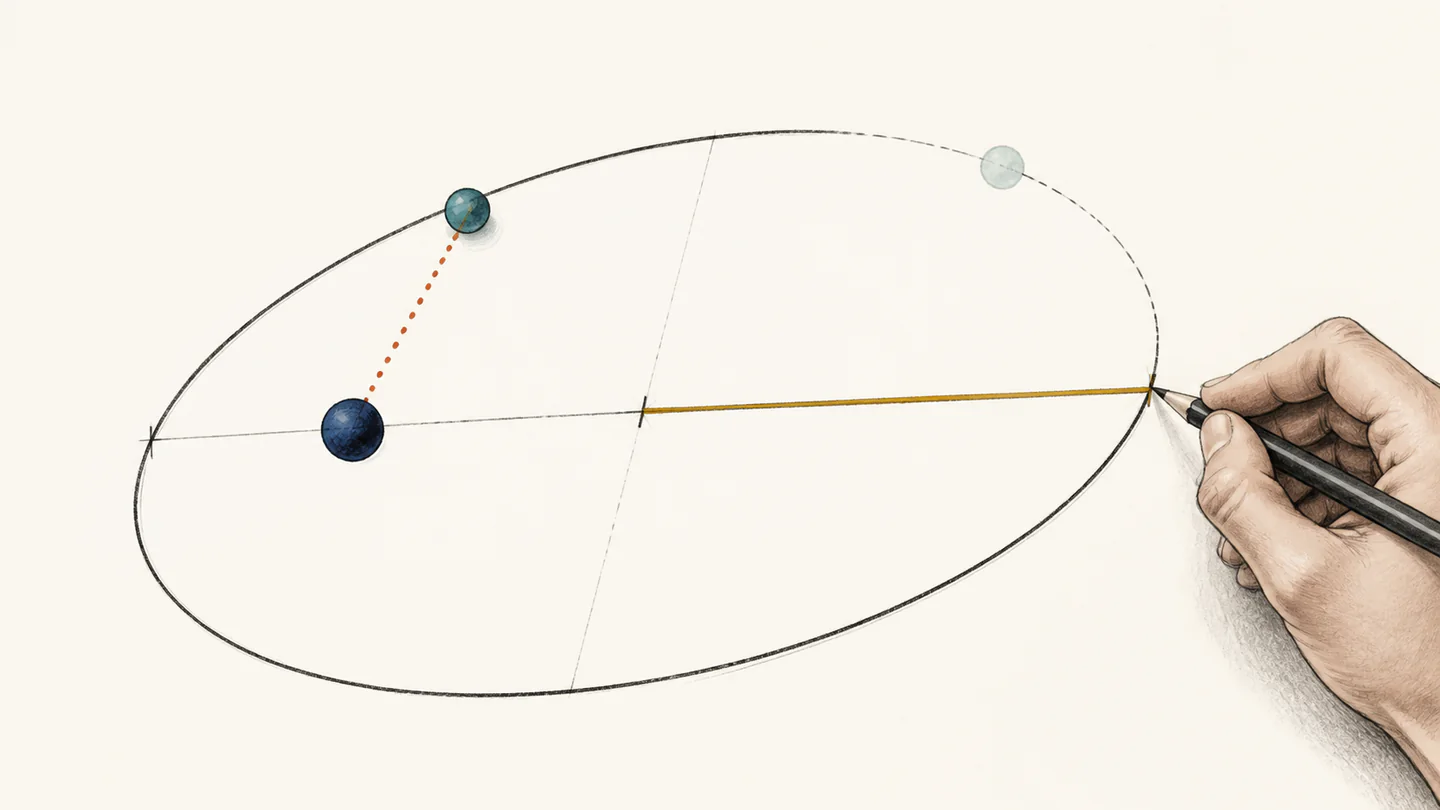
r changes around the orbit; the semi-major axis a is the stable half-major-axis measure.Three useful ways to solve the same relationship
Need the period?
T = 2π√[a³ / G(M + m)]Use a measured orbit and the pair’s total mass.Need the orbit size?
a = [G(M + m)T² / 4π²]^(1/3)Useful when timing is easier than direct distance measurement.Need the central mass?
M = 4π²a³ / GT² − mBetter yet, report G(M + m) when the data constrain a gravitational parameter directly.The mass inversion has a built-in warning: it requires the companion mass to be handled deliberately. It also turns small distance errors into larger mass errors because mass scales as a³. To first order, if the period and semi-major axis are independently measured, the fractional uncertainty in the inferred gravitational parameter is approximately √[(3σa/a)² + (2σT/T)²].
SI units and the handy astronomical shorthand
In SI, keep the set intact: metres, seconds, kilograms, and the stated value of G. The numerical answer collapses if kilometres are fed to SI G, or days are treated as seconds.
| System | Use | Relationship | What to watch |
|---|---|---|---|
| SI | a in m, T in s, masses in kg | T² = 4π²a³ / G(M + m) | Use one stated value of G; do not mix km or days into it. |
| Astronomical units | aAU = a / au; Ty = T / 31,557,600 s | Ty² = 1.00003777384907 aAU³ / q | q = G(M+m)/(GM)☉N; the coefficient is not exactly 1. |
The familiar classroom line, Pyear² ≈ aAU³ / (Mtotal/M☉), is a useful rounded normalization near a solar-mass primary. It is not an exact identity for every meaning of “year” and “solar mass.” With the IAU’s exact astronomical unit, a Julian year of 365.25 days, and the IAU nominal solar mass parameter (GM)☉N, the coefficient above is the precise conversion. This is why professional orbit tables often quote GM ratios rather than pretending a kilogram solar mass is exact.
Example 1: does Earth land near one year?
Use an ideal isolated Sun–Earth pair, not a calendar prediction. Take a = 1 au = 149,597,870,700 m, the IAU nominal solar parameter (GM)☉N = 1.3271244 × 10²⁰ m³ s⁻², and JPL’s Earth parameter GME = 3.98600435507 × 10¹⁴ m³ s⁻².
T = 2π√[a³ / ((GM)☉N + GME)]
31,558,148.63 s, or 1.000017385 Julian years.For a negligible-mass satellite at a = 26,560 km = 2.6560 × 10⁷ m from Earth’s centre:
T = 43,077.758 s using JPL’s GME.The first value is a magnitude check: it agrees with Earth’s listed sidereal scale, while real Earth motion is perturbed by the other planets and needs an ephemeris for precision work. The second is deliberately ideal. Reverse it with an exactly 12-hour period and the inferred semi-major axis is 26,610.223 km; use a = 26,560 km and T = 43,077.758 s together, and 4π²a³/T² returns 398,600.435507 km³ s⁻², the Earth gravitational parameter used as input.
Five mistakes that can produce a plausible-looking wrong answer
| Mistake | Why it fails | Repair |
|---|---|---|
Using today’s separation as a | In an ellipse, r changes from periapsis to apoapsis. | Use the semi-major axis of the relative orbit. |
| Mixing seconds with days or years | T is squared; a unit mismatch explodes quickly. | Convert first, or use one self-consistent astronomical form. |
Giving SI G a distance in km | a³ introduces a factor of 10⁹. | Convert km to m before substitution. |
Using an orbit’s diameter as a | a is half the major axis, not the full long diameter. | Divide the measured major-axis length by two. |
| Dropping a companion that is not small | The exact driver is M+m, not the primary alone. | Use total mass and the separation orbit. In a constructed 0.8 + 0.2 solar-parameter binary at 2 au, ignoring the companion makes the period 11.8% too long. |
What the equation can tell you—and where it must stop
It relates period, orbital scale, and total gravitational mass for a Newtonian two-body ellipse; and lets you infer one when the other two are measured.
An orbit’s orientation, eccentricity, phase, atmosphere, stability in a crowded system, or the detailed path after another body perturbs it.
Third bodies, oblateness, tidal effects, relativity, or high-precision timing matter. Use osculating elements and numerical ephemerides rather than treating the ellipse as permanently fixed.
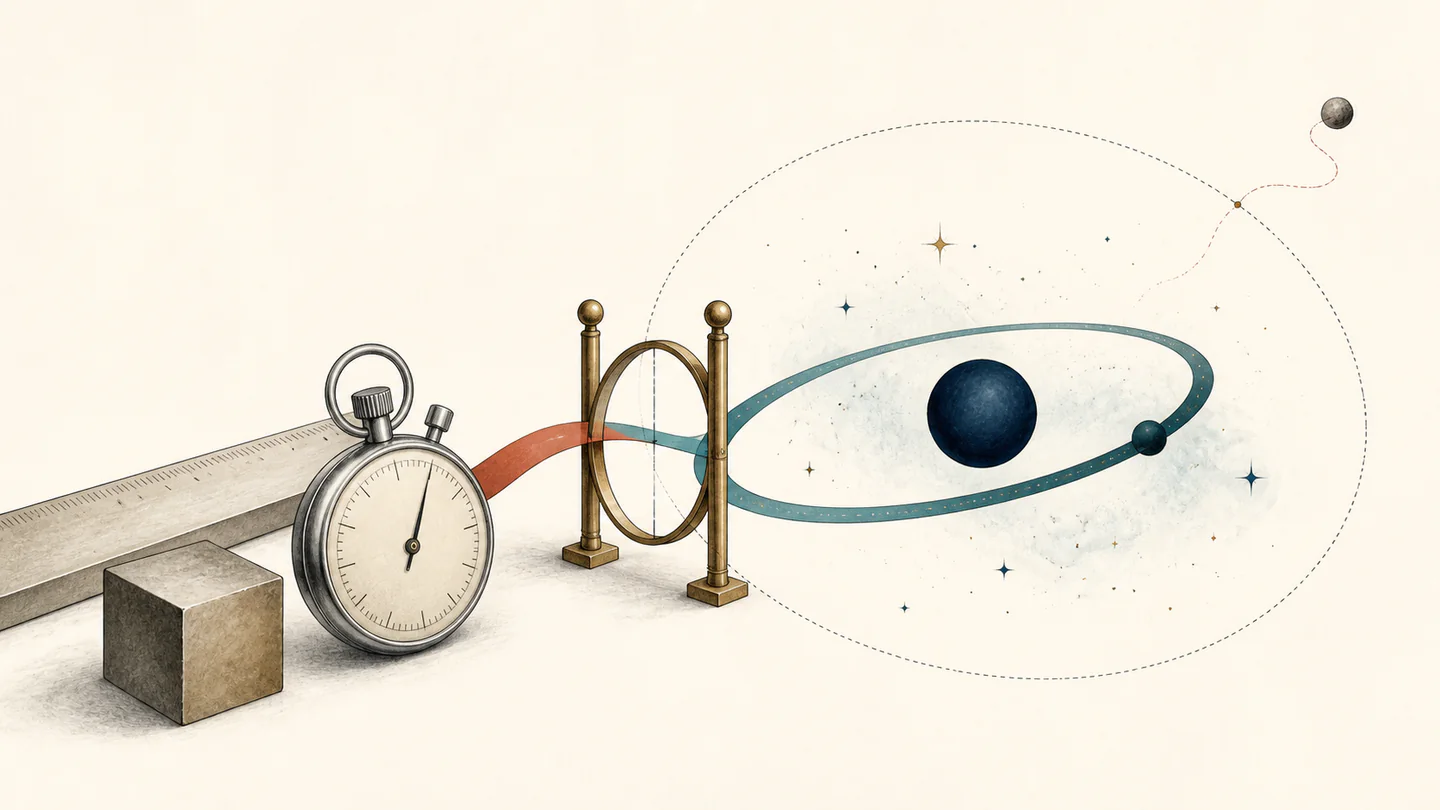
Kepler’s third law is therefore less like a magic distance finder than a disciplined accounting rule for a particular model. It is powerful because timing, geometry, and gravity all leave the same numerical fingerprint. It becomes misleading only when the numbers are clean but the orbit, units, or system boundary have been named carelessly.
Sources and further reading
- IAU Resolution B2 (2012), re-definition of the astronomical unit
- IAU Resolution B3 (2015), recommended nominal conversion constants
- NIST CODATA 2022, Newtonian constant of gravitation
- NASA, Orbits and Kepler’s Laws
- JPL Solar System Dynamics, astrodynamic parameters
- JPL Solar System Dynamics, planetary physical parameters