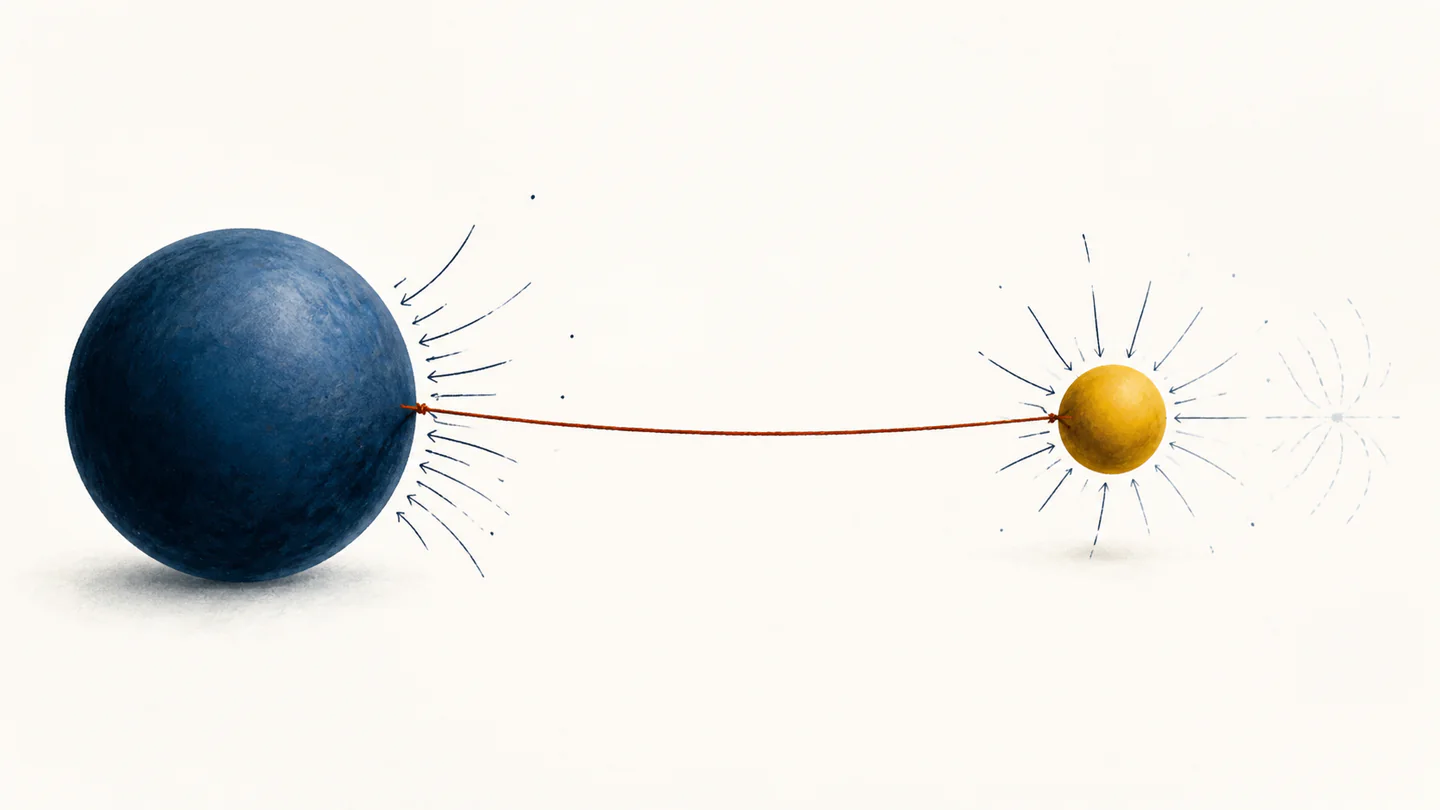
The remarkable part of Newton’s law is not that gravity pulls things down. It is that the same compact rule connects a pair of laboratory masses, a person near Earth, and two worlds separated by a void. Change either mass, change their centre-to-centre distance, and the force changes in a precise, unforgiving way.
That precision makes the law useful for calculations—and makes a nearly right input dangerous. Distance is squared. The force is mutual. And the simple version is a model of two bodies with a well-defined separation, not a universal permission slip for every complicated gravity problem.
F = Gm₁m₂ / r²The vector form adds the direction: the attraction acts along the line joining the two centres, toward the other body.
What each symbol is carrying
The magnitude on each body is equal; the directions are opposite.
The force is proportional to the product of the two masses.
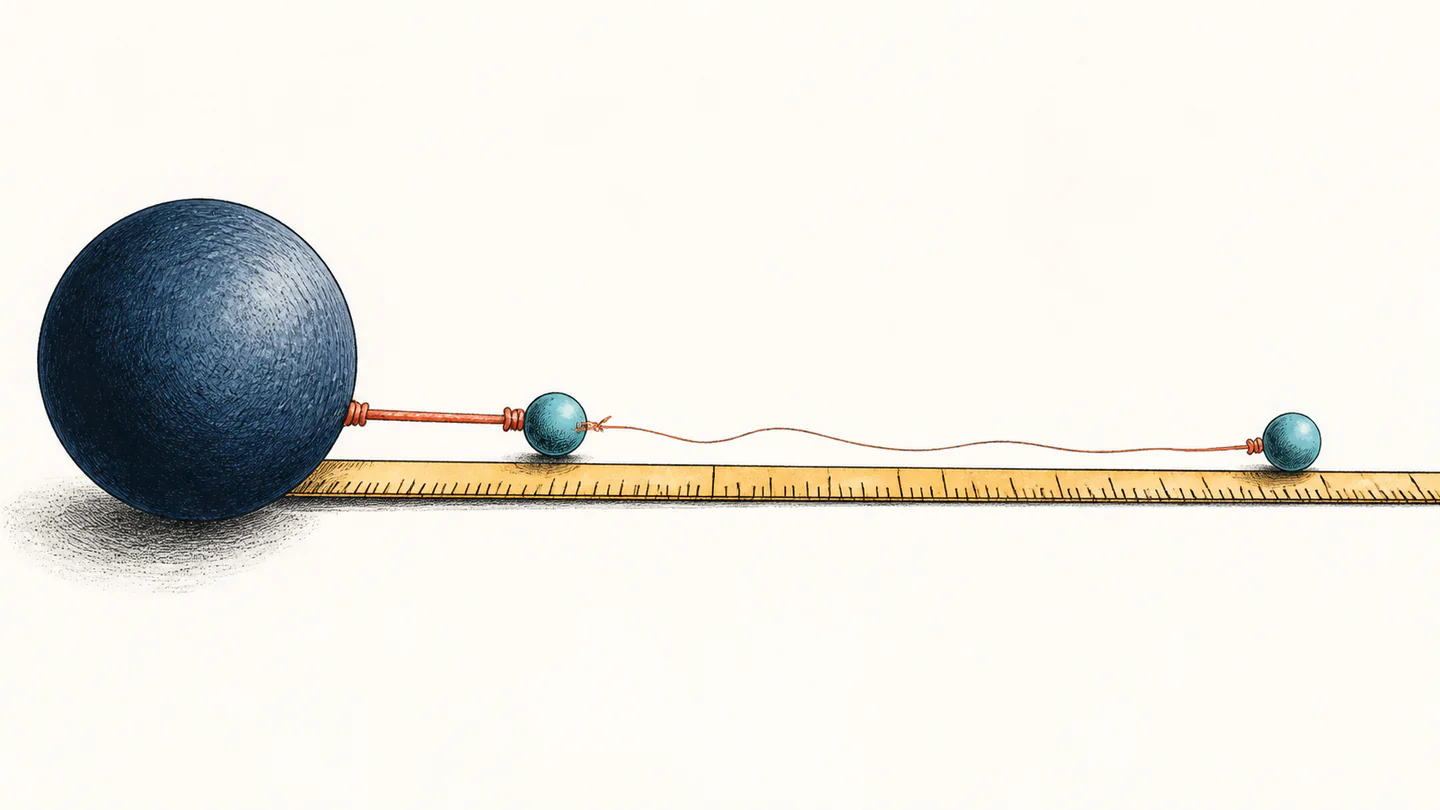
Measure centre to centre, not merely the gap between surfaces.
CODATA 2022: 6.674 30(15) × 10⁻¹¹.
For a coordinate description, let r⃗₁₂ = r⃗₁ − r⃗₂. The force on body 1 due to body 2 is F⃗₁←₂ = −Gm₁m₂r⃗₁₂ / |r⃗₁₂|³. The minus sign says “toward body 2.” Newton’s third law then gives F⃗₂←₁ = −F⃗₁←₂. Equal force does not mean equal motion: acceleration is F/m, so the lighter object changes speed more quickly.
Why the distance is squared
There is a useful symmetry argument before any numbers appear. Imagine a central source whose influence spreads evenly through space. At radius r, that influence is distributed across a sphere with area 4πr². Twice as far away, the same spread covers four times the area. A radial field therefore falls as 1/r².
Newton’s law adds two empirical facts to that geometric pattern: the field produced by the source is proportional to its mass, and the force felt by a test body is proportional to that body’s mass. Put them together and the result is F = Gm₁m₂/r². This is a physical reasoning path, not a proof that gravity must have this form; the law is judged by how well it predicts measured motion.
A unit check that catches expensive mistakes
The units must collapse to a newton:
[Gm₁m₂/r²] = (m³ kg⁻¹ s⁻²)(kg²) / m² = kg m s⁻² = NIf the calculation does not end in newtons, the formula has been given incompatible units. Kilometres with SI G, or a surface-to-surface gap used as a centre separation, can make a number look polished while being wrong.
The form also tells you what the calculator should accept. Use metres, kilograms, and seconds with SI G. If the available distance is in kilometres, multiply by 1,000 before squaring it. Since r is squared, that single missed conversion creates a factor of one million.
Solve the law in the direction the question asks
F = Gm₁m₂ / r²Two masses and their separation are known.
r = √(Gm₁m₂ / F)A measured force is used to infer a distance.
m₁ = Fr² / Gm₂Use only after the model and units are explicit.
g = μ/r²; F = mμ/r²With μ = GM, orbit data often give a better input than a rounded kilogram mass.
The last route is common in space science. A central body’s gravitational parameter μ = GM is directly constrained by orbital motion. Using it avoids multiplying a rounded mass by an uncertain G when the measurement already supplies their product.
Worked example 1: two heavy objects in a room
Let m₁ = m₂ = 1,000 kg and r = 2.00 m. Substitute in SI units:
That is 16.7 micronewtons, a real but tiny attraction. The reconciliation is immediate: move the same masses to 4.00 m, double the separation, and the force must become one quarter: 4.1714375 × 10⁻⁶ N.
Worked example 2: the ideal Earth-centre calculation
For a 70 kg object at r = 6.371 × 10⁶ m from Earth’s centre, use JPL DE440’s Earth parameter μE = 3.98600435507 × 10¹⁴ m³ s⁻². First find the central gravitational acceleration:
(6.371 × 10⁶ m)² = 4.0589641 × 10¹³ m²g = μE/r² = 9.82025033 m s⁻²F = mg = (70)(9.82025033) = 687.417523 NRounded to the sensible precision of the inputs, the force is 687.4 N toward Earth’s centre. This is not a local bathroom-scale prediction. Earth rotates, is not a perfect sphere, and has latitude- and altitude-dependent gravity; a scale also reports a contact force, not gravity in isolation. The example is a clean check of the formula under a stated spherical, non-rotating model.
Errors that survive a quick glance
| Mistake | Why it looks plausible | Repair |
|---|---|---|
Using surface gap as r | The visible empty space is easy to measure. | Use centre-to-centre separation; add radii when starting from a gap. |
| Giving only one object a force | The heavier object appears to be “doing the pulling.” | Both feel equal-magnitude, opposite-direction forces; compare accelerations separately. |
Reading 1/r² as 1/(2r) | Doubling distance sounds like halving an effect. | Square the entire separation: doubling means one quarter. |
Mixing km with SI G | The exponent is easy to overlook. | Convert kilometres to metres before calculating r². |
Calling F = mg a separate law | Near Earth, the compact form is familiar. | It is the central-field version of the same relation, with g = GM/r². |
Where the elegant formula stops being enough
Two point masses, or a location outside a spherically symmetric body, with Newtonian accuracy appropriate to the question.
Inside a non-uniform body, among overlapping extended bodies, or near an irregular asteroid: mass distribution cannot be replaced by one centre point.
Tides compare field differences across an object; many-body systems sum pairwise forces and are normally integrated numerically; high-precision or strong-field work adds relativity.
Do not call G exact. If inferring kilograms from μ/G, CODATA’s relative uncertainty in G enters the result.
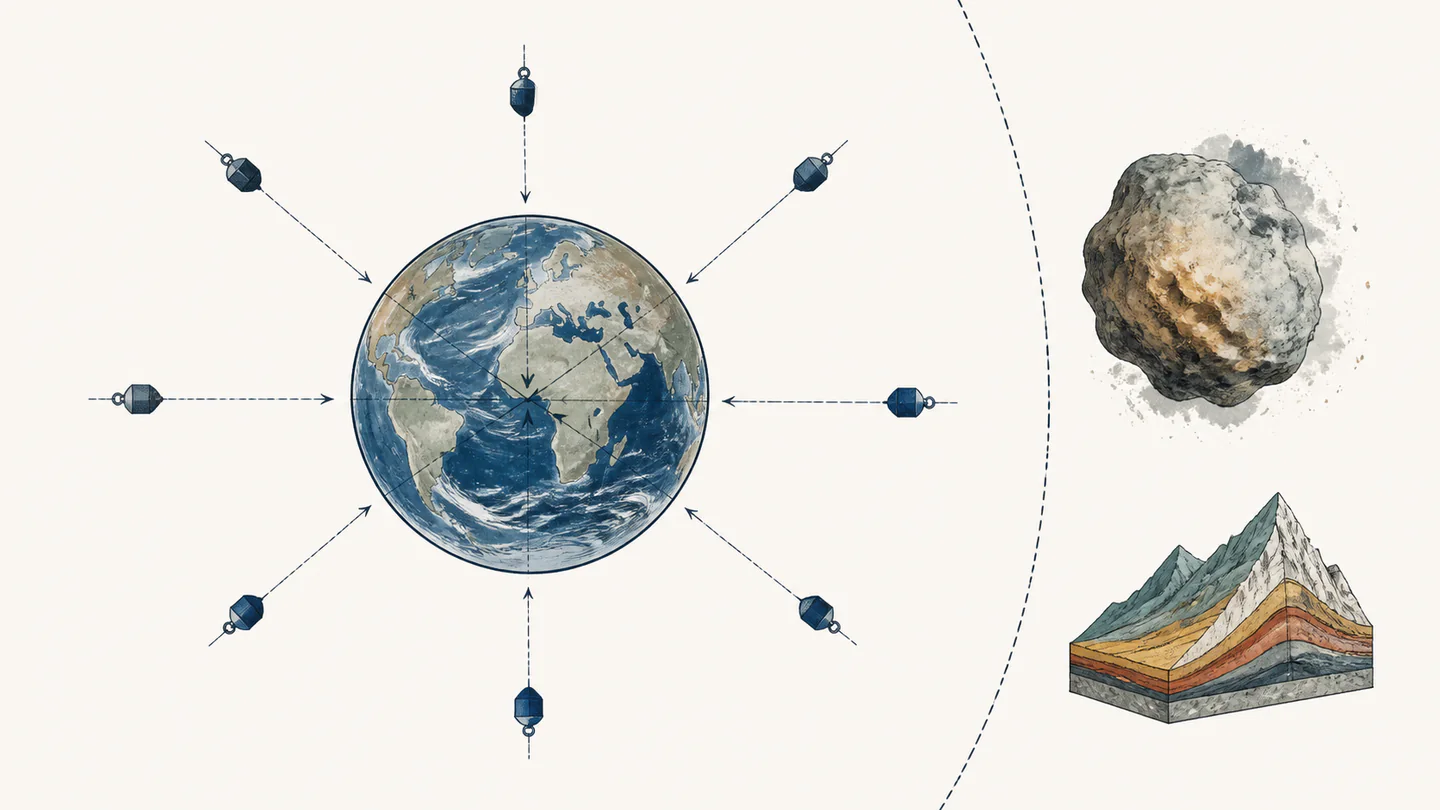
Newton’s law tells you the pairwise force a model predicts. It does not, by itself, choose the correct model, supply a local weight reading, or solve a crowded system. The hard part is often not pressing the formula into a calculator. It is deciding whether the masses, separation, units, and boundary actually describe the physical situation in front of you.