The Reynolds Number: When Flow Inertia Outruns Viscous Smoothing
The Reynolds number compares inertial and viscous effects in a specified flow. Learn its derivation, units, inverse solves, examples, and why transition thresholds are conditional.
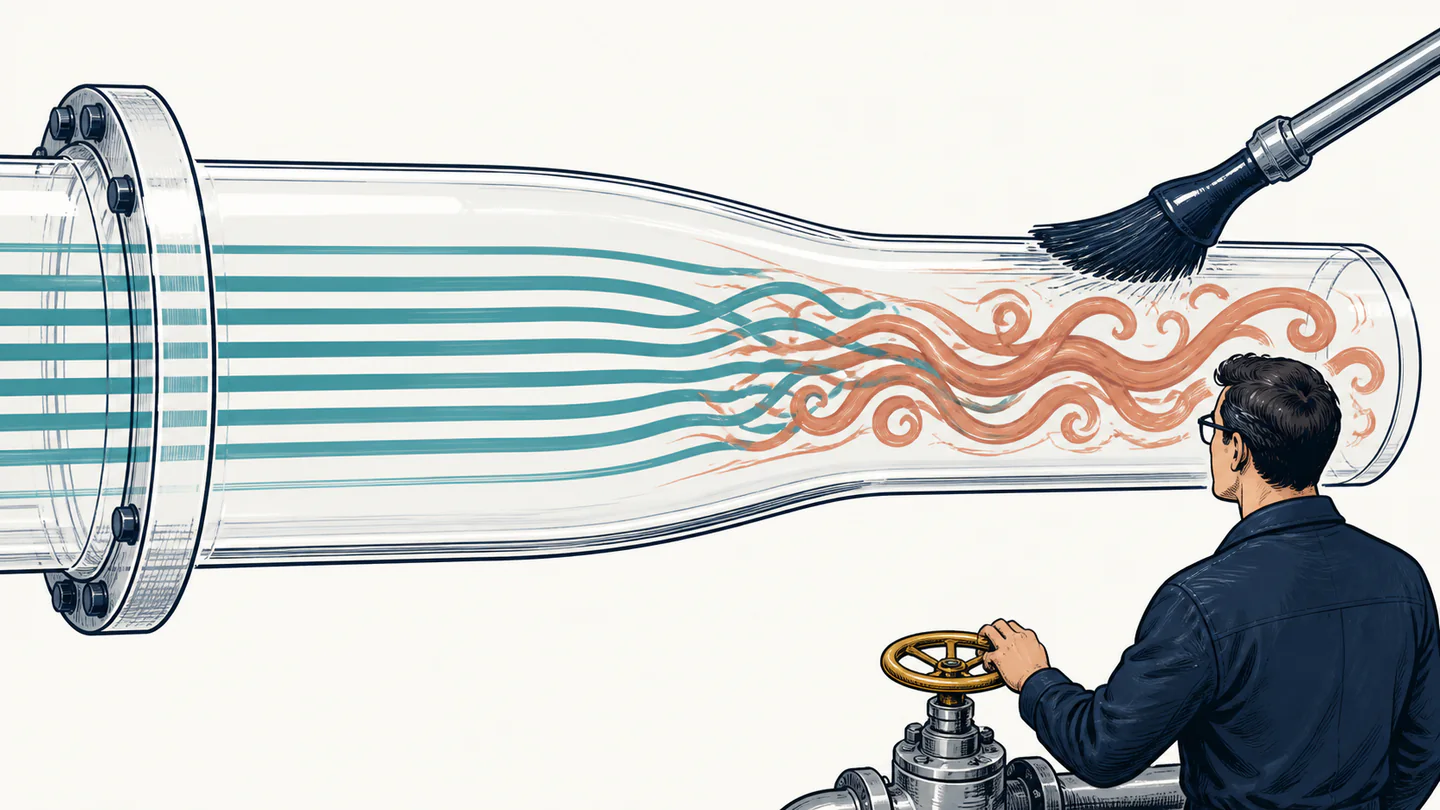
Water can move through the same pipe as a quiet set of layers or as a vigorously mixed flow. The Reynolds number helps explain why, but it is not a universal turbulence button. It compares inertia with viscous momentum diffusion after you have declared a geometry, a reference speed, a length scale, and fluid properties at a stated condition.
For a Newtonian-fluid reference flowRe = ρVL/μ = VL/ν
Reynolds number is dimensionless. Use either dynamic viscosity μ or kinematic viscosity ν = μ/ρ—not both at once.
Reynolds number compares two tendencies: moving fluid carries momentum onward, while viscosity spreads momentum across neighboring layers.
The terms are not interchangeable
ρDensity
Mass density in kg m−3. For gases especially, use the actual temperature and pressure.
VReference speed
m s−1. A full pipe normally uses bulk speed V = Q/A, not volumetric flow rate Q.
LCharacteristic length
m. Circular pipe: inside diameter; external body: the correlation’s stated diameter, chord, or length.
μ or νViscosity
μ in Pa s; ν in m² s−1. They differ by density: ν = μ/ρ.
The unit check exposes a common mistake before it becomes a result:
(kg m−3)(m s−1)(m) / (kg m−1 s−1) = 1
Likewise, (m s−1)(m)/(m² s−1) = 1. If a calculation leaves kilograms or metres behind, it has mixed quantities or units.
Why this ratio appears
Start with the momentum equation’s scale rather than memorizing a formula. A velocity change of order V over a distance L gives an inertial term per volume of about ρV²/L. The corresponding viscous term scales as μV/L². Their ratio is:
Inertia scaleρV²/L
Viscous scaleμV/L²
Ratio(ρV²/L)/(μV/L²) = ρVL/μ = Re
Low Re means viscous momentum diffusion is prominent on the selected scale. High Re means inertia is comparatively prominent. That does not make viscosity irrelevant at high Re: wall layers, wakes, and friction can still dominate a design outcome.
Solves a calculator can do—and what they do not mean
SpeedV = Re μ/(ρL) = Re ν/LLengthL = Re μ/(ρV) = Re ν/VDynamic viscosityμ = ρVL/ReKinematic viscosityν = VL/Re
These are parameter rearrangements, not pressure-drop or drag laws. An apparent viscosity from a shear-thinning material, for example, needs a declared rheology convention before it belongs in a Reynolds-number calculation.
Worked example 1: water in a circular pipe
For water near 20 °C and near atmospheric pressure, use rounded inputs ρ = 998.2 kg m−3 and μ = 1.002 × 10⁻³ Pa s. A pipe has inside diameter D = 0.0500 m and area-mean speed V = 0.800 m s−1.
The stated flow has ReD = 3.98 × 10⁴. In a sufficiently long ordinary pipe, that justifies investigating turbulent-pipe correlations. It does not deliver a pressure drop: roughness, fittings, developing length, and a friction-factor correlation still matter.
Worked example 2: air past a cylinder
At 1976 standard-atmosphere sea level, NASA lists ρ = 1.2250 kg m−3 and μ = 1.789 × 10⁻⁵ Pa s. Air at V = 12.0 m s−1 flows past a smooth cylinder of diameter D = 0.100 m.
Here ReD = 8.22 × 10⁴ describes an external-flow similarity scale. It must not be fed into the familiar pipe threshold. Cylinder separation, drag coefficient, wake behavior, surface condition, and free-stream turbulence need a cylinder-specific correlation or measurement.
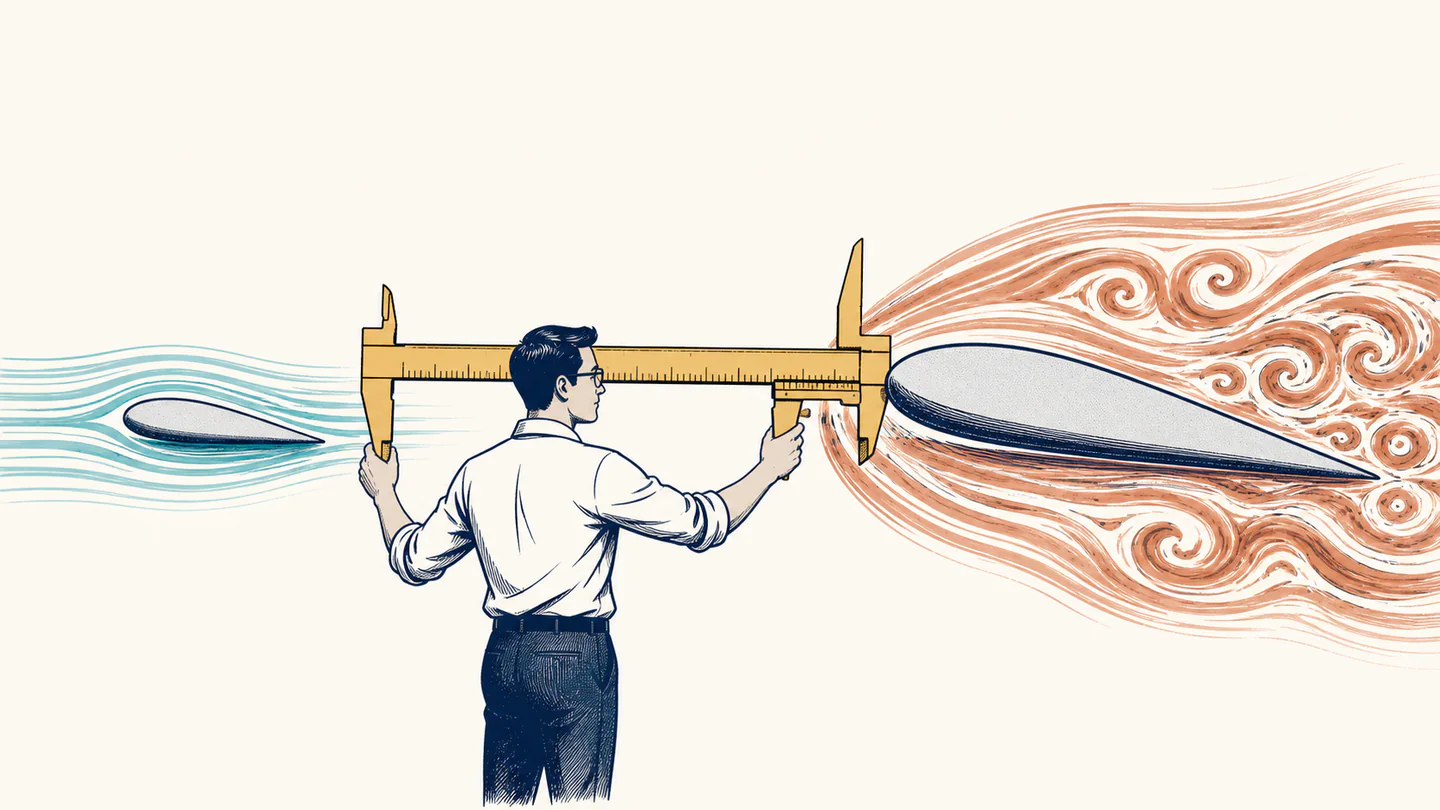
Changing the characteristic length changes Reynolds number even when speed and fluid stay the same. The relevant length is defined by the geometry and the correlation, not by convenience.
One inverse design check
For standard air with ν = 1.460 × 10⁻⁵ m² s−1, a 0.300 m chord model needs Rec = 2.00 × 10⁵. Solving for speed gives V = Recν/c = (2.00 × 10⁵)(1.460 × 10⁻⁵)/0.300 = 9.73 m s−1. Forward substitution gives (9.73)(0.300)/(1.460 × 10−5) = 2.00 × 10⁵ to the input precision. This matches Reynolds number only; if compressibility matters, Mach similarity is another requirement.
Errors that silently change the flow model
Use Q as V
Volumetric flow rate has units m³ s−1. First compute V = Q/A.
Use radius for pipe diameter
That halves a diameter-based ReD. Noncircular ducts usually call for hydraulic diameter.
Mix μ and ν
ρVL/μ and VL/ν are alternatives. Adding density to the latter double-counts it.
Forget the prefix
1 cP = 10−3 Pa s; 1 cSt = 10−6 m² s−1.
Transition is not a single number
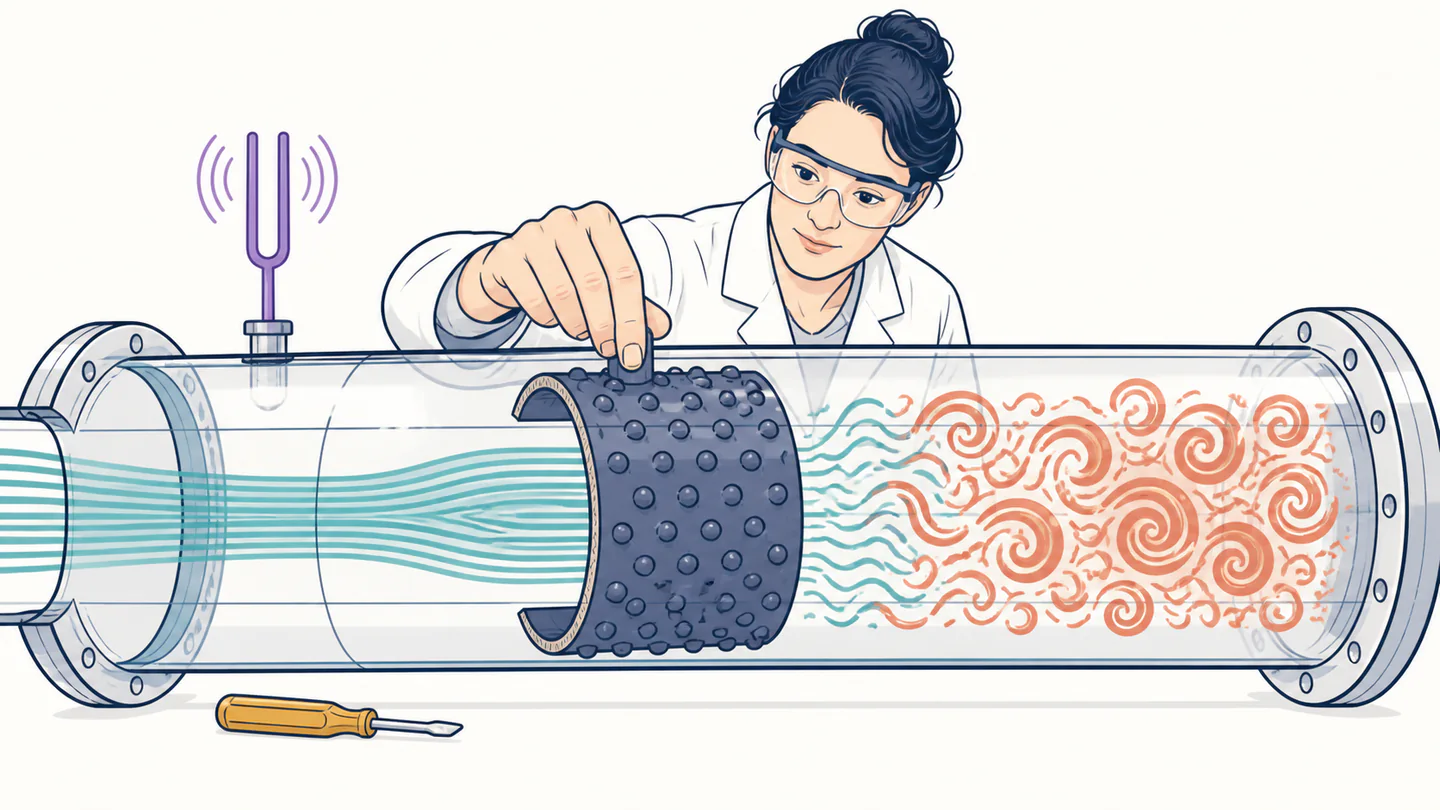
Values around 2,000–2,300 and 4,000 are useful long-pipe screening conventions, not universal borders. NIST’s historical viscosity report describes a critical value near 2,010 as approximate for Reynolds’s long pipes and explicitly says it does not hold for short tubes. Inlets, bends, valves, vibration, free-stream disturbances, pipe length, and roughness can move the observed transition.
Roughness and inlet disturbance are part of the flow problem. A Reynolds number helps organize them; it does not erase them.
For turbulent internal flow, resistance depends on relative roughness as well as Reynolds number. A fully developed correlation cannot be assumed immediately after an inlet or fitting. Non-Newtonian fluids need a rheology model and a geometry-specific generalized Reynolds number. Compressible, multiphase, free-surface, buoyancy-driven, rotating, or strongly unsteady flows can demand Mach, Froude, Weber, Richardson/Grashof, Rossby, Strouhal, or other groups alongside Re.
Reynolds number is at its best as a disciplined question: on this geometry and this scale, how strongly does inertia compete with viscosity? It helps select a model and compare dynamically similar flows. It cannot alone predict a unique drag coefficient, pressure loss, or transition location.