Heat can leave a surface without touching anything. A glowing kiln wall, a warm spacecraft radiator, and a body seen by an infrared camera all send out electromagnetic radiation. The Stefan–Boltzmann law tells us how strongly an ideal thermal surface does that—and it makes temperature unusually consequential. Raise an absolute temperature by a factor of two and ideal radiative emission rises by a factor of sixteen.
That fourth power is memorable, but it is also easy to misuse. The law begins with a blackbody: an ideal emitter and absorber in thermal equilibrium. Real surfaces need an emissivity model. Net radiative heat transfer also needs a defined radiative environment, not just the nearest air-temperature reading. The equation is powerful because its assumptions are precise.

Mbb = σT⁴For a real gray surface emitting to its surroundings, keep the added assumptions visible: q̇ = εσA(Ts⁴ − Tsur⁴).
Three closely related equations—not one interchangeable shortcut
Mbb = σT⁴Radiant power leaving each square metre of an ideal black surface over all wavelengths.
Result: W m⁻²Q̇bb = AσT⁴The same ideal emission multiplied by an emitting area.
Result: WQ̇emit = εσATs⁴An engineering approximation using total hemispherical emissivity.
Result: Wq̇ = εσA(Ts⁴ − Tsur⁴)A small diffuse-gray surface facing a large isothermal radiative enclosure, or an effective radiation temperature.
Positive: net lossThe constant is the Stefan–Boltzmann constant:
h, k, and c.In the net form, Tsur means a radiative surroundings temperature. It can represent a large enclosure, or a carefully constructed effective radiation temperature. It is not automatically the room-air temperature. A surface with a large view of a cold window, a hot furnace opening, or the sky can exchange radiation very differently from what an air thermometer suggests.
What the symbols carry
Power emitted per unit surface area.
A dot means energy per unit time; this is power, not total energy.
Use the actual radiating area exposed to the relevant view.
Kelvin is mandatory inside every fourth power.
A surface/model property, not a universal paint label.
Sets the blackbody scale in SI units.
Where the fourth power comes from
The exponent is not an arbitrary curve fit. A blackbody has a spectral distribution described by Planck’s law. In wavelength form, its spectral radiance can be written as:
Bλ(T) = [2hc² / λ⁵] · 1 / [exp(hc/λkT) − 1]Integrate that spectrum over all wavelengths and over the outward hemisphere, and the result is Mbb = σT⁴. The Stefan–Boltzmann law is therefore a total-radiation result, not a statement about one colour or one infrared band.
This derivation has a boundary. It does not establish that any real coating has one constant emissivity at every wavelength, angle, and temperature. A gray-body ε is often useful, but it is an engineering approximation. Polished metal, oxidized metal, ceramics, and selective surfaces can have strongly wavelength-dependent behavior.

The Kelvin check that catches the largest mistakes
The dimensions of emitted power are:
[σAT⁴] = (W m⁻² K⁻⁴)(m²)(K⁴) = WOmit A and the answer remains a flux in W m⁻². The temperature must be thermodynamic temperature: 500 K is valid; 500 °C is not a number to put directly into a fourth power.
Convert first: T(K) = t(°C) + 273.15. It is true that a one-degree difference has the same numerical size in kelvins and Celsius degrees. It is false that Ts⁴ − Tsur⁴ can be computed from a fourth power of a Celsius difference.
The fourth power also gives a quick scale check. At fixed area and emissivity, double T and emission becomes 2⁴ = 16 times larger; halve the area and power halves. Those checks will not fix a bad radiative model, but they catch many input slips.
Solve the law backwards as well as forwards
T = (Mbb/σ)1/4Use only when the blackbody model is stated.
Ts = [Q̇emit/(εσA)]1/4Requires a suitable total emissivity.
Ts = [q̇/(εσA) + Tsur⁴]1/4Only for the qualified enclosure model.
ε = q̇/[σA(Ts⁴ − Tsur⁴)]Useful only when geometry and radiation temperature are independently known.
The final inversion deserves restraint. A fitted ε can silently absorb missing view factors, reflections, convection, or an incorrect surroundings temperature. A tidy number is not automatically a material property.
Worked example 1: blackbody emission at 500 K
Take a 0.50 m² ideal blackbody surface at T = 500 K. Here ε = 1, and no surroundings term is needed because we are calculating emission rather than net exchange.
The emitted power is 1.77 kW, and the flux is 3.54 kW/m². The area check is immediate: doubling the 0.50 m² area would double the power. The temperature check is sharper: at 1,000 K, the ideal flux would be sixteen times this 500 K value, not twice it.
Worked example 2: a radiation-only surface-temperature target
Suppose a 1.20 m² diffuse-gray surface with ε = 0.90 must reject 500 W by radiation to a large isothermal enclosure at Tsur = 293 K. This is deliberately a restricted model: it assumes the enclosure form is applicable and ignores convection and conduction.
εσA = (0.90)(5.670374419 × 10⁻⁸)(1.20) = 6.12400437252 × 10⁻⁸ W K⁻⁴293⁴ = 7.370050801 × 10⁹ K⁴500/(εσA) = 8.164592472 × 10⁹ K⁴Ts = [7.370050801 × 10⁹ + 8.164592472 × 10⁹]1/4 = 353.041 KConvert only after the fourth power has been resolved: 353.041 K − 273.15 = 79.89 °C. Substitution checks the target: (0.90)σ(1.20)(353.041⁴ − 293⁴) = 500.0 W, to the shown precision.
The result is not a promise that a real object in a 20 °C room will stabilize at 79.89 °C. Air movement, conductive supports, partial views of cooler or warmer surfaces, and non-gray behavior can all change the heat balance.
When the simple net form must give way
Blackbody emission, or a deliberately stated gray/diffuse surface model with a known radiative environment.
Finite surfaces, partial views, multiple walls, or reflective materials require view factors and usually a radiosity or radiation-network calculation.
Convection, conduction, absorbed sunlight, chemical heat, and transient heat storage belong in a broader energy balance.
Selective coatings, semitransparent gases, narrow-band sensors, and high-accuracy pyrometry cannot assume one universal emissivity.
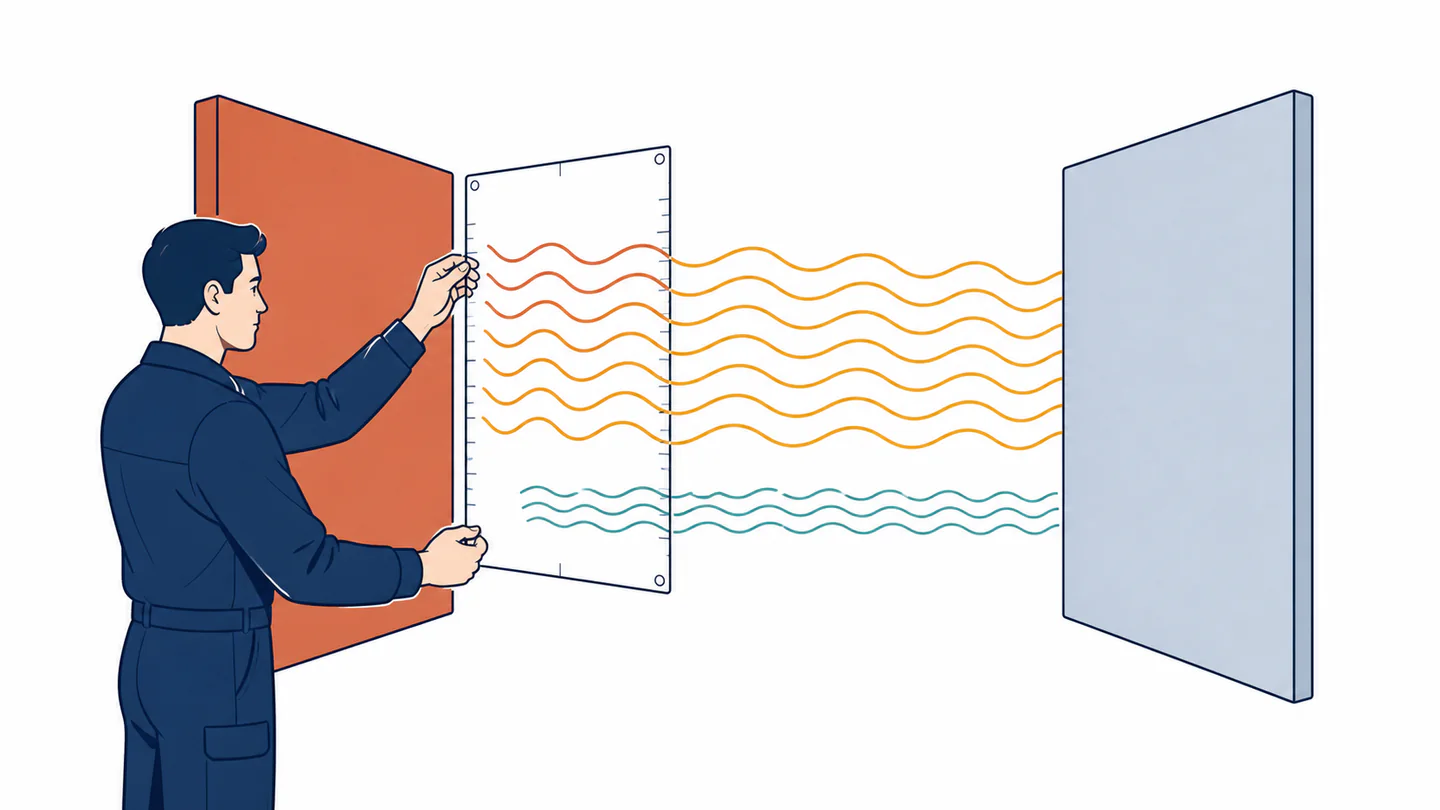
The Stefan–Boltzmann law can tell you the total radiative output of a blackbody and, with explicit engineering assumptions, the scale of real-surface emission or net exchange. It cannot identify emissivity from appearance, choose a radiative enclosure, or replace a complete heat-transfer model. The fourth power is the memorable part. Knowing when it applies is what makes it useful.