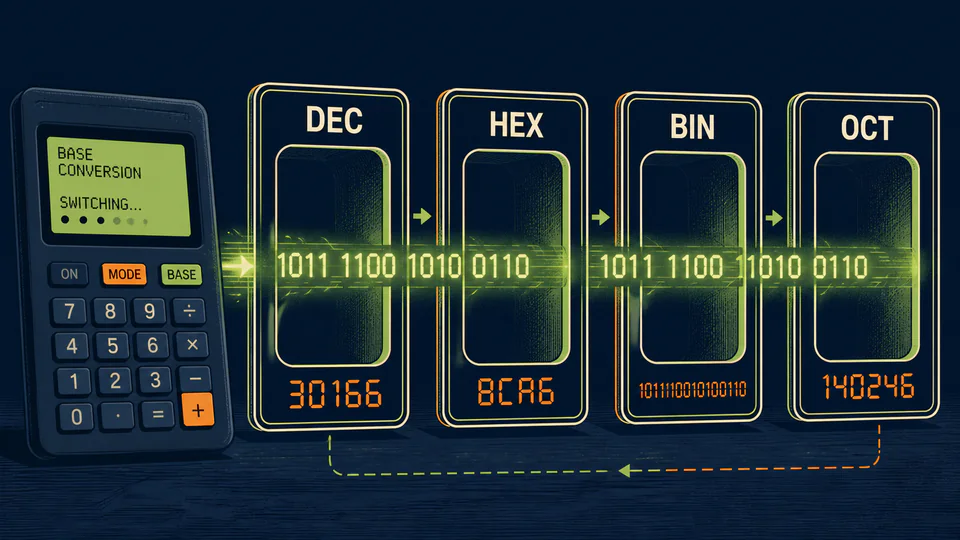
Switch a scientific calculator into hexadecimal mode and the number seems to change personality. Digits become letters. A value such as 31 can turn into 1F. The machine has not changed the quantity. It has changed the alphabet used to spell the same bit pattern.
That is the useful mental model for base-n mode: the representation changes first. The arithmetic rules then follow the selected number system and the calculator’s signed-value conventions.
One quantity can wear several costumes
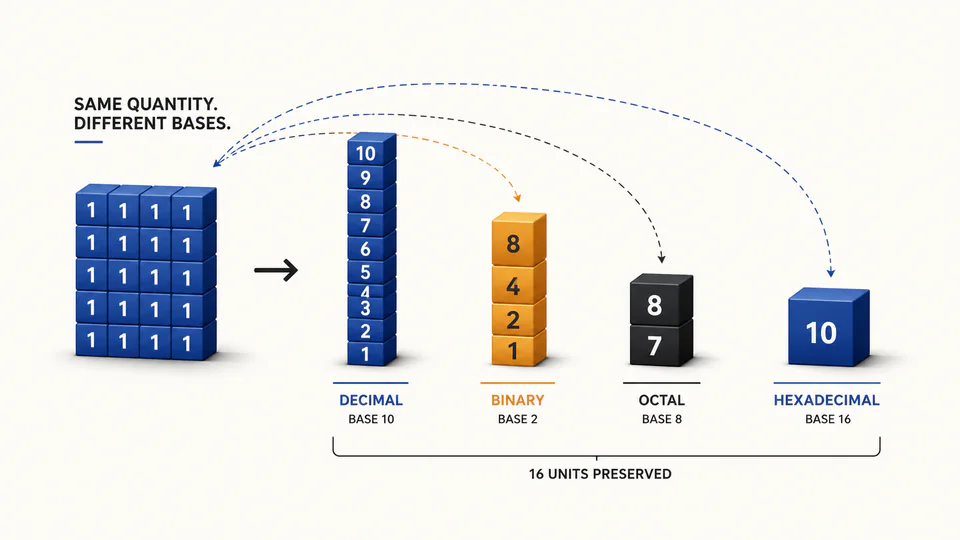
The number 31 in decimal is 11111 in binary and 1F in hexadecimal. Binary makes each bit visible. Hexadecimal groups four binary bits into one compact symbol, which is why it is convenient for inspecting patterns without writing a long string of ones and zeros.
Casio’s BASE-N manual exposes these modes as explicit display settings. The current base is part of the calculator’s interpretation of the input and its result, not a cosmetic filter applied after the calculation.
Hex is compact because four bits fit inside one symbol
Hexadecimal has sixteen symbols: 0 through 9 and A through F. Each symbol maps neatly to a four-bit group. This makes a long binary value easier to scan while preserving the bit boundaries that matter in digital logic.
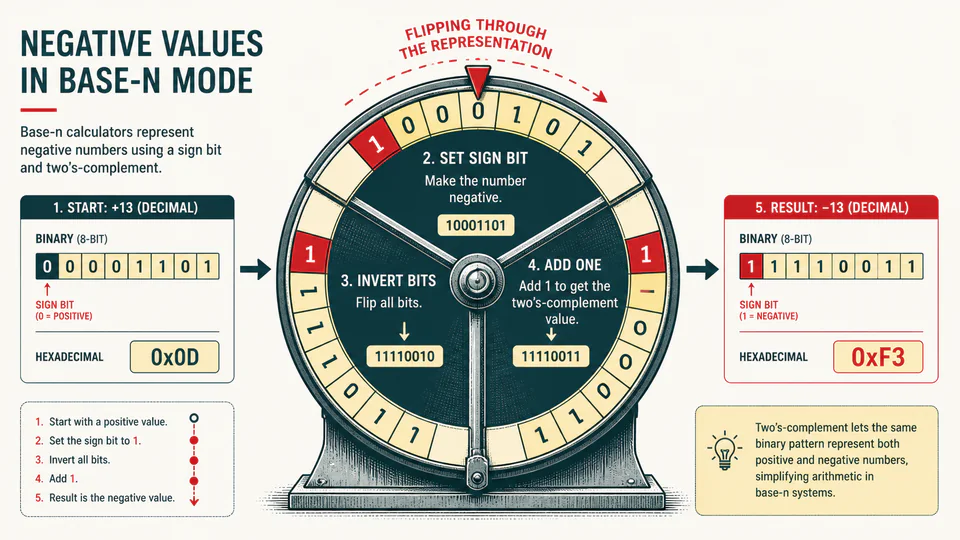
The visual compactness is not the same as mathematical simplicity. A hexadecimal subtraction still needs a rule for borrowing, and a negative value may need a signed representation rather than a leading minus sign.
Negative values reveal the machine’s conventions
Casio documents that negative binary, octal, and hexadecimal values may be handled through two’s complement. In that representation, the same fixed-width bit field can be read as a positive or negative value depending on the sign bit and the interpretation rule.
This is why a base-n calculator is not merely a converter. It is a small laboratory for seeing how number systems and hardware conventions meet.
Changing base does not change the bits. It changes the agreement about how to read them.