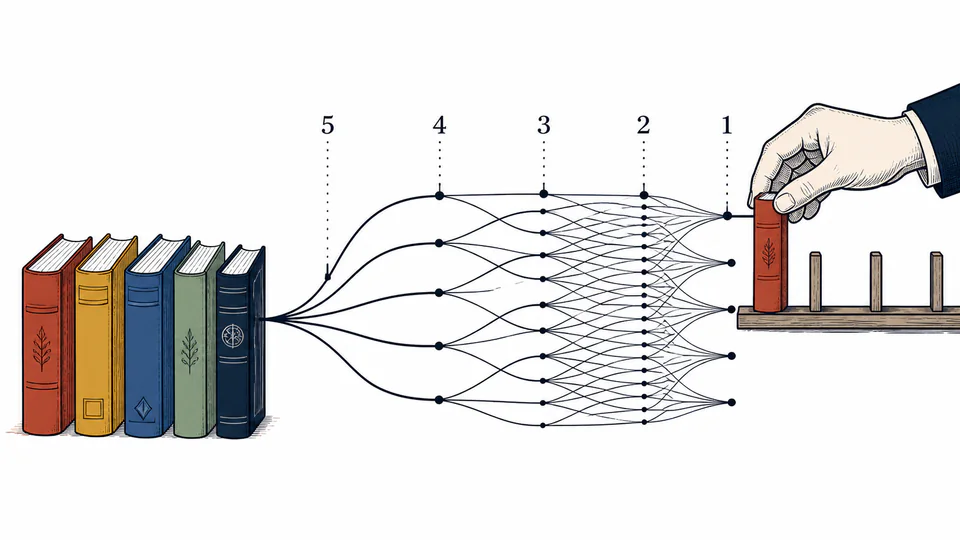
Five books are sitting in a stack. You clear one shelf and decide to display all five. The first slot can take any book. After that choice, four remain for the second slot, then three, two, and one. Nothing about the shelf looks enormous, yet it permits 120 different orders.
That is the story hidden inside 5!. The factorial key is not mainly a shortcut for a descending multiplication. It is a counting tool for situations where every object is distinct, every position is filled, and changing the order creates a different outcome.
The product follows the shrinking choice set
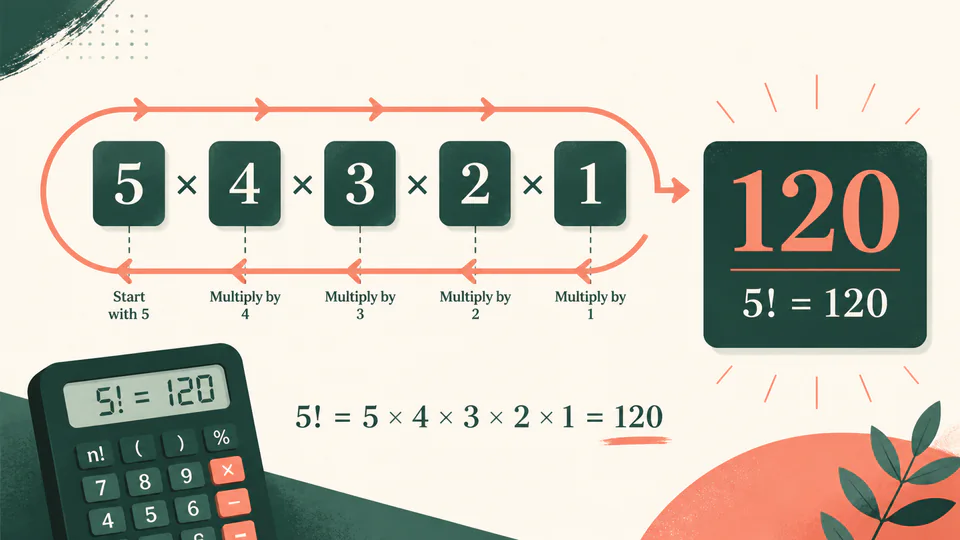
For the shelf, the count is:
The multiplication principle is doing the real work. Each first choice can be followed by four second choices. Each of those can be followed by three third choices, and so on. Factorial packages that repeated branching into one symbol:
n! = n x (n - 1) x (n - 2) x ... x 1
Three questions decide whether factorial fits
Factorial is often overused because the notation is memorable. Before pressing !, test the problem:
Here are three nearby problems that need different tools:
| Problem | Correct structure | Why |
|---|---|---|
| Arrange five different books | 5! = 120 | All five are used and every order is different |
| Choose three of five books for a bag | 5C3 = 10 | The selected group matters, not its listing order |
| Arrange the letters in LEVEL | 5! / (2! x 2!) = 30 | The two Ls and two Es create duplicate orders |
The repeated-letter example shows why “number of objects” is not enough. Factorial assumes labels that distinguish every object. When objects repeat, divide out the internal swaps that do not create a new visible arrangement.
Why zero factorial equals one
0! = 1 sounds like a special favor granted to formulas. It is better understood as a boundary count.
There is one way to arrange zero objects: leave the arrangement empty. The same value also preserves the recurrence
n! = n x (n - 1)!
because 1! = 1 x 0! requires 0! = 1. That single boundary value keeps permutation and combination formulas working when nothing is selected or everything is selected.
A small input can exceed the display
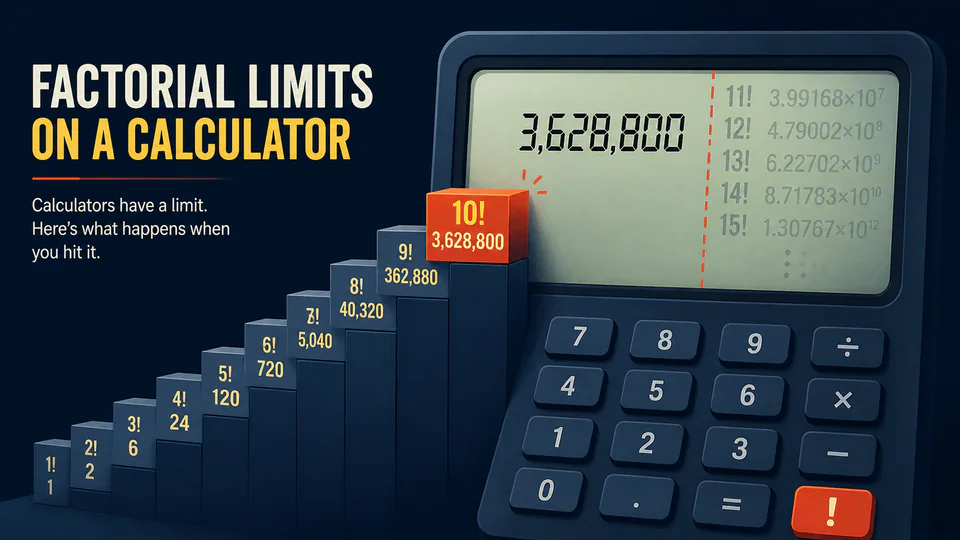
Factorial grows much faster than an exponential with a fixed base over the ranges people first encounter:
A calculator may switch to scientific notation, lose exact integer display, or report a range error. That is an implementation boundary, not evidence that factorial stopped being defined. Casio’s current manual describes its factorial command for zero or positive integer inputs; exact ranges and error behavior remain model-specific.
Do not ask only “can I press n!?” Ask whether the problem really contains n distinct objects filling n ordered positions.