Five slices shared between two plates gives two complete plates and one slice left over. Ordinary division compresses that story into 2.5. A remainder function preserves the discrete version: quotient 2, remainder 1.
That distinction is useful whenever the objects cannot be split: boxes, calendar cycles, seats, packets, or machine slots. The calculator is not merely finding a decimal; it is reporting two different parts of the division.
Quotient and remainder answer different questions
For 17 divided by 6, the quotient is 2 and the remainder is 5. The quotient answers “how many complete groups?” The remainder answers “how many units remain after those groups?” A calculator with a dedicated remainder-division key can show both rather than forcing the user to infer one from a decimal.
Casio documents a ÷R operation that returns quotient and remainder. It also documents a subtle state rule: only the quotient is stored in Ans memory or passed to a later operation on supported models.

The next operation may receive only the quotient
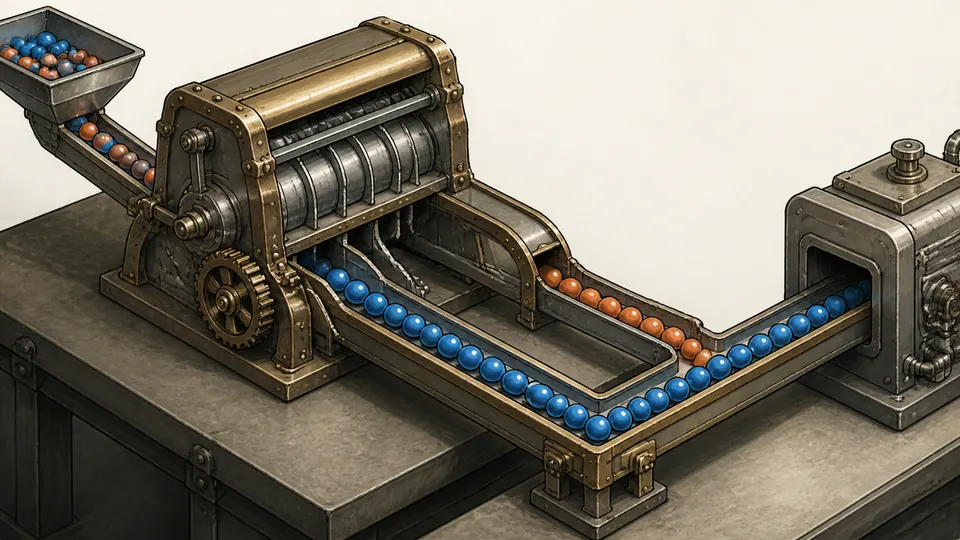
This is the detail that makes a remainder key a state-machine story, not just a school arithmetic shortcut. On the documented Casio behavior, 10 ÷R 6 can display quotient 1 and remainder 4, but a subsequent operation may continue with the quotient only. If you need the remainder, capture it explicitly rather than assuming the whole display is one ordinary number.
Remainders belong to discrete cycles
The key becomes intuitive when the divisor describes a cycle. Dividing minutes by 60 gives hours plus leftover minutes. Dividing an item count by a box capacity gives full boxes plus loose items. The remainder is the part that has not completed one full turn.

A decimal tells you how much division makes. A remainder tells you what the whole groups could not absorb.