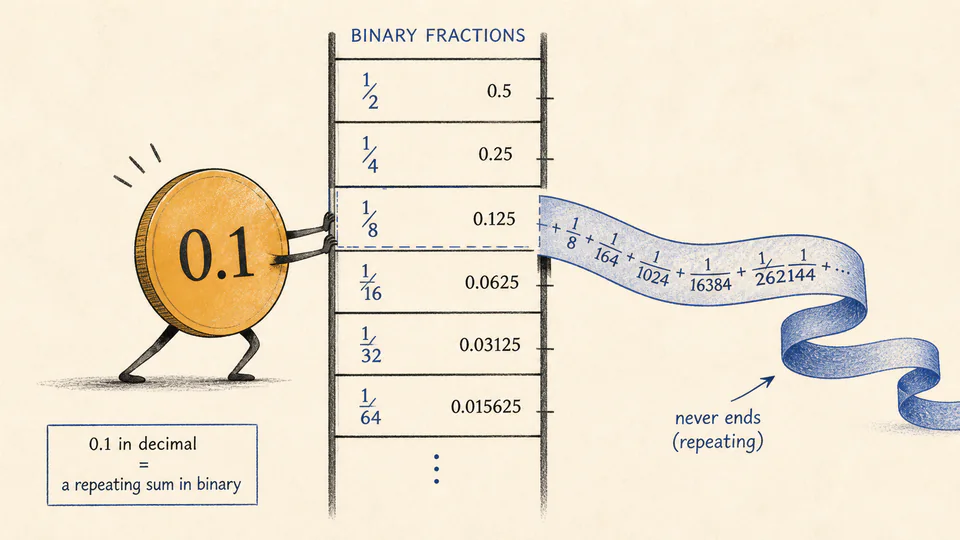
Write 0.1 on paper and it looks finished. There is no repeating tail, no ellipsis, no warning label. In a binary arithmetic system, however, 0.1 is usually a repeating fraction. The machine has to choose one of the nearby representable values and carry that choice into later operations.
This is not a calculator making a careless typo. It is a consequence of changing the base of the number system.
The base decides which fractions fit neatly
In decimal, one tenth is simple because 10 contains the factor 5 and the factor 2. In binary, the only prime factor available is 2. Fractions whose reduced denominators contain other factors keep expanding instead of ending.
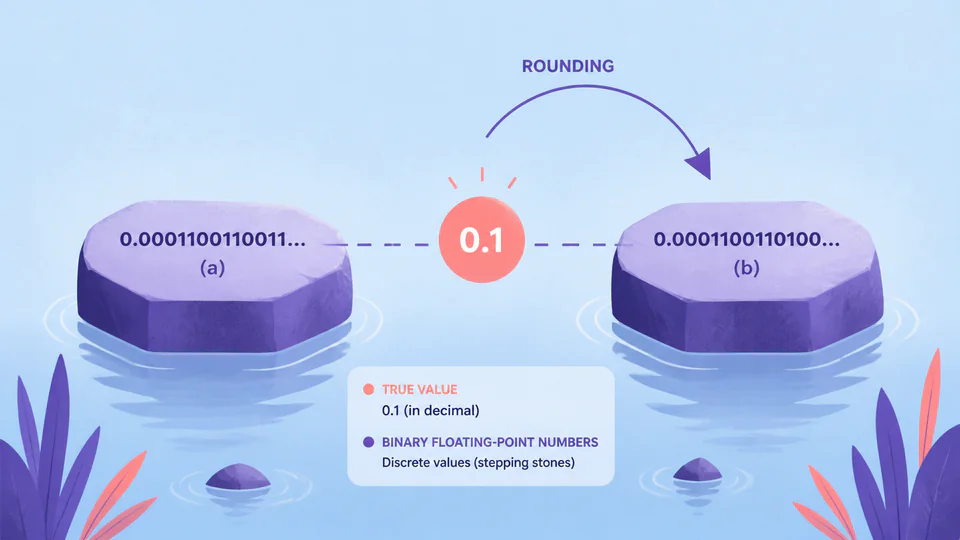
Oracle’s classic floating-point guide uses 0.1 as the example: in a binary format, the value lies strictly between two representable floating-point numbers. A finite storage format has to place it on one side or the other, with a small error.
A rounding decision can become visible later
Suppose a machine stores an approximation to 0.1, then adds it repeatedly. The initial difference may be tiny, but the operation is no longer working with the exact decimal fraction. After enough steps, the accumulated result can land just above or below a display threshold.
The size and visibility of this effect depend on the calculator’s internal number system. Some handheld calculators use decimal-coded or fixed-precision techniques rather than the same binary format used by general-purpose programming languages. The safe statement is not “all calculators show the same binary error.” It is that finite digital arithmetic must represent values in a finite set, and some decimal fractions do not fit that set exactly.
Representation has more than one layer
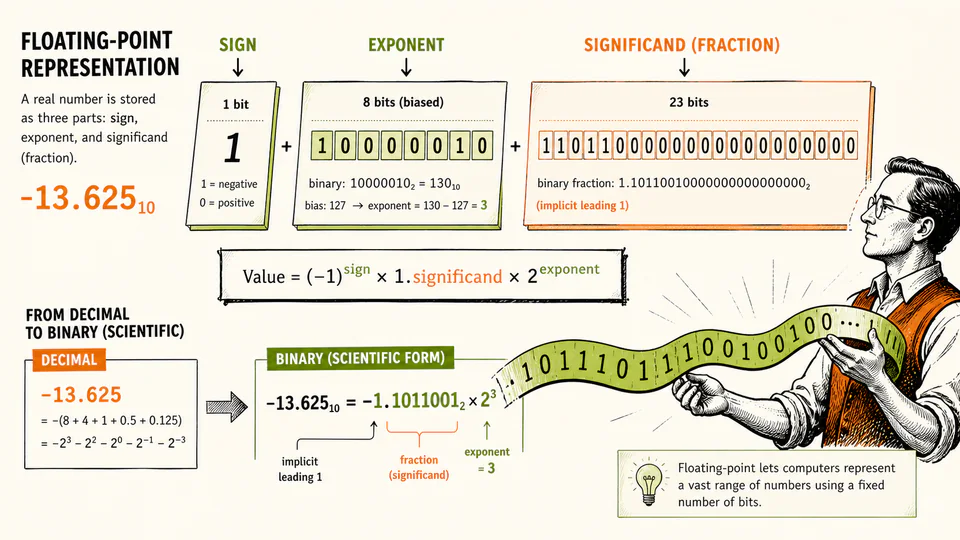
Floating-point formats typically divide a stored value into a sign, an exponent, and a significand. That arrangement gives a wide range with a finite number of meaningful digits. It is excellent for many scientific calculations, but it does not turn every decimal into an exact stored object.
The strange part of 0.1 is not the number. It is the base used to remember it.