The letter i looks almost comically small on a scientific calculator. Press it, however, and the number line grows a second direction. A result no longer has to be only left or right of zero. It can have a real part and an imaginary part, like a point on a map.
This is not a claim that imaginary numbers are fictional. It is a change in the coordinate system used to describe solutions that the ordinary real line cannot contain.
The real line runs out of room
The equation x squared + 1 = 0 has no real solution because the square of a real number is not negative. Mathematicians define i so that i squared equals -1. The definition opens a new axis instead of pretending the old one was wide enough.
Casio scientific calculator manuals treat complex calculations as a separate mode because the result needs different rules and display formats. A complex value can be written as a + bi, where a is the real part and b is the imaginary coefficient.
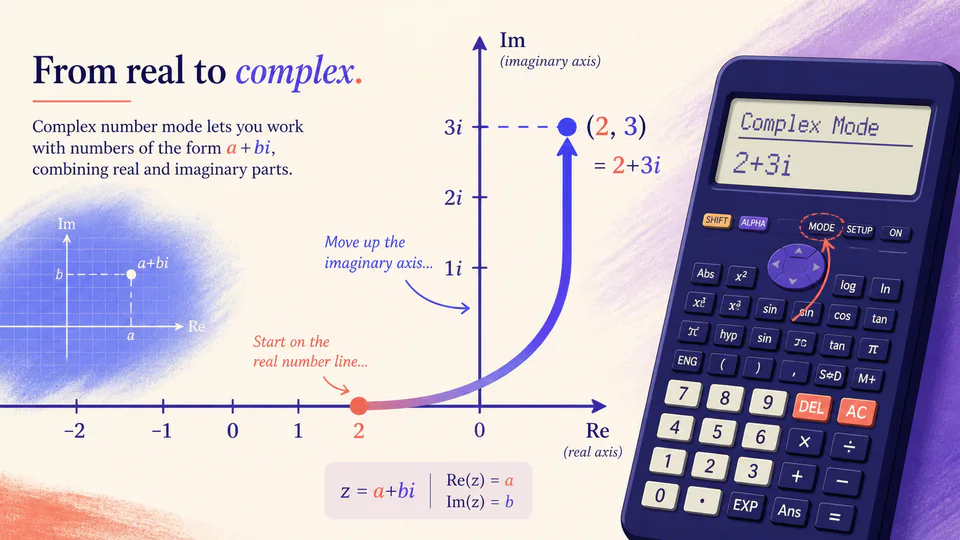
One point can have two useful descriptions
In rectangular form, a complex number is easy to add: combine the real parts and combine the imaginary parts. In polar form, the same point is described by a distance from the origin and an angle. The two forms are not competing answers. They emphasize different geometry.
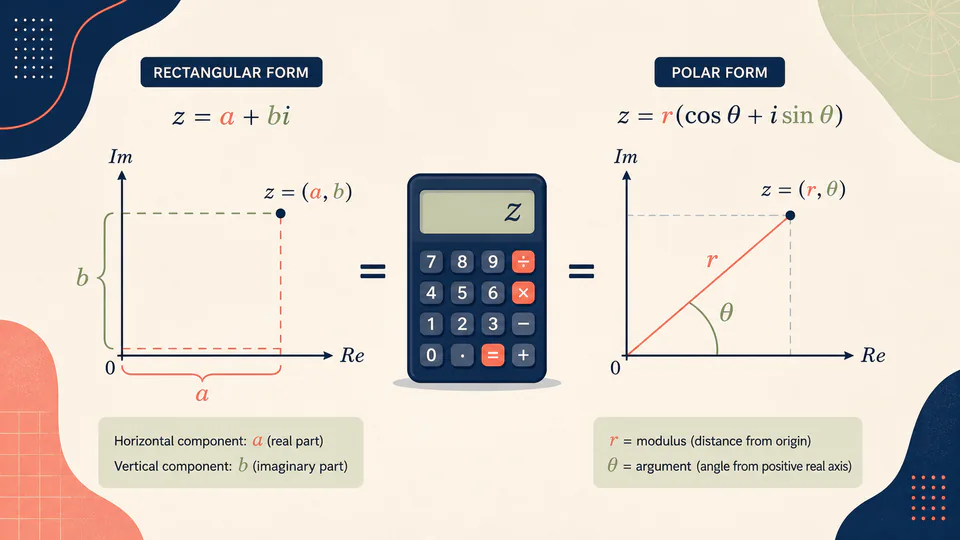
Multiplying by i is a quarter-turn
On the complex plane, multiplying by i rotates a point by a quarter-turn. Multiplying by i again rotates it another quarter-turn, producing -1. The small key therefore connects algebra to geometry: a symbol that changes a coordinate pair can also describe a rotation.
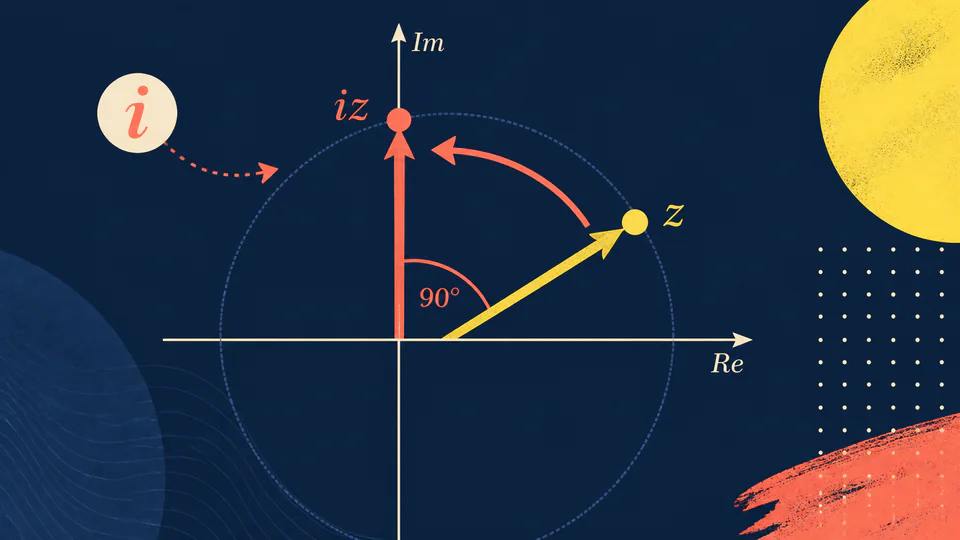
The i key is where a calculator admits that one number line is not enough for every equation.