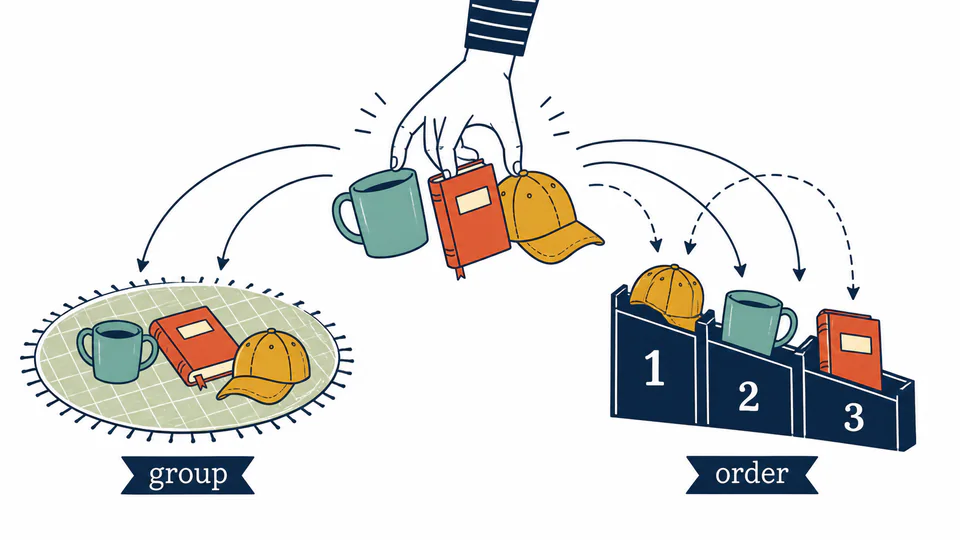
Ten finalists are waiting backstage. Choosing four people for a photo produces one group. Choosing gold, silver, bronze, and fourth place produces an ordered result. The same people can be involved, but the question is counting a different kind of outcome.
That is the whole difference between nCr and nPr: does each selected item merely belong to the group, or does it occupy a named position?
Work one problem both ways
Suppose 10 people are available and 4 are selected.
For a four-person committee, Alice-Ben-Chen-Dara is the same committee as Dara-Alice-Chen-Ben. Order is invisible:
10C4 = 210
For four ranked places, those two listings are different because first place and fourth place are not interchangeable:
10P4 = 5,040
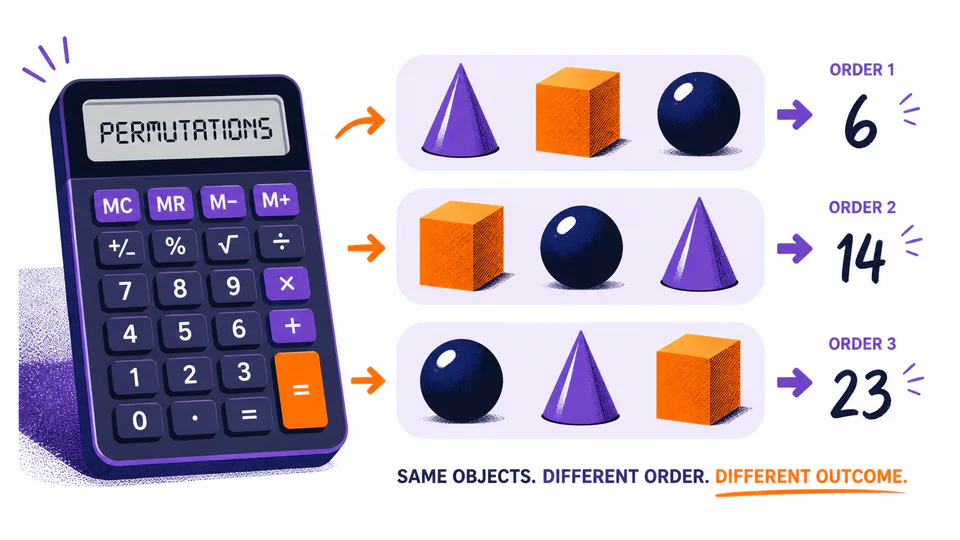
The gap is not mysterious. Every four-person group can be ordered internally in 4! = 24 ways:
A decision path before the buttons
Use this sequence before choosing a key:
This catches the most common mistake: seeing the words “choose” or “select” and pressing nCr automatically. A password chooses symbols, but position matters. A three-person panel may have a chair, a recorder, and a presenter; those named roles make it a permutation problem even though the people were “selected.”
| Situation | Does order matter? | Likely tool |
|---|---|---|
| Pick 5 cards for a hand | No | nCr |
| Award 1st, 2nd, and 3rd places | Yes | nPr |
| Choose 3 people, then assign 3 distinct jobs | Yes | nPr, or nCr followed by 3! |
| Create a 4-digit code where digits may repeat | Yes, with replacement | Neither basic nPr nor nCr alone |
Why the formulas differ
Both formulas begin with choices from n distinct objects:
The extra r! in the combination denominator is the important part. It removes repeated descriptions of the same group. It is not arbitrary algebra; it is a duplicate-removal mechanism.
Inputs have boundaries
For the ordinary calculator functions, n and r represent nonnegative integers with 0 <= r <= n. A Casio manual for the cited model gives that condition explicitly and also states a model-specific upper bound. Other devices can have different numeric ranges.
Three boundary cases are worth recognizing:
nC0 = 1: there is one way to choose nothing.nCn = 1: there is one way to choose everything.nP0 = 1: there is one empty ordered selection.
If r > n, the story itself has failed: you cannot select more distinct objects than are available without replacement.
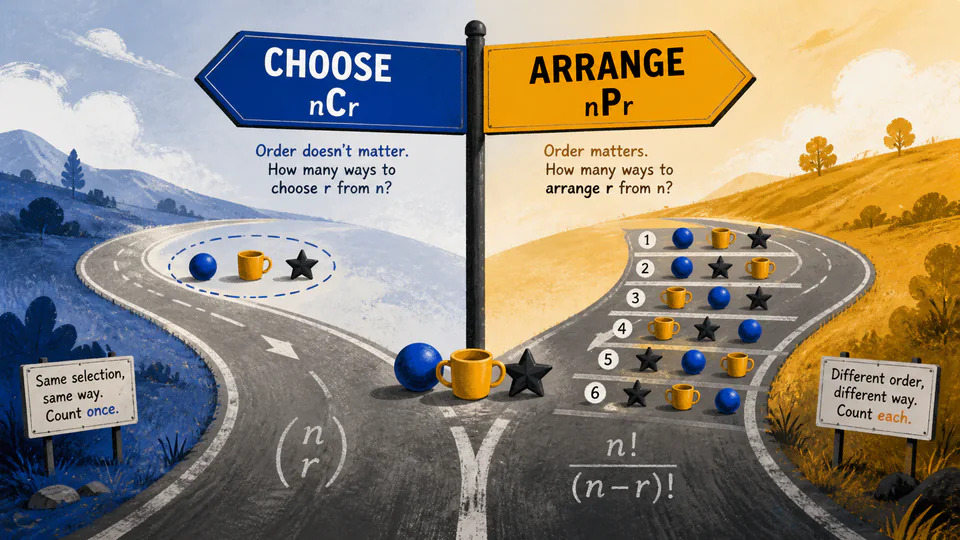
If swapping two selected items changes the answer, the positions have names and order belongs in the count.