Parentheses are the handrails of an expression. They stop a calculator from treating a group of numbers as loose furniture and give that group a boundary.
That boundary changes more than sequence. It changes what counts as an argument, what can be passed into a function, and which intermediate value is allowed to exist before the next operator acts.
Order is only the visible benefit
In 2 x (3 + 4), the parentheses force 3 + 4 to become one value before multiplication. But the deeper change is structural: the multiplication operator receives the result of a complete inner expression. Without the boundary, the input is parsed according to the calculator’s precedence rules instead.
Casio manuals explicitly discuss inputting expressions and omitting a final closed parenthesis on some models. That convenience is possible only because the calculator is tracking an open structure, not merely counting characters.

A function needs a boundary even when precedence looks obvious
Functions such as square root, logarithm, or sine take an argument. sin(30 + 5) means something different from sin(30) + 5. The parentheses are not decoration around a number; they identify the material that belongs inside the function.
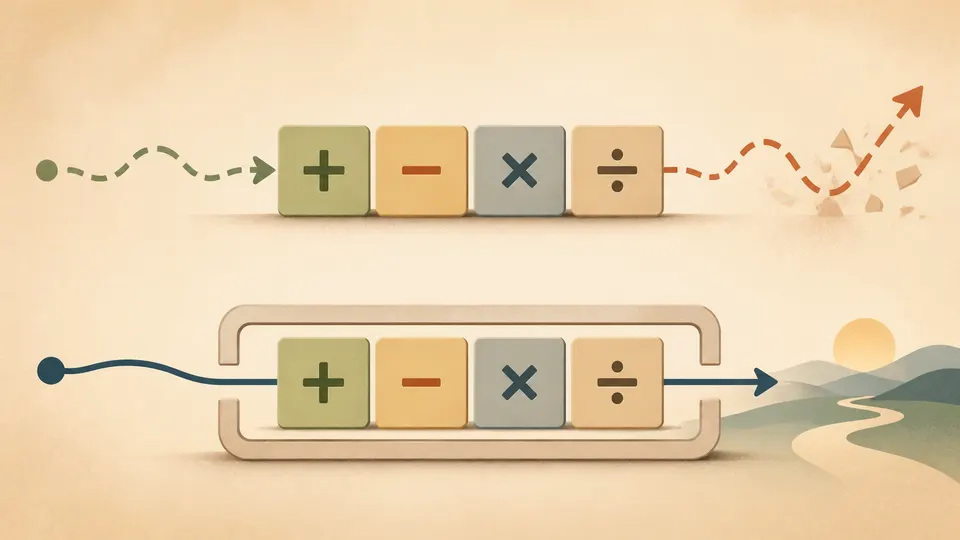
The parser is keeping a stack of open doors
A calculator does not need to understand the entire page the way a human reader does. It can track nesting depth, operators waiting for operands, and the values returned when a group closes. That compact bookkeeping is enough to make a two-character boundary feel like mathematical intent.

Parentheses are not extra punctuation. They are the walls of the room where a calculation happens.