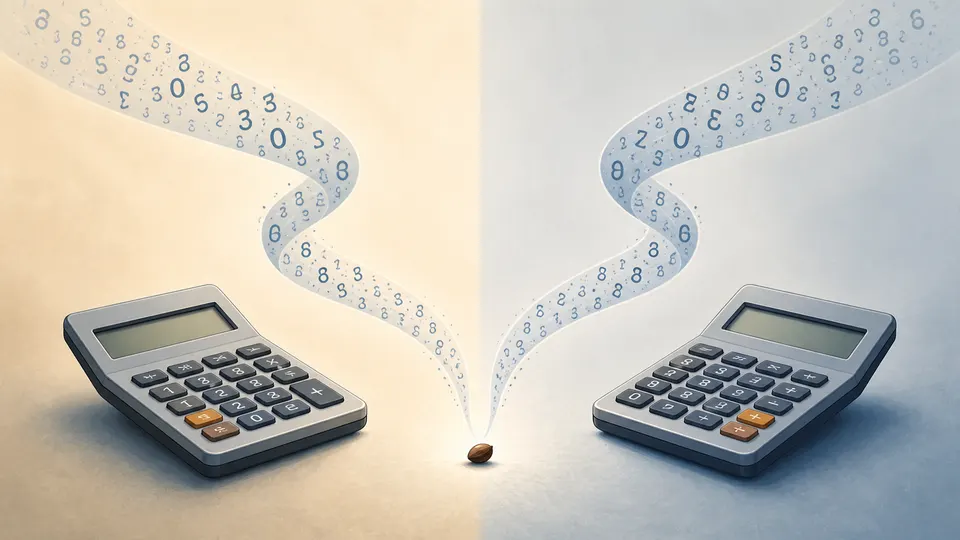
Two calculators can roll the same “random” number if they begin with the same seed. That sounds like cheating until you remember what the machine is: a small deterministic device, not a weather system in a box.
Calculator random functions use a formula to generate a sequence that looks irregular enough for classroom probability, simulation, and games. The sequence is reproducible by design. It is not a source of cryptographic randomness.
The seed is the first tile in the pattern
The seed initializes the generator. After that, each output becomes part of the next internal step. TI guidebooks describe rand as producing a pseudo-random number between 0 and 1 and explain that storing a seed controls the resulting sequence.
This is useful when a teacher wants every student to reproduce the same experiment, or when a programmer wants a test case that can be replayed after a bug. Repeatability is a feature, not a failure.
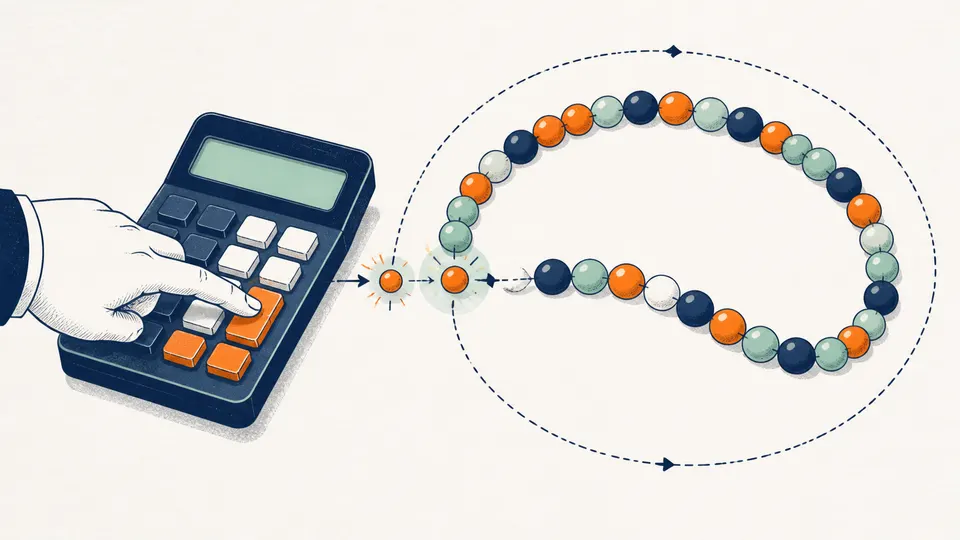
A deterministic sequence can still be statistically useful
“Pseudo” does not mean “useless.” A good generator spreads values through its range and avoids obvious short patterns for the intended use. The calculator does not promise perfect independence forever; it provides a compact approximation that is adequate for many educational examples.
Physical chance is a different machine
A coin toss gets its unpredictability from physical conditions: force, angle, air, and surface. A calculator has no such source unless it deliberately samples one. It is executing arithmetic instructions, so its random key belongs to numerical experimentation rather than security engineering.
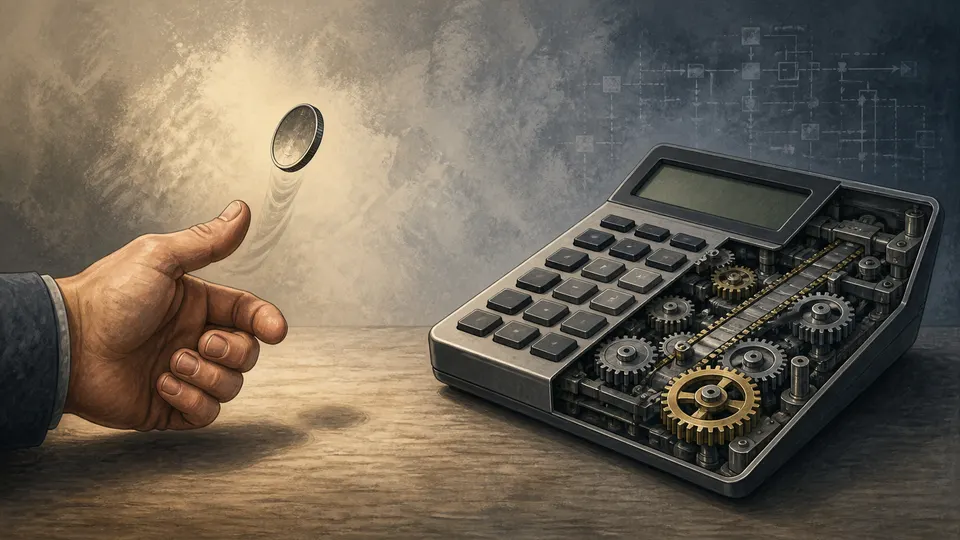
A calculator can make a sequence look wild without ever leaving the rules of a formula.