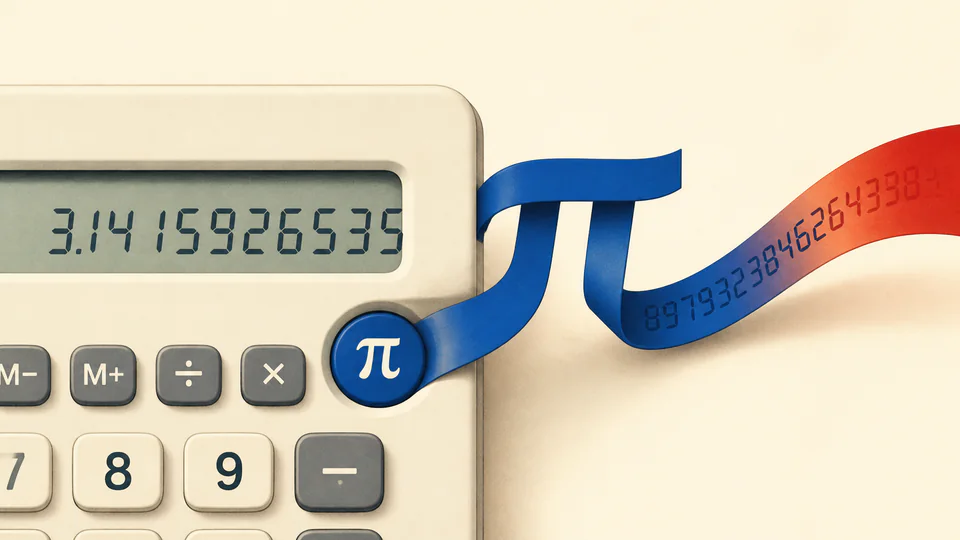
The pi key looks like a tiny vault. Press it and the calculator produces 3.14159265359, a tidy string that feels authoritative. The real constant is less tidy. Its decimal expansion does not terminate, so the key is not opening an infinite storehouse. It is inserting a finite approximation chosen for the calculator’s internal precision.
That sounds like a compromise. It is actually what makes a constant usable inside a finite machine.
The circle supplies the idea
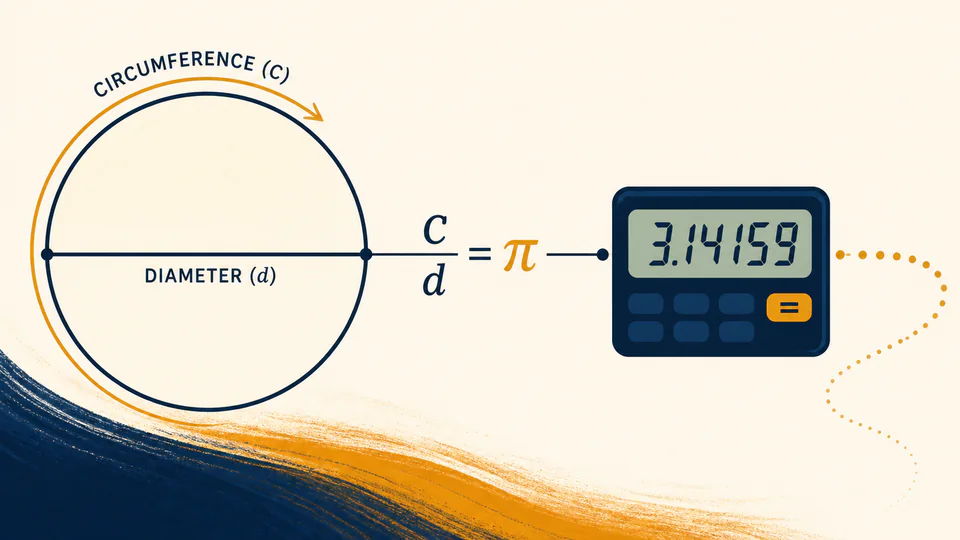
Pi is the ratio of a circle’s circumference to its diameter. The ratio is exact as a mathematical definition even though its decimal expansion never settles into a finite repeating block. NIST’s PiDigits dataset gives the opening digits as 3.1415926535897932384 and uses the constant as a reference for numerical testing.
The calculator does not need every digit to calculate an ordinary circle. It needs enough digits that the rounding error stays below the error budget of the problem.
A constant can be exact without being fully written
There is a useful difference between a value and one of its spellings. The symbol pi names the exact constant. The decimal text on the display names only the visible approximation. Internally, the calculator may keep more precision than it shows; it still cannot keep an infinite expansion in finite memory.
This is also why typing the displayed digits manually is not always equivalent to pressing the pi key. The key can insert the implementation’s stored constant, while the typed decimal is a new input that may be rounded differently.
More digits are useful only when the problem can use them
A longer pi string can reduce rounding error, but only until another part of the calculation becomes the limiting factor. Measurement uncertainty, input precision, display limits, and the algorithm used for the rest of the expression may dominate first.
The question is not “how many digits does pi have?” It is “how many digits does this calculation need?” The pi key answers that practical question for the machine’s own numerical scale.
The pi key is not an infinite number trapped in plastic. It is a carefully chosen abbreviation.