Combining assay batches
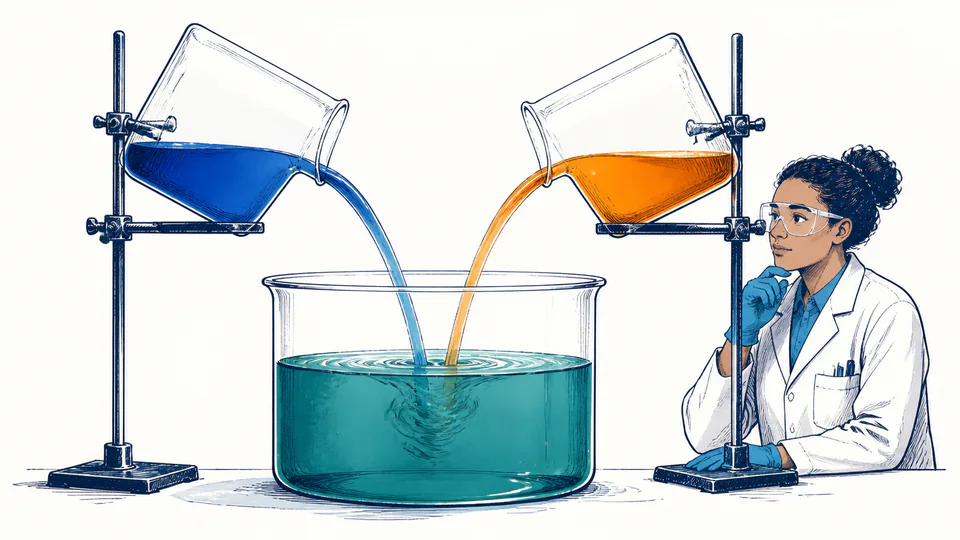
Mixing 20 mL at 100 mM with 30 mL at 20 mM gives 2600 umol in 50 mL, or 52 mM. Source A contributes 76.9% of the solute.
Chemistry and laboratory planning
Calculate the homogeneous post-mixing concentration of two nonreacting solutions of the same solute from separate concentrations and volumes.
Chemistry / mixture balance
Here “equilibrium” means the uniform concentration after complete physical mixing of two nonreacting portions of the same solute. It does not calculate a thermodynamic equilibrium constant, dissociation, partitioning, or reaction extent.
LIVE CURRENT-VALUE ANALYSIS
Source widths follow current volumes, color intensity follows concentration, and the final vessel reports the weighted concentration and amount contributions.
| Balance item | Input or subtotal | Operation | Current result | Unit |
|---|
DETAILED CALCULATION PROCESS
nA = cA VA; nB = cB VB; cf = (nA + nB) / (VA + VB)
Compute each source amount independently, add amounts and nominal volumes, then divide. Keeping the source ledgers separate exposes which portion contributes the solute.
| Symbol | Meaning | Unit | Default basis |
|---|---|---|---|
| cA | Concentration of source A | mM | 100 |
| VA | Volume of source A | mL | 20 |
| cB | Concentration of source B | mM | 20 |
| VB | Volume of source B | mL | 30 |
| nT | Total solute amount | umol | 2600 |
| cf | Uniform post-mixing concentration | mM | 52 |
HOW TO USE THIS CALCULATOR
CHEMISTRY FOUNDATIONS
DEEP ANALYSIS 1
At the default, A is only 40% of volume but supplies about 76.9% of solute because it is five times as concentrated as B.
DEEP ANALYSIS 2
Some solvent systems contract or expand on mixing. If precision requires measured final volume, replace the additive-volume assumption with that measurement.
DEEP ANALYSIS 3
The final concentration should lie between cA and cB for positive volumes. A value outside that interval signals a unit, identity, or arithmetic error.
RESULT INTERPRETATION
The endpoint concentration answers a material-balance question; it does not prove adequate mixing time.
The contribution percentages allocate solute amount, not physical volume or uncertainty.
REAL USE CASES
Mixing 20 mL at 100 mM with 30 mL at 20 mM gives 2600 umol in 50 mL, or 52 mM. Source A contributes 76.9% of the solute.
Mixing 5 mL at 200 mM with 45 mL at 0 mM yields 20 mM. This reproduces an ordinary tenfold dilution through a two-source balance.
EVIDENCE AND DATA QUALITY
Retain solution identities, concentration methods, delivered-volume records, vessel and mixing protocol, temperature where volume matters, timestamps, and the exported source-amount ledger.
LIMITS AND EXCLUSIONS
TERMS USED HERE
RELIABLE SOURCES
FREQUENTLY ASKED QUESTIONS
It gives both sources equal weight even when their volumes differ.
Yes; it then acts as a diluent while retaining its entered volume.
Yes. The result is a valid zero-solute mixture with zero contribution percentages.
No. The title uses equilibrium only for the fully mixed physical endpoint.
Track each species separately or use a reaction model; combining them as one solute is invalid.
If contraction or expansion is material, calculate with a verified final volume in a suitable method rather than assuming additivity.
IMPORTANT BOUNDARY
Use this as a nominal same-solute mass balance, not evidence of chemical equilibrium, compatibility, sterility, complete mixing, or regulatory release.