c

Chemistry and laboratory planning

Dilution Lab Table Calculator

Build a row-by-row constant-ratio serial dilution table with tube concentration, cumulative dilution factor, diluent demand, and usable residual volume.

Chemistry / laboratory workflow

Plan every transfer in a serial dilution run

This calculator turns one repeated transfer rule into a tube-by-tube protocol. Unlike a one-step dilution, it tracks cumulative concentration and verifies that assay withdrawal still leaves enough liquid for the next transfer.

Per-step dilution-
Final concentration-
Cumulative dilution-
Total fresh diluent-
Residual per tube-

LIVE CURRENT-VALUE ANALYSIS

Serial tube concentration trajectory

Each current tube is drawn on a logarithmic concentration scale, with cumulative factor and concentration labels generated from the exact table rows.

Waiting for valid inputs.
Tube-by-tube serial dilution tableCurrent unrounded calculation path
The table is executable only if every tube is mixed before transfer and the residual-volume column remains nonnegative.
TubeTransfer in (uL)Diluent (uL)Mixed volume (uL)Concentration (mM)Cumulative DFResidual after removals (uL)
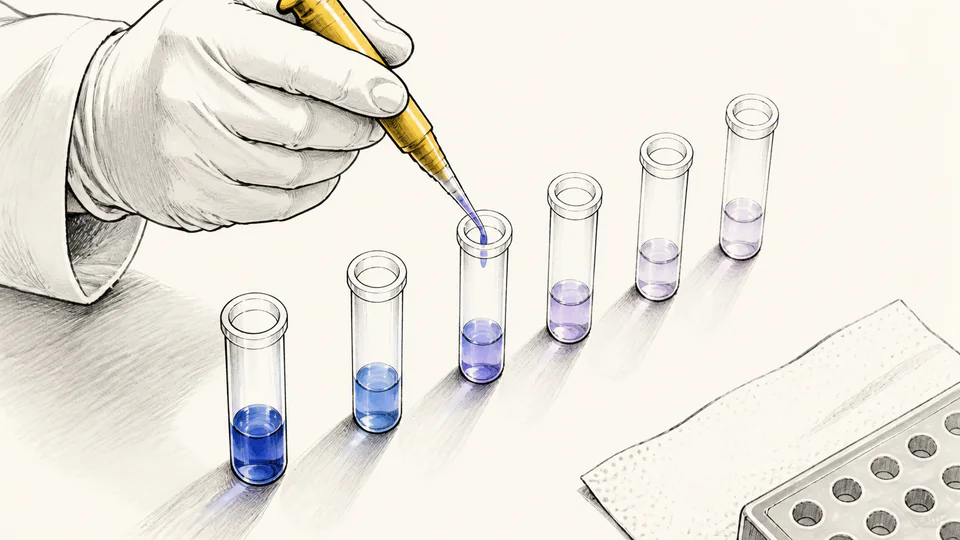
Gloved hand transferring liquid along a row of progressively lighter serial dilution tubes
A serial dilution is a relay: each tube inherits the concentration and handling quality of every previous transfer.

DETAILED CALCULATION PROCESS

Formula, units, current substitution, and reconciliation

1. Governing relation

f = Vtransfer / (Vtransfer + Vdiluent); ci = c0 f^i; DFi = f^(-i)

Each tube receives a fresh diluent volume and one transfer from the previous tube. The model assumes complete mixing before the next transfer and identical nominal volumes at every step.

2. Symbols and default basis

SymbolMeaningUnitDefault basis
c0Starting concentrationmM10
VtTransfer volumeuL100
VdFresh diluentuL900
fConcentration fraction retained each stepdimensionless0.1
iTube or dilution stepinteger1 to 6
DFiCumulative dilution factordimensionless10^i

3. Unit normalization

  • Transfer and diluent volumes are both in uL, so their ratio is dimensionless.
  • The starting and all tube concentrations remain in mM.
  • 10 nM equals 0.00001 mM; the table retains mM to preserve one consistent calculation unit.

4. Current numerical substitution

    5. Independent reconciliation

    HOW TO USE THIS CALCULATOR

    Lay out a constant-ratio serial dilution tube by tube

    1. Choose a transfer volume that is reliable for the available pipette.
    2. Choose fresh diluent so the per-step factor spans the required range without excessive steps.
    3. Enter the number of receiving tubes and any assay withdrawal taken from each.
    4. Review every row, especially residual volume before executing the physical transfer sequence.
    5. Label tubes in advance and export the table with pipette, mixing, and timing records.

    CHEMISTRY FOUNDATIONS

    How transfer volume compounds into cumulative dilution

    Serial errors accumulate
    Every transfer and mixing error propagates into all downstream tubes.
    The ratio uses mixed volume
    The concentration fraction is transfer divided by transfer plus fresh diluent.
    Cumulative dilution is multiplicative
    Six tenfold steps produce 10^6, not a sixtyfold dilution.
    Mix before transfer
    Without complete mixing, the next aliquot does not represent the calculated concentration.
    Residual volume is a workflow constraint
    A mathematically valid ratio can still fail if transfers and assay withdrawals exhaust a tube.

    DEEP ANALYSIS 1

    Selecting the number of steps

    Use fewer steps with larger factors to reduce handling, but avoid aliquots outside calibrated ranges. More steps improve operational scale at the cost of accumulated uncertainty.

    DEEP ANALYSIS 2

    Log scale is the honest visual

    Serial concentrations often span orders of magnitude. The tube graphic uses log position so late tubes remain distinguishable rather than collapsing to zero.

    DEEP ANALYSIS 3

    Why downstream replicates are correlated

    All tubes share upstream preparation errors. Replicates drawn from one chain are not independent preparation replicates.

    RESULT INTERPRETATION

    Read concentration and usable residual volume together

    Final concentration is a nominal endpoint based on exact transfer ratios; it is not an assay of the last tube.

    Residual volume is the post-transfer, post-assay amount available in each intermediate tube under the repeated workflow.

    REAL USE CASES

    A routine dilution series and a residual-volume failure

    Six-point microbial dilution

    A 10 mM tracer with 100 uL into 900 uL for six steps reaches 0.00001 mM and cumulative DF 1,000,000 while retaining 800 uL after a 100 uL assay draw and next transfer.

    Twofold assay plate series

    A 100 uL transfer into 100 uL diluent yields a twofold series. If 120 uL is also withdrawn before the next transfer, the protocol is invalid because only 100 uL would remain after transfer.

    EVIDENCE AND DATA QUALITY

    Keep the tube map, pipette record, and transfer order

    Retain tube map, diluent lot, calibrated pipette IDs and ranges, tip-change policy, mixing method and cycle count, transfer order, timestamps, plate mapping, and any gravimetric verification.

    LIMITS AND EXCLUSIONS

    Where a constant-ratio serial protocol is insufficient

    • Assumes the same transfer and diluent volumes at every step.
    • Assumes complete mixing before each downstream transfer.
    • Does not propagate pipette bias, imprecision, carryover, or evaporation.
    • Does not model changing matrix composition or adsorption at low concentration.
    • Supports 1 to 24 steps to keep the protocol and report inspectable.

    TERMS USED HERE

    Vocabulary for serial transfers, cumulative factor, and carryover

    Serial dilution
    Sequence in which each dilution supplies the next.
    Transfer volume
    Aliquot moved from one mixed tube to the next.
    Step factor
    Dilution factor produced by one transfer/diluent pair.
    Cumulative factor
    Product of all step factors through a given tube.
    Residual volume
    Liquid remaining after downstream transfer and assay withdrawal.
    Carryover
    Unintended material transferred by a tip or vessel between steps.

    RELIABLE SOURCES

    Solution concentration and laboratory-unit references

    FREQUENTLY ASKED QUESTIONS

    Why must the step count be an integer? and related questions

    Why must the step count be an integer?

    Each step corresponds to a physical receiving tube.

    Can assay withdrawal be zero?

    Yes; the residual then accounts only for the downstream transfer.

    Why is the final value shown in mM?

    All rows use one unit for consistent arithmetic; convert the final value for reporting if needed.

    Can I use a different ratio in each tube?

    Not on this page; a variable-ratio protocol needs a row-specific model.

    Why does withdrawal have a limit?

    The tube must retain the requested next transfer plus the assay portion without going negative.

    Does the model include pipette uncertainty?

    No. Use calibration and replicate data for an uncertainty analysis.

    IMPORTANT BOUNDARY

    A nominal transfer table, not a pipette uncertainty study

    This nominal table is not a substitute for a validated dilution SOP, pipette qualification, contamination controls, uncertainty analysis, or assay-specific acceptance criteria.