Chemistry and reaction planning
Stoichiometry Reaction Calculator
Determine the limiting reagent, maximum reaction extent, theoretical product mass and pure excess remaining from two measured reactants and a balanced equation.
CURRENT STOICHIOMETRIC MODEL
Enter the chemical assumptions
For chemistry students, laboratory planning and batch checks where both reactants may constrain product.
LIVE DECISION VIEW
Which reactant sets the reaction extent?
The shorter reactant-capacity bar sets the achievable extent; the chart redraws from the current masses, purities and coefficients.
| Quantity | Formula path | Current value | Interpretation |
|---|
HOW TO USE
Use Stoichiometry Reaction Calculator without hiding assumptions
- Enter gross masses and assay purities for both reactants.
- Enter molar masses and the balanced coefficients exactly as written for aA + bB -> cP.
- Compare extent capacities, then inspect theoretical product and excess remaining.
- Treat the result as a stoichiometric ceiling, not a guaranteed isolated yield.
CURRENT CALCULATION PROCESS
Formula, substitution, intermediate steps and final check
xi_max = min(n_A/a, n_B/b); n_P = c xi_max; m_P = n_P M_P.
Correct each gross mass for purity, convert to moles, divide each amount by its balanced coefficient, and use the smaller extent capacity.
Waiting for valid inputs.
MODEL EXPLANATION
Reaction extent makes unlike reactants comparable
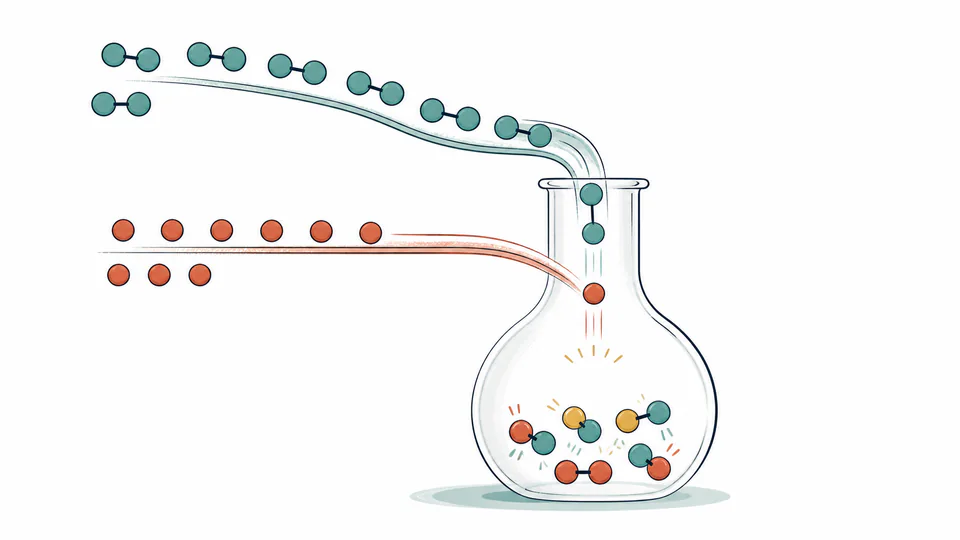
Moles of A and B cannot be compared directly when their coefficients differ. Dividing each amount by its coefficient expresses how many moles of the balanced reaction that reactant can support.
The limiting reagent is consumed at the maximum idealized extent. Excess remaining is a pure-mole balance; solvents, side reactions and equilibrium are outside this calculation.
SYMBOLS AND VARIABLES
Read the formula before relying on the result
| Symbol | Unit or range | Meaning |
|---|---|---|
| xi | mol | extent of reaction |
| n_A, n_B | mol | usable amounts after purity correction |
| a, b, c | dimensionless | balanced-equation coefficients |
| M_P | g mol^-1 | product molar mass |
WORKED EXAMPLE
Default two-reactant case
- A provides 10 x 0.98 / 50 = 0.196 mol and an extent capacity of 0.196 mol.
- B provides 12 x 0.95 / 60 = 0.190 mol; dividing by coefficient 2 gives 0.095 mol reaction extent.
- B limits the reaction. Product = 1 x 0.095 x 110 = 10.45 g, while 0.101 mol A remains.
CHEMISTRY FOUNDATIONS
Balanced-equation foundations
- Coefficients are mole ratios, not mass ratios.
- Purity must be applied before converting gross mass to reacting moles.
- A stoichiometric tie can occur when extent capacities agree within numerical tolerance.
- Theoretical product assumes the limiting reagent is consumed along the stated reaction path.
DEEPER ANALYSIS
When this simple reaction model needs extension
- Reversible reactions require an equilibrium model rather than complete limiting-reagent consumption.
- Multiple products require separate selectivity or branching assumptions.
- Hydrates, solvates and solution assays must be reflected in molar mass and purity definitions.
- Scale-up also needs heat transfer, mixing, addition order and safety review.
REAL-WORLD CASE
Case: planning a generic synthesis charge
A chemist has assayed lots of two reagents and wants to know which lot constrains a trial charge.
The extent comparison exposes that additional A would not increase theoretical product while B remains limiting.
The product mass becomes the theoretical basis for a later yield calculation, not a promise of recovered material.
TERMS
Page-specific chemistry vocabulary
- Limiting reagent
- Reactant with the smallest coefficient-normalized amount.
- Excess reagent
- Reactant remaining after the limiting reagent is ideally consumed.
- Extent of reaction
- Common progress variable tied to stoichiometric coefficients.
- Theoretical yield
- Maximum product implied by the stated stoichiometry.
- Assay purity
- Fraction of gross material treated as the reacting species.
LIMITS AND DISCLAIMER
Where this model stops
- Requires a correctly balanced single-path equation.
- Assumes stated purities apply on the same mass basis.
- Does not model equilibrium, kinetics, selectivity or work-up loss.
- Molar masses must match the actual chemical forms used.
- Laboratory and process safety decisions require substance-specific review.
Educational stoichiometric planning only; verify chemical identity, balanced equations, assays, hazards and operating procedures before real work.
Frequently asked questions
Why divide moles by the coefficient?
That converts each reactant amount into the reaction extent it can support.
Can the heavier reactant still be limiting?
Yes. Limitation depends on moles and coefficients, not gross mass alone.
What does a stoichiometric tie mean?
Both reactants support essentially the same reaction extent under the entered assumptions.
Should solvent mass be included?
No, unless the solvent is a reacting species represented in the balanced equation.
Does theoretical product include expected yield?
No. This page reports the stoichiometric ceiling; use the Yield Calculator for recovered product.
Can I enter fractional coefficients?
This implementation requires equivalent positive whole-number coefficients to keep the reaction ledger auditable.
SOURCES