Chemistry and reaction planning
Stoichiometry Yield Calculator
Calculate theoretical product, purity-corrected actual product, percent yield and recovery difference from a limiting reagent and isolated product assay.
CURRENT STOICHIOMETRIC MODEL
Enter the chemical assumptions
For laboratory reports and process reviews that must distinguish gross isolated mass from pure recovered product.
LIVE DECISION VIEW
How much of the theoretical product was recovered?
Current theoretical and pure actual masses share one scale; a negative difference is shown as an investigation flag rather than clipped.
| Quantity | Formula path | Current value | Interpretation |
|---|
HOW TO USE
Use Stoichiometry Yield Calculator without hiding assumptions
- Confirm the entered reagent really is limiting under the balanced equation.
- Correct both reagent and isolated product for their respective assays.
- Compare theoretical and actual pure mass in the same unit.
- Investigate any result above 100% instead of accepting it as improved chemistry.
CURRENT CALCULATION PROCESS
Formula, substitution, intermediate steps and final check
m_theoretical = (m_R p_R / M_R) (c/a) M_P; yield% = (m_isolated p_P / m_theoretical) x 100.
Build theoretical product from the purity-corrected limiting reagent, then compare it with purity-corrected isolated product in the same mass unit.
Waiting for valid inputs.
MODEL EXPLANATION
Percent yield measures recovery, not atom economy
Theoretical yield comes from reaction stoichiometry. Actual yield is what was recovered, and this calculator corrects isolated material for entered product purity.
Percent yield can exceed 100% numerically when wet solvent, salts, incorrect identity, assay error, or incorrect stoichiometry inflates actual mass. That is a diagnostic condition.
SYMBOLS AND VARIABLES
Read the formula before relying on the result
| Symbol | Unit or range | Meaning |
|---|---|---|
| m_R | g | gross limiting-reagent mass |
| p_R, p_P | 0 to 1 | reagent and product assay fractions |
| a, c | dimensionless | reagent and product coefficients |
| m_theoretical | g | stoichiometric pure-product ceiling |
| m_actual,pure | g | isolated mass corrected for product purity |
WORKED EXAMPLE
Default purity-corrected recovery
- Pure limiting reagent = 8 x 0.97 = 7.76 g, or 0.097 mol.
- Theoretical product = (0.097 / 2) x 3 x 60 = 8.73 g.
- Actual pure product = 7.5 x 0.92 = 6.90 g; percent yield = 79.04% and difference = 1.83 g.
CHEMISTRY FOUNDATIONS
Interpreting a yield result
- Use the same basis for actual and theoretical quantities.
- Drying and assay affect actual pure mass but not theoretical stoichiometric mass.
- Yield does not identify where loss occurred.
- Selectivity, conversion and isolation recovery are separate concepts even when combined in one observed yield.
DEEPER ANALYSIS
Diagnosing recovery loss
- Incomplete conversion and competing reactions reduce chemical formation.
- Transfers, filtration, washing and crystallization reduce physical recovery.
- A low assay can reveal co-isolated solvent or impurities.
- Replicate uncertainty should be reported separately from the point estimate.
REAL-WORLD CASE
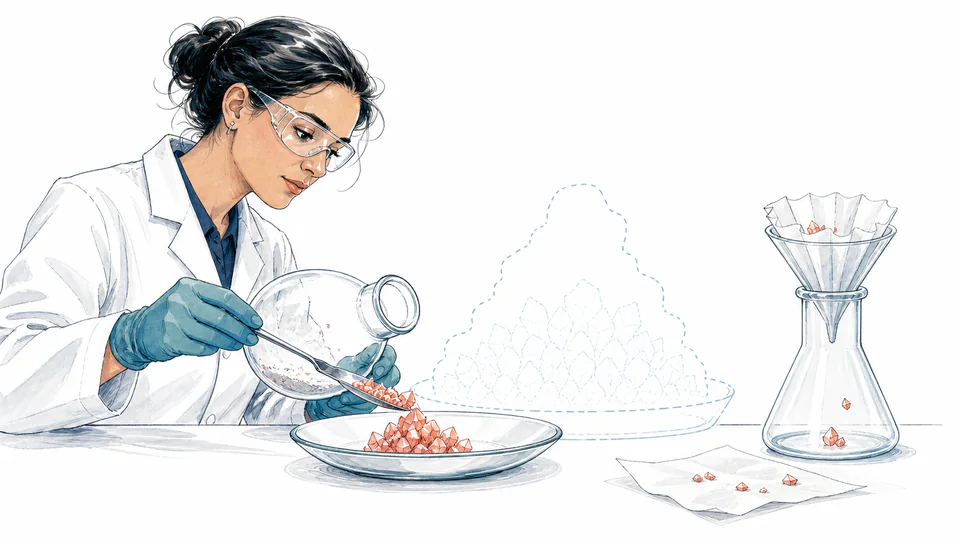
Case: a crystalline intermediate after drying
A batch record reports 7.5 g of recovered solid, but assay shows only 92% target compound.
Using 6.90 g rather than 7.5 g prevents the process yield from being overstated.
The 1.83 g gap remains an aggregate signal; mass balance and impurity data are needed to locate it.
TERMS
Page-specific chemistry vocabulary
- Theoretical yield
- Maximum product predicted from the limiting reagent.
- Actual yield
- Recovered product on the stated basis.
- Percent yield
- Actual divided by theoretical, times 100.
- Product assay
- Fraction of isolated mass identified as target product.
- Recovery difference
- Theoretical pure mass minus actual pure mass.
LIMITS AND DISCLAIMER
Where this model stops
- Assumes the entered reagent is limiting.
- Requires product and reagent assays on valid stated bases.
- Does not separate reaction conversion, selectivity and work-up recovery.
- Does not propagate measurement uncertainty.
- An over-100% result requires investigation, not automatic acceptance.
Use as an educational and planning calculation; analytical methods, identity testing and approved batch records govern reportable yield.
Frequently asked questions
Why correct isolated product for purity?
Gross isolated mass may contain solvent or impurities and can overstate target-product recovery.
Can percent yield be over 100%?
The arithmetic can, but it normally signals wet product, impurities, assay error, identity error or incorrect assumptions.
Is percent yield the same as conversion?
No. Conversion describes reactant consumption; yield also reflects product formation and recovery.
Should actual and theoretical yield use the same unit?
Yes. Their ratio is meaningful only on a consistent basis.
Does a low yield prove the reaction failed?
No. Loss may occur during isolation even when chemical conversion is high.
Where does the limiting reagent come from?
Determine it from all relevant reactants or use the Reaction Calculator before this page.
SOURCES