EDU

Education

Separate delivered potential from commissioned usable seats before calling a capacity build complete

A room can be delivered but not yet usable. This record compares required capacity, delivered room potential, and commissioned seats so the lower of those evidence streams controls completion.

CAPACITY COMMISSIONING

Separate delivered potential from commissioned usable seats before calling a capacity build complete

A room can be delivered but not yet usable. This record compares required capacity, delivered room potential, and commissioned seats so the lower of those evidence streams controls completion.

Capacity completion-
Effective delivered seats-
Seats remaining-
Delivered potential-
Completion status-

LIVE CAPACITY / SCORE VISUAL

Read the current value beside the exact ledger

A room can be delivered but not yet usable. This record compares required capacity, delivered room potential, and commissioned seats so the lower of those evidence streams controls completion. The visual updates from the same validated calculation record; it is an interpretation aid, not a policy or compliance ruling.
Current inputs will populate the chart after validation.
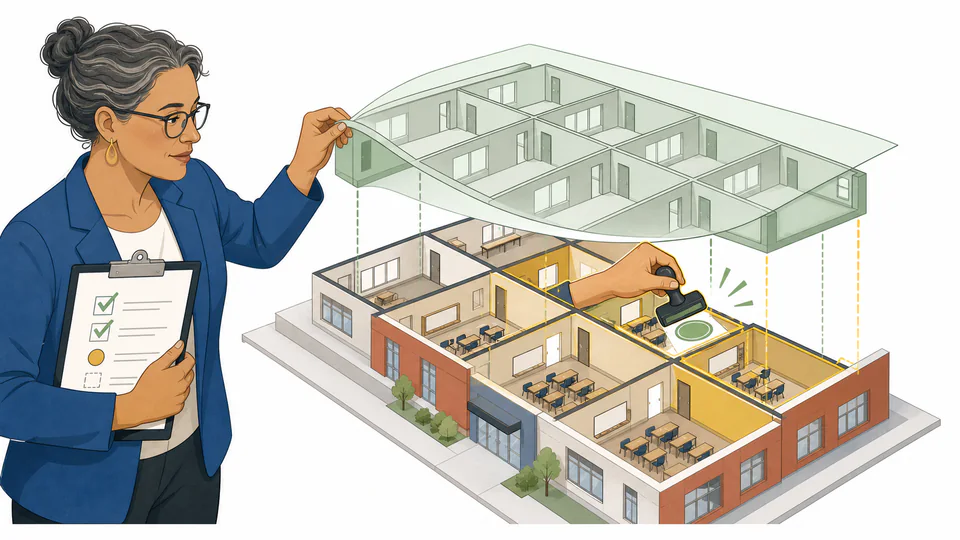
A commissioning checklist moves classroom blocks from delivered construction into a smaller set of signed-off usable seats.
Capacity completion ledgerExact current calculation path
Evidence layerRooms / seatsCalculated capacityControlling valueRelease meaning

How to use

Count only the capacity supported by both delivery and commissioning evidence

  1. Enter required rooms and the required seats per room for the target programme.
  2. Enter rooms physically delivered and their delivered seat basis.
  3. Enter the number of seats actually commissioned as usable.
  4. Review required, potential, commissioned, and effective delivered capacity separately.
  5. Use the remaining seats and completion percentage to identify the next release boundary.

Completion fundamentals

Delivered potential is not the same as released capacity

Required seats
The seat quantity implied by required rooms and seat standard.
Delivered potential
Rooms delivered multiplied by the delivered seat basis.
Commissioned seats
Seats accepted as usable under the project’s release evidence.
Effective delivered
The lowest applicable evidence value, capped at the requirement.
Completion
Effective delivered seats divided by required seats.

Calculation method

Let the controlling evidence stream set completion

The page calculates required and delivered potential separately, then takes the minimum of delivered potential, commissioned seats, and required seats. This prevents a physically finished but uncommissioned room from appearing fully complete.

Commissioning

Commissioned is a state with evidence

Use the number supported by the release checklist, furniture installation, access review, and local acceptance record. A room count alone cannot prove usable seats.

Scope integrity

Keep the requirement basis stable

If the programme changes from 28 to 30 seats per room, it is a new requirement basis. Recalculate rather than comparing the old completion percentage with a changed target.

Decision boundary

Completion is not a quality grade

A 100% result means the entered seat quantity has been released against this model. It does not certify teaching quality, safety, accessibility, or long-term maintenance.

Detailed calculation process

Completion equations and default substitution

Required seats = required rooms × required seats per roomDelivered potential = delivered rooms × delivered seats per roomEffective delivered = min(delivered potential, commissioned seats, required seats)Completion = effective delivered ÷ required seats × 100Remaining = required seats − effective delivered
  1. Defaults: required 20×28 = 560 seats; delivered 17×28 = 476 potential seats; commissioned = 448.
  2. Effective delivered = min(476, 448, 560) = 448 seats.
  3. Completion = 448 ÷ 560 × 100 = 80.00%.
  4. Remaining = 560 − 448 = 112 seats.
  5. The commissioning record controls because 448 is lower than delivered potential.
  6. Reverse check: 448 effective seats plus 112 remaining equals the 560-seat requirement.

The current evidence layers above provide the final reconciliation.

Result interpretation

Find the bottleneck by comparing the layers

If delivered potential is higher than commissioned seats, release evidence is the bottleneck. If delivered potential is below the requirement, room delivery is the bottleneck. The effective value controls the percentage in both cases.

Release action

Use the lower evidence value to sequence work

The next action may be commissioning, furniture, room delivery, or requirement clarification. The page makes that difference visible without inventing a cause.

Limits and exclusions

Completion exclusions

  • It does not inspect the commissioning checklist or verify the entered number.
  • It does not value partial room readiness, staff allocation, or timetable access.
  • It does not permit delivered rooms above the requirement in this scoped record.
  • It does not replace an authority’s occupancy or accessibility approval.

Key terminology

Commissioning vocabulary

Requirement
The target room-and-seat basis for the programme.
Potential
Capacity implied by delivered physical quantities.
Commissioning
Evidence that a delivered capacity is released for use.
Effective delivered
The controlling capacity counted as complete.
Release boundary
The evidence needed before a capacity can be used.
Residual
Capacity still required after effective delivery.

Worked decision cases

Two completion bottlenecks

Rooms finished, sign-off pending

Delivered potential exceeds commissioned seats. The arithmetic points to release evidence, not another construction order.

Sign-off available, rooms missing

Commissioned capacity cannot exceed what was delivered. The remaining-seat figure stays tied to room delivery.

Authoritative basis

Sources for facilities and capacity data

Important note

Use completion as a quantity reconciliation. Formal release depends on the responsible authority’s commissioning, safety, and accessibility evidence.

Frequently asked questions

Why take the minimum of potential and commissioned?

The lower evidence stream controls usable completion.

Can completion be above 100%?

No; effective delivery is capped at the requirement.

What if commissioned seats exceed potential?

Potential still controls because commissioning cannot create rooms.

Does 100% mean the project is safe?

No, it only closes the entered seat quantity.

Can delivered rooms exceed required rooms?

This record rejects that mismatch to keep scope explicit.