Simple weighted syllabus
A current non-final average and a 30% final fit the model directly, making the required exam score transparent.
Education
Make the course-weight arithmetic explicit while preserving the syllabus as the authority for drops, caps, rounding, prerequisites, and letter-grade thresholds.
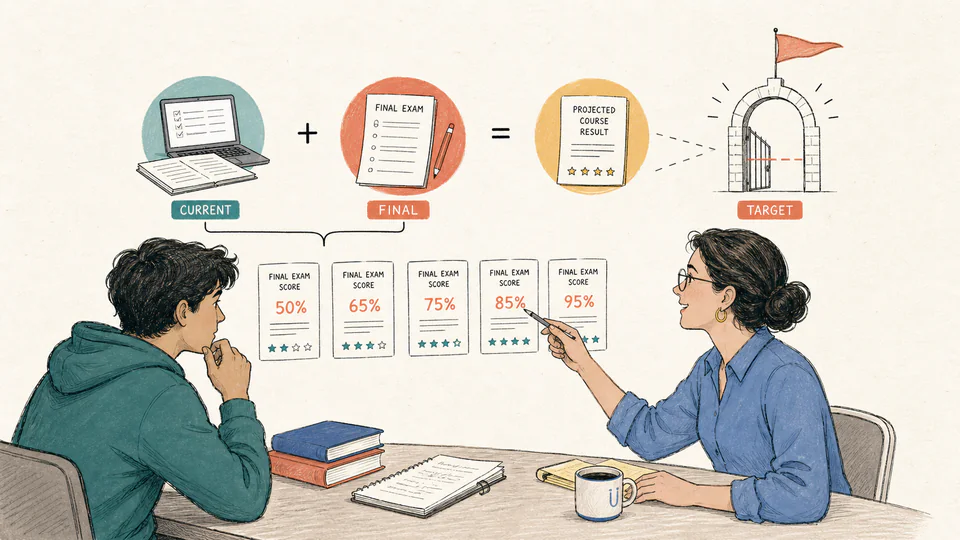
FINAL EXAM OUTCOME SCENARIOS
The entered coursework grade is treated as the completed non-final portion. Each exam scenario is weighted into the course total without inventing curves or policy rules.
SUBJECT DECISION ILLUSTRATION
The illustration explains the professional setting without pretending to be a data chart. The ledger below preserves the entered values and calculation path.
| Scenario | Exam score | Coursework contribution | Exam contribution | Projected course grade | Target status |
|---|
How to use
Grade fundamentals
Calculation method
The entered coursework percentage represents all work outside the final. Its weight is one minus the exam weight. The required exam score is the difference between target and coursework contribution divided by exam weight. Each listed exam score is then substituted into the same course-grade equation.
Policy boundary
Dropped assignments, category weights, extra credit, grade replacement, minimum-final rules, curves, rounding, incompletes, and letter-grade cutoffs can change the official result. Enter a coursework grade already consistent with those policies.
Feasibility boundary
A value above 100% means the entered target cannot be reached under this simple weighted model without policy changes or extra credit. A value below 0% means the target is already secured mathematically, subject to minimum-exam rules.
Decision depth
Scenario grades show arithmetic outcomes for entered exam scores. They do not predict exam difficulty, preparation effectiveness, grading reliability, curve decisions, or the instructor's official record.
Detailed calculation process
The current result cards and scenario ledger provide the live reconciliation.
Result interpretation
The required score answers a threshold question; the scenario table answers outcome questions. A narrow gap between realistic scenarios can support a precise plan, while a target beyond 100% requires policy or goal review rather than false decimal precision.
Decision analysis
Confirm missing items, ungraded work, category weighting, penalties, drops, and extra credit. A current grade shown by a learning-management system may include or exclude ungraded work differently from this model.
Evidence and data lineage
Keep course and section, syllabus version, assessment weights, current grade date, included assignments, missing and dropped items, extra credit, gradebook settings, target basis, scenario scores, instructor clarifications, calculation date, and exported unrounded results. Protect education records according to applicable privacy rules.
Limits and exclusions
Key terminology
Worked decision cases
A current non-final average and a 30% final fit the model directly, making the required exam score transparent.
The current displayed grade may not match the completed coursework basis, and passing may require a separate minimum exam score.
Authoritative basis
This calculator provides arithmetic planning only. The syllabus, instructor, institution, and official gradebook govern weights, policies, accommodations, rounding, and final grades.
It is the percentage for the entire completed non-final portion after applicable course policies.
The model needs both a completed coursework portion and a remaining final-exam portion.
The target is mathematically unreachable under the entered simple weighting without additional policy effects.
The entered target is already secured mathematically, unless a minimum-final or other policy applies.
No. Official precision and rounding belong to course policy.
No. Convert them only using the course's official numerical policy.