EDU

Education

Turn one grade-level roster into usable seats, sections, and a clear capacity margin

Keep nominal seats separate from the seats you intentionally reserve for flexibility, then compare the resulting classroom capacity with the enrolled cohort.

GRADE-LEVEL CAPACITY

Turn one grade-level roster into usable seats, sections, and a clear capacity margin

Keep nominal seats separate from the seats you intentionally reserve for flexibility, then compare the resulting classroom capacity with the enrolled cohort.

Usable seats-
Sections needed-
Seat margin-
Utilization-
Capacity status-

LIVE CAPACITY / SCORE VISUAL

Read the current value beside the exact ledger

Keep nominal seats separate from the seats you intentionally reserve for flexibility, then compare the resulting classroom capacity with the enrolled cohort. The visual updates from the same validated calculation record; it is an interpretation aid, not a policy or compliance ruling.
Current inputs will populate the chart after validation.
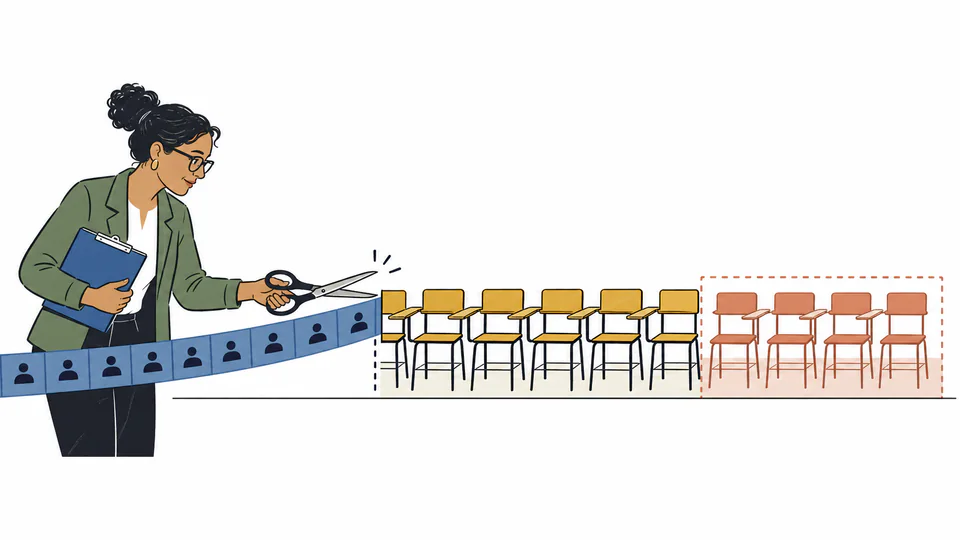
A school planner traces a grade-level roster into classroom rows while reserved seats remain visibly open for flexibility.
Grade-level capacity ledgerExact current calculation path
Capacity layerFormula basisUnrounded valueDisplayed valueDecision meaning

How to use

Read one grade-level roster against the rooms actually assigned to it

  1. Name the grade or cohort so the exported record cannot be confused with another roster.
  2. Count assigned classrooms and use the room’s normal seat count, not a fire-code or furniture assumption copied from another room.
  3. Enter enrolled students from the same census date as the capacity plan.
  4. Reserve a percentage only when the planning team has a documented reason to keep seats open.
  5. Review usable seats, whole sections, utilization, and the seat margin before deciding whether the grade needs a room change.

Grade capacity fundamentals

Capacity is a relationship between rooms, seats, demand, and policy

Assigned classroom
A room counted for this grade’s schedule, not every room in the building.
Nominal seats
The entered seat count before a planning reserve is set aside.
Reserve
A declared share held for movement, support needs, timetable slack, or local policy.
Usable seats
Nominal seats after the reserve percentage is removed.
Sections needed
Whole classrooms required when enrolled students are divided by seats per room.

Calculation method

Reserve capacity before comparing seats with enrollment

The model first multiplies classrooms by seats per classroom. It then removes the declared reserve from that gross count. Sections are rounded upward because a fraction of a class is not a schedulable room. Utilization uses enrolled students divided by usable seats; it is not the same measure as a student-to-teacher ratio.

Reserve policy

A reserve percentage is a planning choice, not spare space by definition

Keep the reserve rationale with the result. A room may have seats on paper but still need space for mobility, equipment, small-group work, or timetable changes. Changing the reserve changes the decision boundary directly.

Section formation

Whole-section rounding exposes the operational step

The seat margin can be positive while the roster still requires another section because section count is rounded upward from enrollment. Use the section result with staffing and timetable checks rather than treating it as a room count alone.

Evidence quality

Freeze the roster date and room assignment before comparing grades

Use an enrollment extract with a stated date, the current room schedule, an observed seat count, and the reserve rule approved for the planning exercise. A later roster or a room used by another grade will move both capacity and utilization.

Detailed calculation process

Grade-level formula, default substitution, and reconciliation

Gross seats = classrooms × seats per classroomUsable seats = gross seats × (1 − reserve% ÷ 100)Sections needed = ceil(enrollment ÷ seats per classroom)Seat margin = usable seats − enrollmentUtilization = enrollment ÷ usable seats
  1. Default label is Grade 7; classrooms = 6; seats per classroom = 28; enrollment = 154; reserve = 8%.
  2. Gross seats = 6 × 28 = 168 seats.
  3. Usable seats = 168 × (1 − 0.08) = 154.56 seats; the card displays 154 whole seats while the ledger keeps the decimal.
  4. Sections needed = ceil(154 ÷ 28) = 6 sections.
  5. Seat margin = 154.56 − 154 = 0.56 seats; utilization = 154 ÷ 154.56 = 99.6%.
  6. The live cards, ledger, visual, copy, and PDF use these same unrounded intermediates and display rules.

The current substitution and result ledger above provide the final reconciliation.

Result interpretation

Read a small positive margin as a tight plan

A negative margin is a modeled shortfall. A near-zero positive margin is not a comfortable operating buffer. Utilization above 100% cannot occur in a valid result because the page blocks a capacity comparison that is not finite or usable.

Decision case

Use sections and seats together

A grade with six sections and a 99.6% utilization may technically fit while leaving no room for late enrollment or support pulls. The arithmetic supports a capacity review, not an automatic room allocation.

Limits and exclusions

What this grade-level screen does not establish

  • It does not establish a legal maximum occupancy, egress capacity, or fire-code limit.
  • It does not calculate teacher availability, specialist-room conflicts, or timetable feasibility.
  • It does not distinguish general education, special education, or program-specific space rules.
  • It does not forecast enrollment uncertainty beyond the entered roster.

Key terminology

Terms used in the grade capacity record

Cohort
The students represented by the entered grade or group.
Nominal capacity
Seats before any reserve or operating policy is applied.
Usable capacity
Capacity remaining after the entered reserve.
Seat margin
Usable seats minus enrolled students.
Utilization
Enrollment divided by usable seats.
Section
A scheduled class group occupying one classroom slot.

Worked decision cases

Two grade-level decisions with different evidence needs

Stable Grade 7 roster

A confirmed roster and current room schedule show six rooms with a small margin. The next step is to validate support-room and timetable constraints before treating the plan as serviceable.

Late-enrollment Grade 4

A seven-student increase can erase a fractional margin. Re-run the record with the updated census rather than rounding the earlier result upward.

Authoritative basis

Sources for capacity language and interpretation

Important note

Use this as a transparent planning calculation. Local occupancy rules, accessibility requirements, staffing contracts, and the school’s timetable remain controlling evidence.

Frequently asked questions

Why does the page show both usable seats and sections?

Seats describe capacity margin; sections describe whole scheduled groups.

Can I enter a reserve of 0%?

Yes, but record why no operating reserve is needed for the decision.

Is utilization the student/teacher ratio?

No. Utilization compares enrollment with seats; ratio needs teacher data.

What should a negative margin mean?

It means the entered grade roster exceeds reserve-adjusted seats.

Should I use a projected enrollment?

Yes only when the projection date and method are retained with the report.