Unequal load zones
Reactions, clearance, preload, and housing deformation change rolling-element load.
Engineering
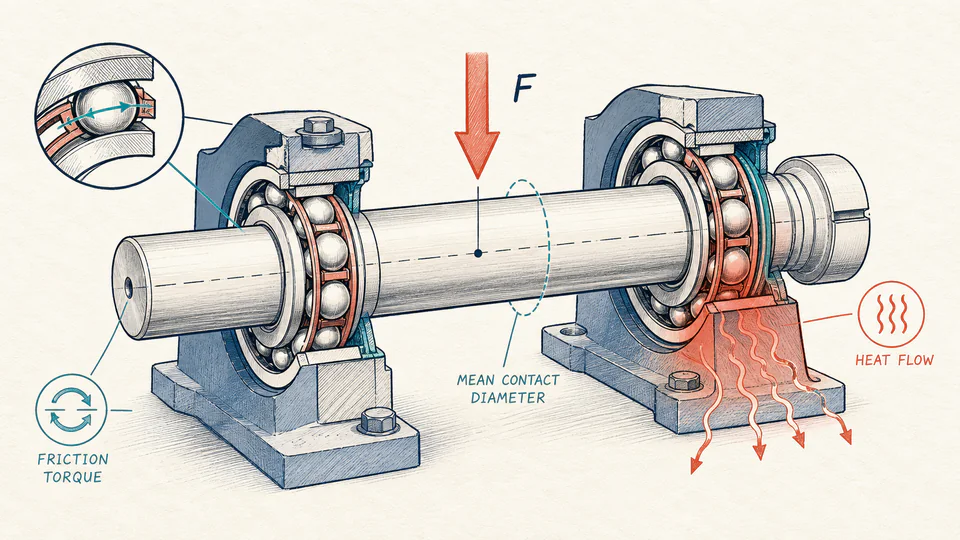
Estimate bearing-set friction torque and power loss from load, effective coefficient, mean diameter, count, speed, and transmitted torque.
BEARING EFFICIENCY
Bearing efficiency is not a universal percentage. The calculator makes the assumed friction coefficient and contact diameter visible before converting drag torque to heat and delivered power.
ENGINEERING DECISION VIEW
Use the output to compare documented conditions or estimate heat. Improve coefficient evidence before changing equipment or lubrication.
| Balance item | Load / torque | Diameter / speed | Power or torque | Meaning |
|---|
LIVE CALCULATION PROCESS
Tfriction = mu*F*dm/2*count; Ploss = Tfriction*2*pi*N/60,000; efficiency = (Pin-Ploss)/Pin
One entered effective coefficient is applied to each identical represented bearing. This transparent screen does not replace a manufacturer loss model for rolling, sliding, seal, and lubricant drag.
HOW TO USE
SUBJECT FUNDAMENTALS
CALCULATION METHOD
One entered effective coefficient is applied to each identical represented bearing. This transparent screen does not replace a manufacturer loss model for rolling, sliding, seal, and lubricant drag.
DEFAULT CASE AUDIT TRAIL
| Symbol | Meaning | Unit |
|---|---|---|
| F | Radial load represented per bearing | N |
| mu | Effective friction coefficient | dimensionless |
| dm | Mean bearing diameter | mm |
| z | Identically represented bearing count | whole number |
| Tf | Bearing-set friction torque | N*m |
| N | Rotational speed | rpm |
Independent check:Delivered power plus bearing loss returns transmitted input power, and the torque-domain ratio 1 - 1.9125/420 gives the same simplified efficiency as the power-domain ratio.
DEEPER ANALYSIS
Reactions, clearance, preload, and housing deformation change rolling-element load.
Cold oil or excess grease can greatly raise drag.
Contact seals can exceed rolling-contact loss in small bearings.
WORKED DECISION CASES
Documented coefficients at the same condition are converted to cooler heat load.
A paired support estimate is retained while unequal reactions are verified separately.
EVIDENCE AND DATA LINEAGE
Keep bearing designation, reactions, preload, clearance, fits, lubricant, temperature, speed, torque, seal inclusion, coefficient source, count, and unrounded balance.
LIMITS AND EXCLUSIONS
RELIABLE SOURCES
FREQUENTLY ASKED QUESTIONS
No; replace the illustrative default with bearing-specific evidence.
The model multiplies one bearing estimate by count; unequal reactions need separate runs.
Only if the coefficient explicitly includes them.
A similar loss is a larger fraction of low transmitted power.
Only for a start-up decision, not stabilized running efficiency.
No; life, static safety, speed, lubrication, fit, and clearance remain.
RELATED CALCULATORS
Check dynamic rating life and static safety as separate selection gates.
Place bearing loss inside a broader shaft, seal, and windage balance.
IMPORTANT NOTE
Final decisions should use current manufacturer methods or validated tests for the complete bearing arrangement.