EN

Engineering

Retaining Wall Loss Calculator

Apply void, drainage, and damage deductions sequentially to a retaining-wall material volume.

RETAINING WALL LOSS

Reconcile gross fill volume to net retained material

Gross quantity is not the same as usable retained volume. Sequential deductions keep voids, drainage allowance, and damage allowance visible for procurement and inspection.

Decision boundary:For estimators and inspectors reconciling gross and net wall-material quantities; the allowances do not represent structural resistance losses.

Net usable volume (m3/m)-
Total volume loss (m3/m)-
Loss rate-
Largest allowance-

DECISION MAP

Retaining Wall Loss Calculator evidence path

Use the largest allowance to focus measurement and procurement controls; do not simply add percentages unless that is the approved quantity rule.
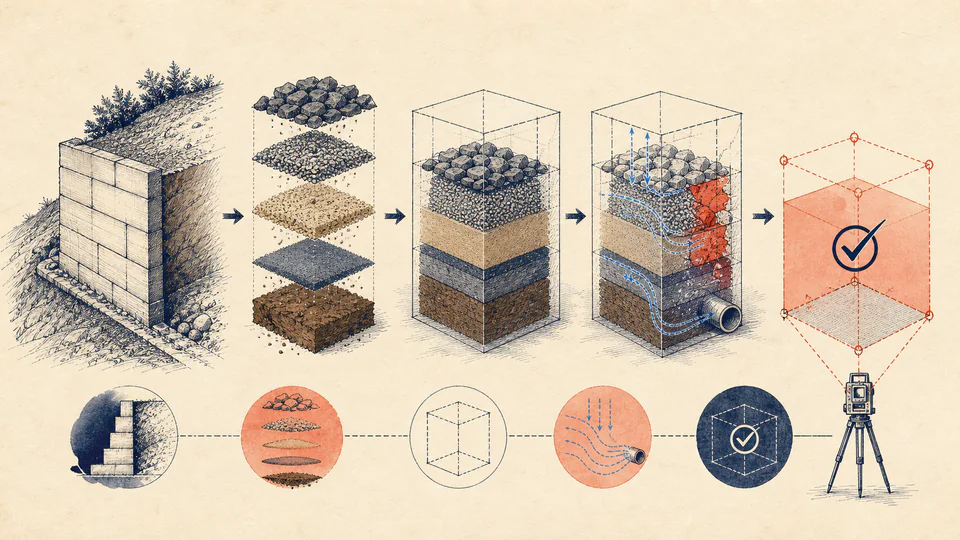
A retaining-wall material stack passes through transparent void, drainage, and damage overlays before a net-volume marker is recorded.
Retaining Wall Loss Calculator calculation ledgerUnrounded path and interpretation
LayerStarting volume (m3/m)Allowance (%)Loss or retained volume (m3/m)Meaning

LIVE CALCULATION PROCESS

Formula, symbols, substitution, and final check

V_net = V_g(1-l_v)(1-l_d)(1-l_r)

Each allowance is applied to the volume remaining after the prior layer. The calculation is a quantity reconciliation, not a structural resistance check.

SymbolMeaningUnitCurrent input
VgGross material volume on the declared wall-length basism3/m32
lvVoid allowance%6
ldDrainage-space allowance%4
lrDamage and rework allowance%3

    HOW TO USE

    Reconcile gross fill volume to net retained material

    1. Enter gross retained volume on one consistent wall-length and geometry basis.
    2. Apply void, drainage, and damage allowances as sequential deductions.
    3. Compare each layer's loss with the net retained volume and largest allowance.
    4. Reconcile gross volume to net plus total deducted volume before procurement use.
    5. Revise the allowance policy when field inspection shows a different loss mechanism.

    SUBJECT FUNDAMENTALS

    Terms behind Retaining Wall Loss Calculator

    Gross volume
    Measured starting quantity
    Void allowance
    Unfilled or inaccessible volume
    Drainage allowance
    Intentional drainage space
    Damage allowance
    Rework or handling reserve
    Net volume
    Retained usable quantity

    CALCULATION METHOD

    Why this formula fits the topic

    V_net = V_g(1-l_v)(1-l_d)(1-l_r)

    Each allowance is applied to the volume remaining after the prior layer. The calculation is a quantity reconciliation, not a structural resistance check.

    DEEPER ANALYSIS

    Where professional judgement still matters

    Sequential arithmetic

    Compounding deductions differ from subtracting each percentage from gross.

    Measurement basis

    The gross volume must share the same wall length and geometry definition.

    Procurement use

    A quantity allowance should be reconciled with field tickets and inspection records.

    WORKED DECISION CASES

    Two realistic uses

    Material order reconciliation

    Starting with 32 m3/m, sequential 6%, 4%, and 3% allowances leave 28.0105 m3/m. Total deducted volume is 3.9895 m3/m, or 12.47% of gross, and void allowance is the largest entered percentage.

    Zero-allowance as-built record

    A measured 20 m3/m gross section with all three allowances at 0% returns 20 m3/m net and zero loss. That boundary is valid only when inspection and contract records support no reserve.

    Technical glossary

    Gross volume
    The measured starting quantity before allowances.
    Void allowance
    The share reserved for inaccessible or unfilled volume.
    Drainage allowance
    Intentional open space required for drainage details.
    Damage allowance
    The reserve for handling, inspection, or rework loss.
    Net volume
    The quantity retained after each sequential deduction.
    Quantity reconciliation
    The record tying takeoff, delivery, and as-built measurements.

    EVIDENCE AND DATA LINEAGE

    What to retain with the result

    Retain takeoff dimensions, allowance policy, delivery records, and as-built notes.

    LIMITS AND EXCLUSIONS

    What this model does not establish

    • No strength, stability, bearing, or hydraulic calculation is included.
    • Allowances are project assumptions, not universal rates.
    • Confirm the quantity rule with the contract and inspector.

    RELIABLE SOURCES

    References for method and context

    FREQUENTLY ASKED QUESTIONS

    Retaining Wall Loss Calculator questions

    Is this a structural loss factor?

    No. It is a quantity allowance model.

    Can allowances total 100%?

    No; each is bounded below 100% so retained volume remains meaningful.

    Why apply drainage after voids?

    The page follows the declared sequential policy.

    Should I round each layer?

    No. Round only the displayed result.

    Can wall length change?

    Recalculate all inputs on the same per-metre basis.

    What evidence should be kept?

    Section dimensions, delivery tickets, inspection notes, and allowance policy.

    IMPORTANT NOTE

    Before relying on the exported result

    Quantity planning aid only; it does not approve a retaining-wall design.

    RELATED CALCULATORS

    Continue the decision with a neighboring check