Separate normal and emergency ratings
Normal continuous loading, cyclic loading, and short emergency loading have different thermal histories. Do not use a normal-rating factor to authorize an emergency interval.
Electrical Engineering
Compare peak apparent-power demand with transformer capacity after explicit ambient and harmonic derating.
TRANSFORMER CAPACITY MARGIN
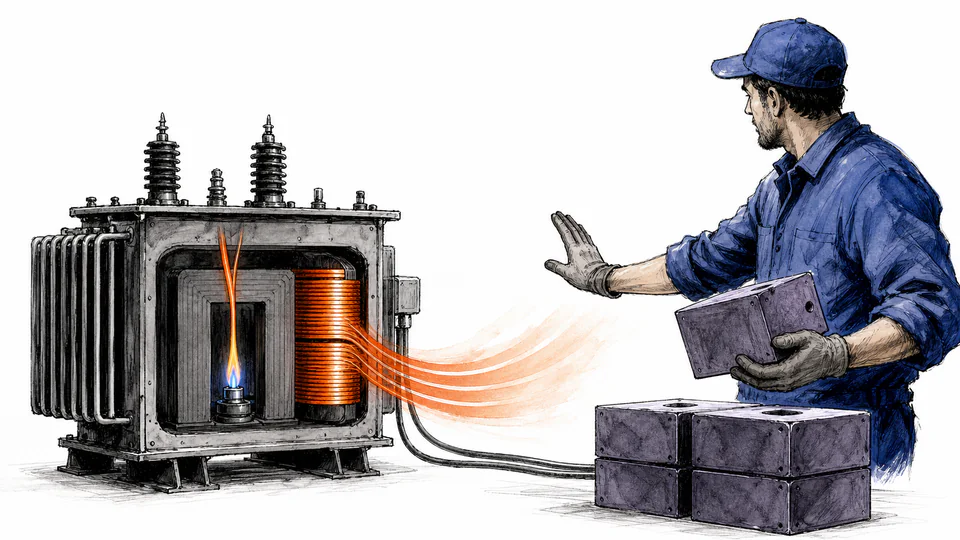
This screen is for preliminary loading reviews where peak demand is known in kVA. It keeps the nameplate, ambient allowance, harmonic allowance, usable capacity, and the owner-selected acceptance factor separate. It does not turn an arbitrary reserve percentage into a code requirement.
TRANSFORMER CAPACITY MARGIN
Use the factor to identify margin for a documented loading study; confirm actual transformer temperature-rise class, cooling mode, harmonic spectrum, emergency-rating policy, and manufacturer limits before setting an operating limit.
| Stage | Input basis | Unit or context | Applied factor | Calculated value | Engineering meaning |
|---|
CURRENT CALCULATION PROCESS
F = S_usable / S_demand; S_usable = S_nameplate × [1 − d_temp − d_harmonic]
The calculation applies only the entered derating allowances, then divides the resulting usable apparent-power capacity by coincident apparent-power demand. Ambient below the reference does not create an uprating.
| Symbol | Engineering meaning | Unit | Default |
|---|---|---|---|
| S_nameplate | Transformer nameplate apparent power | kVA | 1000 |
| S_demand | Coincident maximum demand | kVA | 720 |
| T_ambient | Reviewed ambient temperature | deg C | 45 |
| T_reference | Linear-derating reference ambient | deg C | 40 |
| d_T | Temperature derating per degree | %/deg C | 0.5 |
| d_h | Harmonic allowance | % | 8 |
| F_required | Owner-selected capacity criterion | ratio | 1.15 |
Intermediate values remain unrounded until display formatting.
HOW TO USE THIS MODEL
TRANSFORMER CAPACITY MARGIN FUNDAMENTALS
MODEL AND FORMULA
The calculation applies only the entered derating allowances, then divides the resulting usable apparent-power capacity by coincident apparent-power demand. Ambient below the reference does not create an uprating.
DEEPER ENGINEERING ANALYSIS
Normal continuous loading, cyclic loading, and short emergency loading have different thermal histories. Do not use a normal-rating factor to authorize an emergency interval.
Top-oil and winding hot-spot estimates can be more informative than a generic ambient adjustment because load cycle, cooling state, and prior temperature matter.
One blanket percentage is a planning allowance. Detailed work should use measured harmonic currents, winding construction, eddy-loss data, and the applicable standard method.
WORKED DECISION CASES
A 1,000 kVA unit with 720 kVA coincident peak is screened at a hot-day ambient and with a study-specific harmonic allowance. The result documents whether margin remains before a new feeder is approved.
A unit with apparently comfortable fundamental demand may lose margin when UPS and power-supply harmonics are included. The screen shows how much of the reserve depends on the harmonic assumption.
TECHNICAL LANGUAGE
EVIDENCE AND DATA LINEAGE
Retain the nameplate photograph, rating and cooling mode, demand interval and meter basis, power factor, ambient source, harmonic report, derating references, date, scenario ownership, and the unrounded result. These records make later reconciliation possible when the load mix or cooling state changes.
LIMITS AND EXCLUSIONS
RELIABLE SOURCES
FREQUENTLY ASKED QUESTIONS
No. The required factor is an owner or study decision and should reflect load uncertainty, redundancy, criticality, growth, monitoring, and the applicable rating method.
Only after converting with a defensible coincident power factor. Using kW directly understates current when power factor is below unity.
This conservative screen avoids inventing an uprating. Any cold-ambient uprating should come from the applicable thermal model or manufacturer guidance.
No. It is an explicit planning allowance. A K-factor or detailed loss evaluation uses the current spectrum and transformer design.
Review demand evidence, cooling availability, harmonic losses, load transfer, monitoring, or a larger transformer. Do not simply lower the criterion.
No. Insulation aging depends on hot-spot temperature over time, moisture, prior history, cooling performance, and other conditions outside this ratio.
RELATED CALCULATORS
Use the next model to test a separate operating boundary without hiding it inside this result.
IMPORTANT ENGINEERING NOTE
A qualified power engineer should establish the applicable rating, derating method, monitoring requirements, protection coordination, and allowable loading policy. Do not operate above nameplate or alter protection based only on this calculator.