Bracket credible conditions
Use separate likely, adverse, and contingency scenarios instead of one exaggerated case that mixes unrelated worst values.
Electrical Engineering
Quantify how simultaneous changes in transformer demand and ambient temperature alter usable-capacity factor.
TRANSFORMER WHAT-IF ANALYSIS
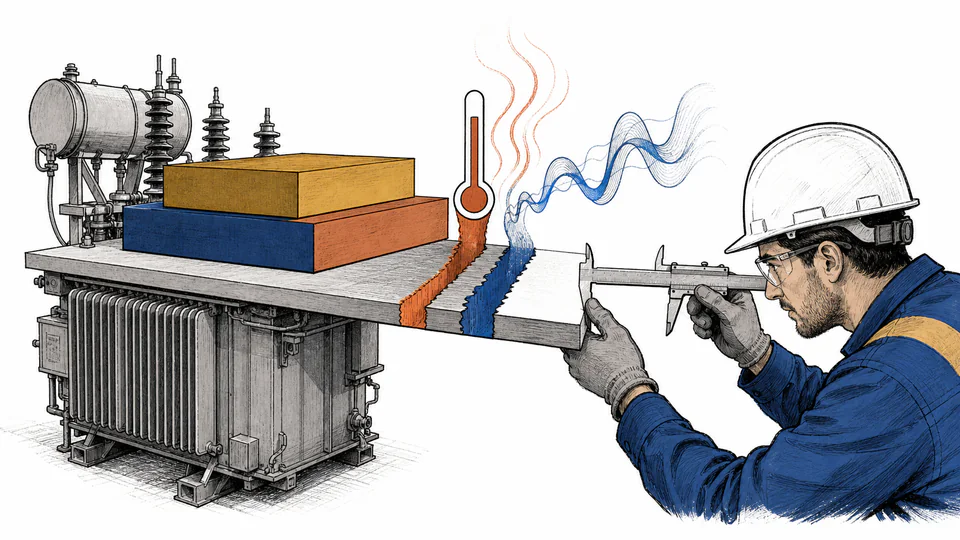
This two-state model recomputes both demand and ambient derating rather than applying a generic percentage to the final answer. It is intended for planning comparisons such as load growth, temporary transfer, seasonal heat, or delayed replacement.
TRANSFORMER WHAT-IF ANALYSIS
The signed factor change identifies which scenario consumes margin, while the two state rows keep the causes visible. Use it to prioritize measurement, transfer planning, or replacement—not to predict transformer life.
| State | Demand or change | Ambient | Temperature derating (%) | Usable capacity (kVA) | Capacity factor |
|---|
CURRENT CALCULATION PROCESS
ΔF = F_scenario − F_base, where F_state = S_nameplate(1 − d_fixed − d_temp,state) / S_demand,state
Each state is calculated independently. Demand change affects the denominator; ambient change affects usable capacity only when the ambient exceeds the entered reference.
| Symbol | Engineering meaning | Unit | Default |
|---|---|---|---|
| S_nameplate | Fixed transformer nameplate capacity | kVA | 1500 |
| S_base | Baseline coincident demand | kVA | 900 |
| delta_S | Scenario demand change | % | 15 |
| T_base | Baseline ambient temperature | deg C | 35 |
| delta_T | Scenario ambient change | deg C | 10 |
| T_reference | Temperature-derating reference | deg C | 40 |
| d_fixed | Non-temperature allowance held in both states | % | 5 |
Intermediate values remain unrounded until display formatting.
HOW TO USE THIS MODEL
TRANSFORMER WHAT-IF ANALYSIS FUNDAMENTALS
MODEL AND FORMULA
Each state is calculated independently. Demand change affects the denominator; ambient change affects usable capacity only when the ambient exceeds the entered reference.
DEEPER ENGINEERING ANALYSIS
Use separate likely, adverse, and contingency scenarios instead of one exaggerated case that mixes unrelated worst values.
Peak kVA alone does not show duration. For thermal decisions, pair this screen with interval data or a dynamic hot-spot model.
Run load transfer, power-factor improvement, cooling restoration, or staged project cases as separate scenarios so the source of recovered margin is auditable.
WORKED DECISION CASES
A replacement is delayed into a hotter season while site demand grows. The scenario quantifies how the two changes erode capacity factor before temporary cooling or transfer is selected.
An outage shifts 20% additional demand to a neighboring transformer. The model compares normal and transfer states using the transfer-day ambient rather than annual average weather.
TECHNICAL LANGUAGE
EVIDENCE AND DATA LINEAGE
Record the baseline meter interval, forecast or transfer basis, ambient timestamps, fixed-derating components, reference temperature, load ownership, and scenario label. Store baseline and scenario values rather than only the final difference so a reviewer can reproduce both states.
LIMITS AND EXCLUSIONS
RELIABLE SOURCES
FREQUENTLY ASKED QUESTIONS
Demand is the denominator. A larger scenario demand reduces the factor without any change in nameplate or temperature derating.
Yes, when they represent the same scenario. If their timing is unrelated, separate cases are more defensible.
No. The factor is inversely proportional to demand, so the signed percentage change is not exactly symmetric; ambient derating may also change the numerator.
It may, but only if those allowances are independently established and constant across both states. Keep a record of what the percentage represents.
This screen only removes temperature derating above the reference; it does not credit capacity above the entered nameplate basis.
No. It is a deterministic result for the entered assumptions. Probability or confidence requires a separate uncertainty model.
RELATED CALCULATORS
Use the next model to test a separate operating boundary without hiding it inside this result.
IMPORTANT ENGINEERING NOTE
Use the output to organize engineering review. Emergency or cyclic loading decisions require an applicable thermal model, asset condition, protection and cooling status, operating procedure, and authorized owner approval.