Vehicle rate is a chosen boundary
Fuel-only rates omit wear; full ownership rates may include costs paid even without commuting. State which decision the rate supports.
Practical household planning
Build an annual and monthly mixed-mode commute budget from office days, driving mileage, operating rate, parking, tolls, transit fare or pass, workweeks, and fixed costs.
MIXED-MODE COMMUTE BUDGET
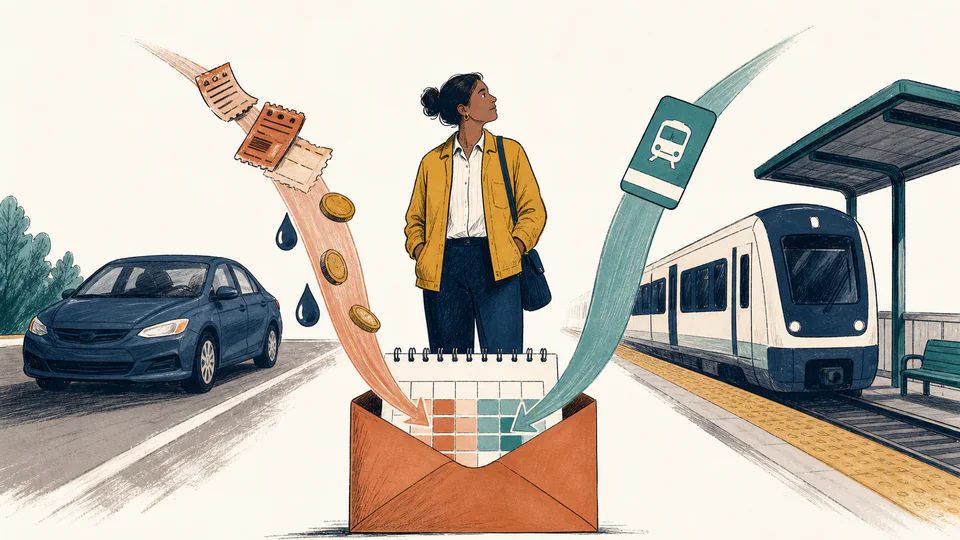
A commute budget should count round trips, mode days, parking, tolls, transit products, and fixed commute-specific charges on one annual calendar. This calculator is for a worker planning cash outlay across driving and public transit. It lets fare and pass compete on the entered transit volume and leaves unused office days visible; it is not a tax deduction calculator or a complete vehicle ownership model.
MIXED-MODE COMMUTE BUDGET
Unassigned office days mean the weekly mode plan is incomplete, not free. A completed budget requires driving plus transit plus any other modeled mode to explain every office day or an explicit reason for exclusion.
| Commute stream | Days / week | Annual basis | Extended cost |
|---|
CURRENT CALCULATION PROCESS
Ad=[mr+p+t]dw; At=min(fdTw,12M) when transit is used; C=Ad+At+F; Cm=C/12; Cd=C/(ow)
Multiply round-trip miles m by a chosen variable rate r, add parking p and tolls t, and extend driving days d across workweeks w. Price transit days T by fare f, use a cheaper pass when entered, add fixed costs F, then normalize annual cost to month and office day.
| Symbol | Meaning | Unit | Default |
|---|---|---|---|
| C | Annual commute budget | USD/year | calculated |
| o | Office days | days/week | 5 |
| d | Driving days | days/week | 3 |
| T | Transit days | days/week | 2 |
| w | Commuting weeks | weeks/year | 48 |
| m | Driving round-trip distance | miles/day | 24 |
| r | Vehicle variable rate | USD/mile | 0.35 |
| f | Transit round-trip fare | USD/day | 6.50 |
| F | Fixed commute costs | USD/year | 300 |
Conversions and rounding: Office days and mode days are weekly counts. Extend by entered workweeks; compare fare total with twelve monthly passes only when transit is used. Round money after annual reconciliation.
HOW TO USE
SUBJECT FUNDAMENTALS
MODEL AND FORMULA
Multiply round-trip miles m by a chosen variable rate r, add parking p and tolls t, and extend driving days d across workweeks w. Price transit days T by fare f, use a cheaper pass when entered, add fixed costs F, then normalize annual cost to month and office day.
DEEPER DECISION ANALYSIS
Fuel-only rates omit wear; full ownership rates may include costs paid even without commuting. State which decision the rate supports.
A monthly pass can cover non-work travel, zones, or blackout rules. This page compares only the entered commute fare basis.
A cheaper mode can require more time or expose missed connections. Price those only with a documented value-of-time analysis.
WORKED DECISION CASES
Three driving days accumulate parking and tolls while two transit days remain cheaper as individual fares; the annual ledger reveals the driving share.
A worker commuting most weeks finds a pass cheaper than round-trip fares, but still records bicycle storage and first-mile costs as fixed charges.
TECHNICAL LANGUAGE
EVIDENCE AND DATA LINEAGE
Retain odometer or route distance, fuel and maintenance records supporting the per-mile rate, parking invoices, toll statements, transit fare rules, pass eligibility, employer benefit documentation, workplace schedule, leave calendar, and fixed-cost receipts. Date every tariff because fares and tolls change.
LIMITS AND EXCLUSIONS
RELIABLE SOURCES
FREQUENTLY ASKED QUESTIONS
Not as a default commute cost or deduction. It serves tax purposes with specific eligibility; use an actual planning rate that matches this decision.
That would double-count the weekly travel calendar unless a multi-mode trip is modeled on a net combined basis.
Leave them unassigned only temporarily; add their attributable cost to fixed charges or use a separate mode model.
No. The comparison values only entered commute fare. Additional benefit requires a broader travel budget.
Enter the worker’s final expected cash cost and retain documentation for any confirmed subsidy.
No. It spreads annual cost evenly; fuel, permits, repairs, and passes can arrive on different dates.
IMPORTANT NOTE
This calculator supports personal planning only. Verify fares, routes, reimbursements, vehicle records, and applicable tax rules with authoritative guidance or a qualified professional.