H

Lifestyle planning

Hobby Break-Even Calculator

Estimate whole-item break-even and target-profit volume from fixed costs, sale price, variable cost, platform fee, and annual overhead.

HOBBY SALES THRESHOLD

Find how many finished items must sell before the hobby activity covers entered costs

For hobbyists testing a small sales plan without assuming demand. Platform fees reduce revenue first, variable cost is subtracted per item, and whole-item thresholds are rounded upward. The result is cost arithmetic, not a claim that an activity is a business or that buyers exist.

Whole items to break even-
Whole items for target profit-
Contribution margin-
Revenue at target volume-
Fees at target volume-
Modeled profit at target volume-

HOBBY SALES THRESHOLD

Hobby sales contribution ledger

Use the threshold only after verifying demand, legal and tax obligations, capacity, returns, quality, safety, and whether labor has been valued consistently. Selling more can magnify losses when contribution is non-positive.
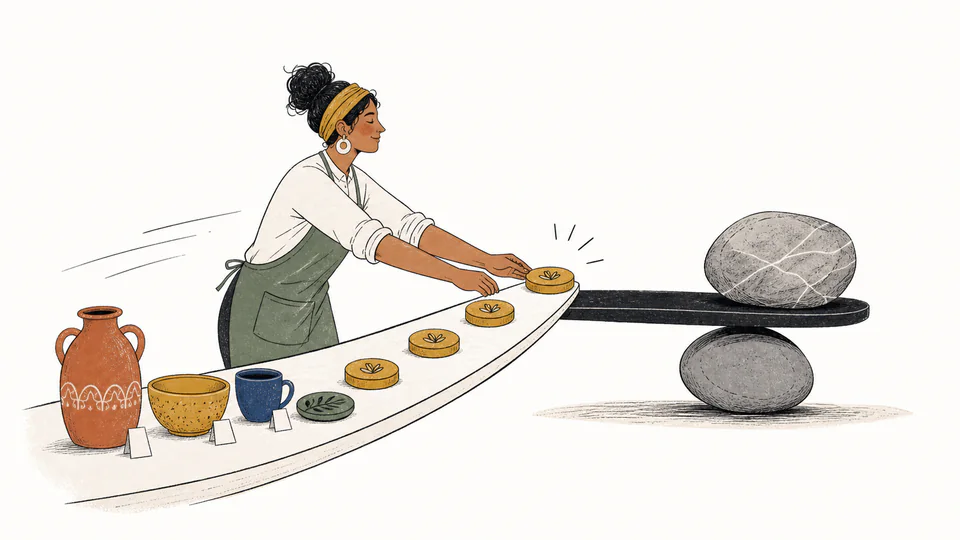
Editorial illustration of a craft seller balancing a fixed-cost stone with contribution tokens from handmade item sales
Each sale contributes only what remains after platform fees and variable cost.
Hobby sales contribution ledgerExact current inputs and intermediate quantities
Live detail from the current planning case
Threshold layerRevenue or costDeduction / rateContribution or units

CURRENT CALCULATION PROCESS

Formula, current substitution, intermediate steps, and reconciliation

cn=p(1-f)-v; Q0=ceil((F+A)/cn); Qt=ceil((F+A+T)/cn)

Percentage fees reduce price to net revenue. Variable cost is subtracted to create per-item contribution. Fixed and annual costs, then target profit, are divided by positive contribution and rounded up to whole sellable items.

    HOW TO USE

    Calculate a threshold without pretending sales are guaranteed

    1. Define one sellable item with stable size, quality, packaging, and return policy.
    2. Record price net of discounts consistently and combine percentage platform and payment fees.
    3. Measure material, packaging, shipping subsidy, per-order fees, and declared labor basis per item.
    4. Allocate launch and annual overhead to the same sales period without double counting equipment.
    5. Inspect contribution first, then whole-item break-even and target volume against real capacity and demand evidence.

    SUBJECT FUNDAMENTALS

    Five quantities in a sales threshold

    Net revenue
    Sale price remaining after percentage fees.
    Variable cost
    Cost that increases for each additional finished item.
    Contribution
    Net revenue minus variable cost available for fixed costs and profit.
    Fixed cost
    Cost incurred for the plan regardless of units sold.
    Whole-item threshold
    Ceiling count required because partial units cannot be sold.

    MODEL AND FORMULA

    Validate positive contribution before dividing fixed cost

    cn=p(1-f)-v; Q0=ceil((F+A)/cn); Qt=ceil((F+A+T)/cn)

    Percentage fees reduce price to net revenue. Variable cost is subtracted to create per-item contribution. Fixed and annual costs, then target profit, are divided by positive contribution and rounded up to whole sellable items.

    DEEPER DECISION ANALYSIS

    Why a break-even count is not a sales forecast

    Demand and capacity are separate

    The formula states required sales, not whether buyers, production hours, or channel capacity exist.

    Labor treatment changes meaning

    Unpaid hobby time may be excluded for cash break-even but must be explicit before claiming economic profit.

    Returns and defects can erase contribution

    Refunds, remakes, spoilage, platform disputes, taxes, and shipping variability need separate measured allowances.

    WORKED DECISION CASES

    Two contribution decisions

    Market booth ceramics

    A potter allocates booth and card fees, packaging, clay, glaze, firing, and breakage before comparing the unit threshold with kiln capacity.

    Digital pattern launch

    A designer has low replication cost but includes platform fees, support time only if valued, software overhead, refunds, and uncertain demand separately.

    TECHNICAL LANGUAGE

    Hobby break-even terms

    Contribution per item
    Amount one sale adds toward fixed cost and profit.
    Contribution margin
    Contribution divided by sale price.
    Fixed overhead
    Period cost not caused by one extra item.
    Variable cost
    Incremental cost of producing and fulfilling one item.
    Break-even unit
    First whole sales count with non-negative modeled profit.
    Target-profit volume
    Whole units required to cover costs and the entered profit target.

    EVIDENCE AND DATA LINEAGE

    Retain receipts, fee schedules, time studies, and sales records

    Save bill of materials, scrap and defect rates, packaging, shipping policy, platform and payment fee schedule, refund history, fixed-cost allocation period, equipment life, sales price and discounts, tax treatment, labor policy, production capacity, and actual sell-through.

    LIMITS AND EXCLUSIONS

    Limits of the hobby sales threshold

    • Demand, seasonality, inventory timing, returns, taxes, shipping overruns, and bad debt are not forecast.
    • Price, fee rate, and variable cost remain constant at every unit.
    • Fixed-cost allocation and any labor valuation are user policies, not accounting or tax advice.
    • The model does not determine legal business status, permits, insurance, product safety, or consumer obligations.

    RELIABLE SOURCES

    References for the method and planning boundaries

    FREQUENTLY ASKED QUESTIONS

    Hobby break-even questions

    Why does the calculator reject non-positive contribution?

    Dividing by zero or a negative amount would produce a plausible but meaningless threshold; each extra sale must contribute toward fixed cost.

    Should labor be a variable cost?

    Include it when measuring economic profit with a documented rate; exclude it only when explicitly measuring cash recovery.

    Do taxes belong in the platform fee?

    Only if they reduce seller revenue on the same basis. Income and sales-tax obligations require separate professional guidance.

    Can I use expected sales as the target?

    Compare expected demand with required units, but do not let the formula manufacture demand evidence.

    Why round target units up?

    The entered cost and profit target must be met by complete sellable items.

    Does break-even mean I should start a business?

    No. It is one arithmetic screen; demand, capacity, legal status, taxes, safety, insurance, and personal goals remain separate.

    IMPORTANT NOTE

    A sales threshold is not legal, tax, demand, or business advice

    Verify obligations with qualified professionals and official authorities. Do not represent projected volume or profit as guaranteed.